

2026 guide to DSCR loans in Rhode Island — PPP caps on 1-4 units, Providence/Warwick markets, mixed foreclosure paths, and 1.53% effective property tax.
Rhode Island is a small special-tier DSCR state defined by one rule: R.I. Gen. Laws §34-23-5 caps prepayment penalties on 1-4 unit residential mortgages at 2% in the first year and none after, with a longer, consented PPP allowed only on refinances. The market is also shaped by Providence’s unusual dual-rate property tax system that treats non-owner-occupied residential property differently from owner-occupied.
This guide covers DSCR lending in Rhode Island: the PPP cap, the Providence tax structure, and the markets that matter.
Why Investors Choose Rhode Island
Rhode Island is the smallest state (by area) with just over 1 million residents. Population has been essentially flat for 20 years. Providence metro (which includes nearby Massachusetts towns like Fall River and Attleboro) is the economic core. Brown University, Rhode Island School of Design, Johnson & Wales, Providence College, and University of Rhode Island create a significant student-housing market. Healthcare (Lifespan, Care New England), financial services (CVS Health HQ in nearby Woonsocket), and marine industry anchor the private sector.
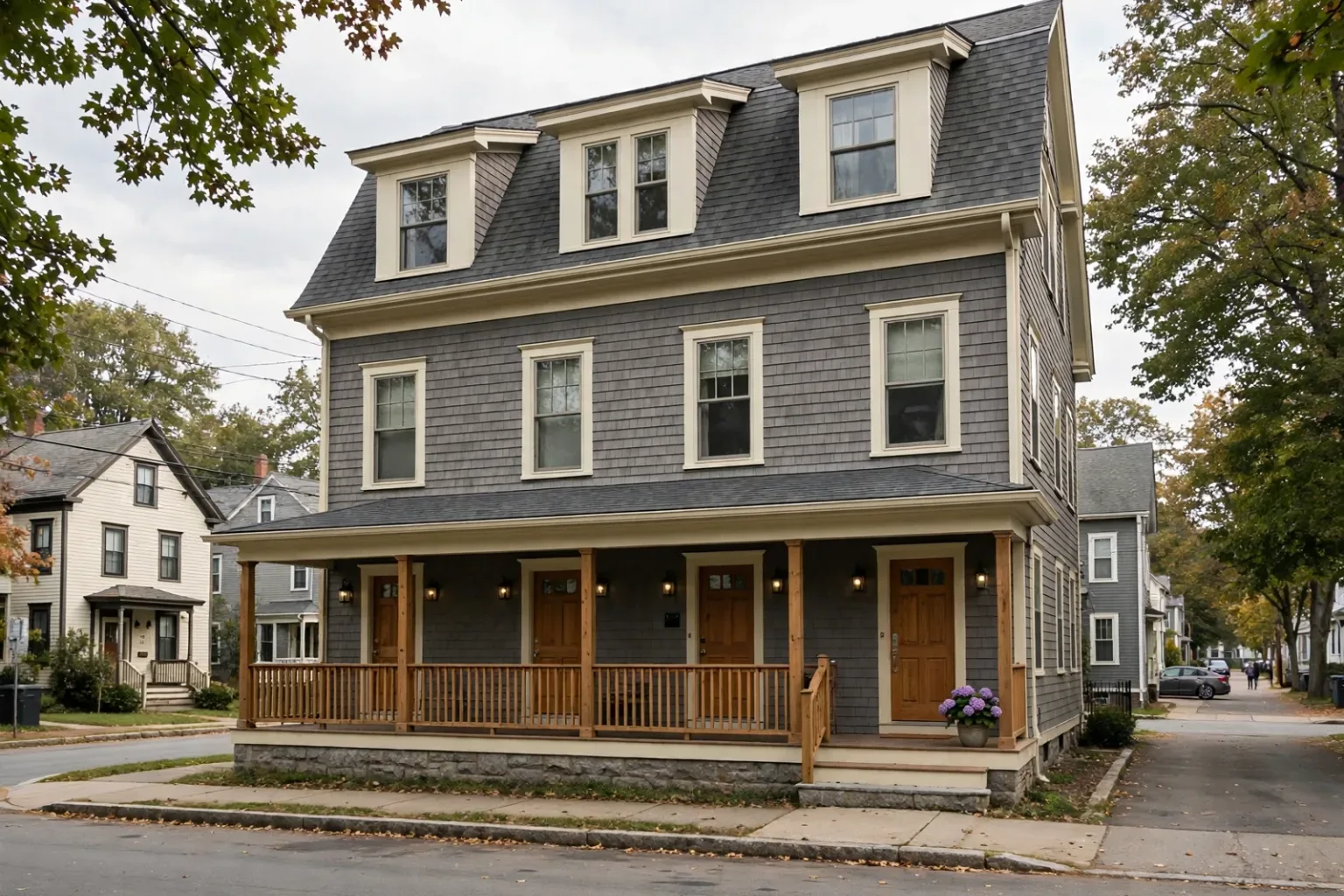
Providence has classic New England 2-4 unit “triple-decker” housing stock, similar to Boston but at a lower basis. These buildings trade at moderate cap rates and are well-suited to DSCR financing. Warwick and Cranston are Providence suburbs with single-family focus. Pawtucket, East Providence, and Woonsocket are older mill-town municipalities with lower basis.
Newport is the wealthy summer market on the coast. Very high basis; different investor thesis (short-term rental, vacation home, luxury long-term).
DSCR Loan Rules in Rhode Island — The PPP Cap
R.I. Gen. Laws §34-23-5 applies to every lender making a mortgage loan on Rhode Island real estate with dwelling houses of not more than four units. It has no occupancy test, so it reaches investor DSCR loans.
Practical effect:
- Rhode Island caps prepayment penalties on 1–4 unit purchase loans at 2% in year one, with no penalty after the first year
- On a refinance, a lender can offer a larger PPP lasting up to 60 months, but only if the terms are disclosed in writing and you agree to them, and it must also offer a product that meets the one-year limit
- The standard 5/4/3/2/1 structure is not available on an RI purchase loan; ask each lender for its compliant PPP and no-PPP pricing
Confirm the PPP terms with your lender.
Standard terms otherwise: min DSCR 0.85-1.20, max LTV 70-75%, min FICO 680-700, 6-9 months reserves.
Taxes & Carrying Costs
Providence has a distinctive two-tier property tax structure: owner-occupied residential gets a lower rate (around $15 per $1,000 assessed value) and non-owner-occupied residential (investor-owned) gets a higher rate (around $24 per $1,000). This “tangible tax” differential is a meaningful DSCR expense — investor-owned Providence rentals pay materially more in property tax than the same owner-occupied property would. Model Providence deals using the non-owner-occupied rate.
Rhode Island’s effective property tax statewide is 1.46%. Outside Providence, rates vary by town and are closer to straightforward millage calculations. Warwick, Cranston, East Providence are in the 1.4-1.8% effective range.
State income tax: graduated 3.75% to 5.99%. Out-of-state investors file RI non-resident returns. RI LLCs: $150 formation, $50 annual filing.
Insurance runs $1,100-$1,800 per $300K for most of RI. Coastal properties (Newport, Narragansett, South County) run higher with wind exposure.
Foreclosure & Eviction Landscape
Rhode Island permits both judicial and non-judicial foreclosure. Post-Bucci v. Lehman Bros. (2014) and subsequent RI Supreme Court decisions, non-judicial foreclosure has become more procedurally complicated, and many lenders use judicial process when contested. Typical timeline 6-10 months.
Eviction in RI runs 30-60 days. Non-payment starts with a 5-day Notice to Quit. Landlords file in district court. Physical removal by constable follows judgment.
Landlord-Tenant Law
No statewide rent control. Providence has discussed local rent stabilization without passage. Security deposits capped at one month’s rent. Landlords have 20 days to return with itemized deductions. RI requires 48-hour notice before non-emergency entry.
Providence requires rental registration for all non-owner-occupied rental property (annual fee, inspection). Compliance is straightforward but required.
Top Rhode Island Markets
Providence — Anchor market. 2-4 unit triple-deckers and historic single-family throughout Elmhurst, Federal Hill, Mount Hope, Silver Lake, Reservoir, Washington Park, Fox Point. DSCR properties price $275K-$525K for single-family; $450K-$750K for 2-4 unit. Two-tier tax structure is critical to model.
Warwick and Cranston — Providence suburbs. More single-family, better schools. DSCR properties $350K-$500K with rents $2,000-$2,500.
Pawtucket and East Providence — Lower basis, higher cap rates. Tenant-quality variance higher than Providence proper.
Woonsocket — Former mill town. Lowest basis in the metro.
Newport — Luxury and vacation market. Different underwriting (STR, second-home, high-basis). Newport’s summer STR economy is mature, but Rhode Island’s wind-exposed coastal properties carry materially higher insurance costs and hurricane deductible structures.
Special Considerations
Providence’s dual-rate tax structure is the single operational detail that catches out-of-state investors off guard. The non-owner-occupied rate in Providence is approximately 60% higher than the owner-occupied homestead rate on the same property. An out-of-state investor buying from a long-held owner-occupant in Providence will see a property-tax bill that is 50-70% higher than the seller’s bill, simply because the property loses its owner-occupant classification at closing. Model accurately.
The PPP cap under §34-23-5 affects rate shopping. On a purchase loan the most a lender can charge is 2% in year one, so you can’t trade a long step-down PPP for a lower rate the way you can in many states. On a refinance, compare the consented 60-month option against the one-year-limit product the lender must also offer. Understand which category you fall into before comparing RI rate sheets to non-RI benchmarks.
Coastal property (Newport, Narragansett, South County) carries wind/flood exposure that materially changes underwriting. Bound quotes take 2-4 weeks. Providence rental registration is required for non-owner-occupied rentals and involves an inspection — budget $100-$300 per unit annually.
Triple-decker housing stock in Providence is the signature Rhode Island small-multifamily product. 3-unit frame buildings built 1890-1920, often with owner-occupied top-floor history. Current-condition varies widely; systems (electrical, plumbing, heat) frequently need updating. Older stock can have knob-and-tube wiring that lenders and insurers flag.
Entity Formation Notes
RI LLCs cost $150 formation, $50 annually. Standard structures apply. Many investors use Wyoming or Delaware parent holding LLCs owning RI LLCs. See the entity structure guide.
Getting Started
Work with a DSCR lender experienced in RI (the PPP cap and Providence tax structure are specific items a generalist can miss). Use the DSCR calculator with the Providence non-owner-occupied rate if applicable, check current rates, then get matched.
Related guides: Massachusetts, Connecticut, Pennsylvania.