

2026 guide to DSCR loans in Massachusetts — prepayment-penalty rules for investors, Boston/Worcester markets, no statewide rent control, and best DSCR lenders for MA.
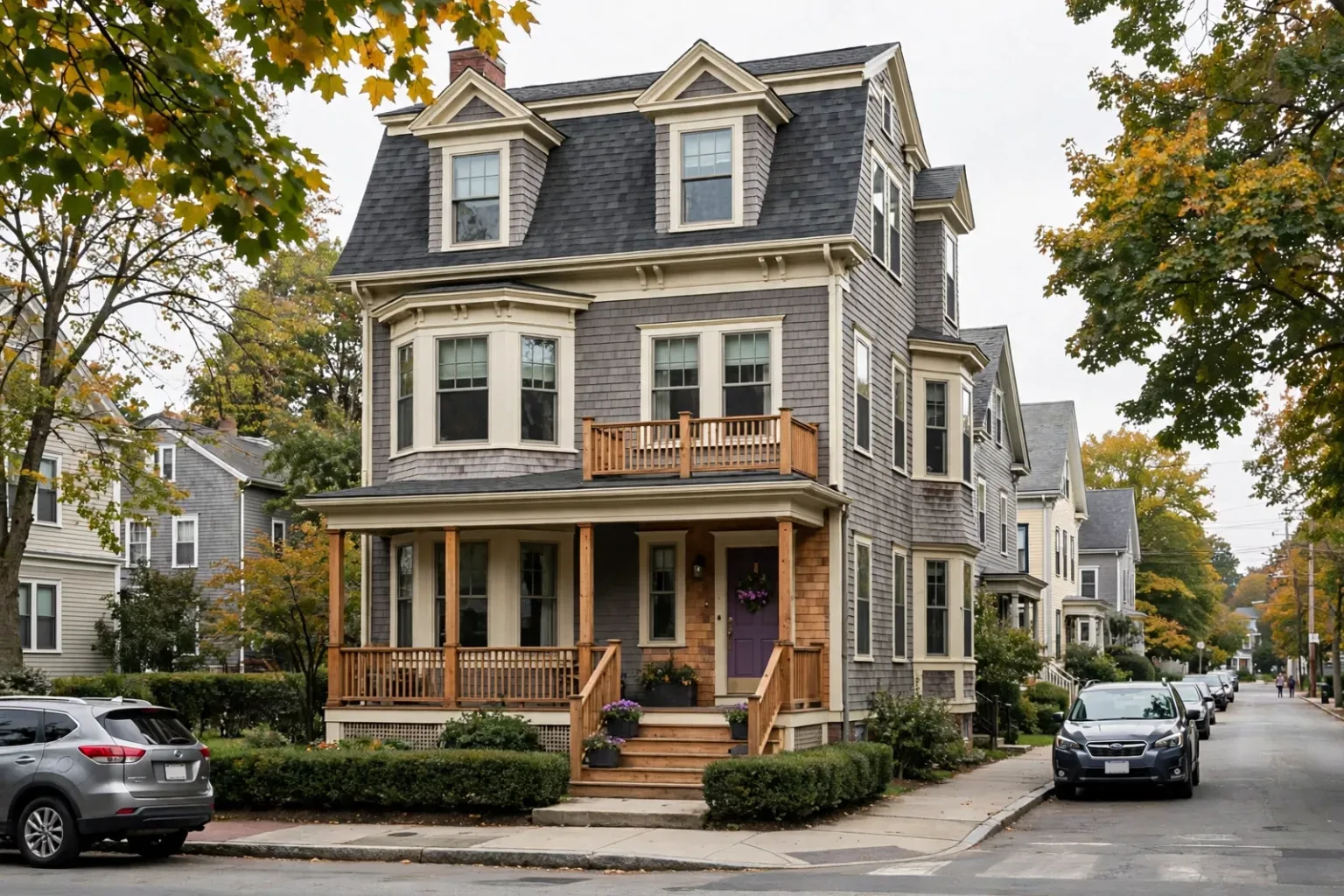
Massachusetts is a higher-cost, higher-regulation, higher-rate DSCR market — Boston’s education-and-biotech economy drives the strongest tenant demand in New England, but the state’s Landlord-Tenant Law, eviction process, and rent-control debate all add friction. For disciplined operators, Boston-metro 2-4 unit triple-deckers and Worcester/Springfield cash-flow plays remain among the most resilient DSCR opportunities in the Northeast.
This guide covers the Massachusetts DSCR environment in 2026: the prepayment-penalty rule, the live rent-control debate, foreclosure mechanics, and the markets.
Why Investors Choose Massachusetts
Boston-metro rental demand is structurally strong: six of the nation’s top research universities (Harvard, MIT, BU, Northeastern, Tufts, BC), the largest biotech cluster in the US, a deep healthcare employment base (Mass General Brigham, Beth Israel Lahey), and a steady financial-services presence. Tenant credit quality is high. Vacancy is low. The trade-off is price — Boston/Cambridge entry prices rival California.
Worcester, Springfield, Lowell, and Fall River offer meaningful cash-flow plays at mainland-US price points — 3-unit triple-deckers are a New England signature, and DSCR underwriting on well-maintained triple-deckers is among the more reliable uses of the product.
DSCR Loan Rules in Massachusetts
Prepayment penalties: owner-occupied rule only. M.G.L. c.183 §56 caps PPPs on mortgages on 1-4 family homes occupied in whole or in part by the borrower (none after 36 months). It is not a ban on investor loans: a DSCR loan on a non-owner-occupied rental generally falls outside it, while an owner-occupied triple-decker gets the cap. Confirm the PPP terms with your lender.
Non-QM licensing via Massachusetts Division of Banks. Every major national DSCR lender funds MA; underwriting is tighter on 2-4 unit triple-deckers (common housing stock in New England) given age of structures and lead-paint exposure.
| Typical Massachusetts DSCR Terms, 2026 | Range |
|---|---|
| Minimum DSCR | 1.00 - 1.25 |
| Max LTV (purchase) | 70% - 80% |
| Max LTV (cash-out refi) | 65% - 75% |
| Minimum FICO | 660 - 700 |
| Prepayment penalty | No state ban on investor loans (owner-occupied cap only) |
Taxes & Carrying Costs
State income tax. Flat 5%, plus 4% surtax on income over ~$1M (as of 2023 ballot initiative, indexed). Combined effective top: 9% on high earners.
Property tax. Effective rate ~1.14% statewide. Cambridge and Boston ~1.10%-1.20%; Worcester County ~1.50%; Springfield ~1.80%-1.90% (one of the higher rates in the state).
MA LLC fees. $500 to form, $500 annual report. Among the more expensive LLC regimes in the country.
Deeds Excise Tax. Paid at closing by seller, $4.56/$1,000 of purchase price (Barnstable $6.12/$1,000).
Insurance. Coastal MA (Cape Cod, South Shore, North Shore) carries windstorm/hurricane premiums. Triple-decker insurance requires attention to electrical updates and porch/stair structure.
Foreclosure & Eviction Landscape
Non-judicial foreclosure via statutory power-of-sale (MGL ch. 244). The lender must issue a Notice of Intent to Foreclose, complete a 150-day right-to-cure period for the first foreclosure on a property, publish notice of sale, and conduct an auction. Typical timeline: 3-12 months depending on process. Servicemembers Civil Relief Act pre-foreclosure check is required and adds 30-90 days.
Eviction. MA eviction (Summary Process) is moderately slow. 14-day notice for non-payment, filing in District Court or Housing Court, hearing typically 14-30 days after filing, execution 10 days after judgment. Total: 30-60 days uncontested. Boston Housing Court has historically been slow and tenant-protective; contested evictions can run 90-180+ days.
Landlord-Tenant Law
Rent control — currently banned, periodically debated. Massachusetts banned rent control statewide in 1994 via a narrow ballot initiative. A 2024 ballot attempt to revisit the ban failed. Boston, Cambridge, and Somerville have proposed home-rule petitions to re-enable rent stabilization; these require MA Legislature approval and have not been enacted. Watch this carefully — any modification to the 1994 ban would be a significant structural change for Boston-area DSCR investors.
MBTA Communities Act (2023). Massachusetts’s 2023 zoning-preemption law requires cities and towns served by MBTA transit to allow multifamily as-of-right in at least one zoning district near transit. Compliance deadlines have rolled through 2024-2025, and upzoned parcels in inner-suburban markets (Arlington, Newton, Milton, Watertown, Brookline, Medford) have begun to trade. For DSCR investors targeting 5-10 unit multifamily, this is a real supply-side shift — and a potential development/BRRRR opportunity.
Security deposits. Capped at 1 month rent. Strict statutory requirements: held in separate MA bank escrow account, receipts with bank name/address, and proper statement of conditions at move-in. Violations can trigger triple damages — a common landlord pitfall.
Last month’s rent. May be collected as last month’s rent at lease inception; must accrue interest annually.
Late fees. May not be charged until rent is 30+ days late.
Notice to terminate month-to-month. One full rental period or 30 days, whichever is longer.
Lead paint (MGL ch. 111, §197). Massachusetts requires lead-paint abatement or professional risk assessment for rentals occupied by children under 6. Non-compliance creates statutory liability. Triple-decker DSCR files frequently require lead-safe compliance documentation.
Top Massachusetts Markets
Boston. Highest entry prices, deepest demand, most regulated. Allston-Brighton and JP for university-heavy rentals; South End and Back Bay for high-end; Dorchester and Roxbury for value plays. Triple-decker 3-unit is a Boston DSCR signature.
Cambridge. Academic tenant base (Harvard, MIT). Very high entry prices; rent-control debate centered here.
Worcester. Central MA cash-flow market. Lower entry prices, strong triple-decker inventory, UMass Medical and Becker College tenant base. The best DSCR value-play in the state.
Springfield. Lowest entry prices, MGM Springfield casino employment, Baystate Health anchor. High yields, also highest property tax rate. More distressed housing stock.
Lowell / Lawrence / Fall River / New Bedford. Cash-flow mill cities; triple-decker inventory; moderate rehab profiles.
Special Considerations
Lead-paint compliance. Any pre-1978 rental occupied by a child under 6 must be deleaded or risk-assessed per MGL ch. 111. Triple-deckers are mostly pre-1978. DSCR underwriting may require evidence of lead-safe status.
Triple-decker dynamics. MA’s signature housing stock — three stacked 2BR/3BR units. Often delivers 1.30+ DSCR on a purchase with conservative rents. Porch, stair, and electrical underwriting is common; age 90-120 years is typical.
Boston/Cambridge rent-control watch. Track home-rule petition status. A rent-stabilization reintroduction would materially reshape DSCR math on covered buildings.
Security deposit triple damages. Any mistake on deposit handling can trigger 3x damages. Use a MA-compliant property manager from day 1.
Entity Formation
Form in MA if holding MA property. $500 filing, $500 annual report — expensive. Single-member LLCs pass-through by default.
Wyoming parent / MA operating LLC works for anonymity. Some investors form directly in MA; others accept the foreign-qualification route to keep the operating-LLC cost-per-state lower. See our entity-structure guide.
How to Get Started
Massachusetts DSCR is a higher-tax, regulated market where the lender-match question centers on comfort with triple-deckers and lead-paint files. Our free matching tool at /get-matched routes to MA-active lenders.
Run the DSCR calculator, review the prepayment penalty guide, and compare at /compare/best-dscr-lenders. MA investors often pair with higher-yield markets like Ohio or Tennessee for balance.