
2026 Georgia DSCR market brief: landlord-friendly law, non-judicial foreclosure, Atlanta/Savannah/Macon/Augusta underwriting, and current lender appetite.
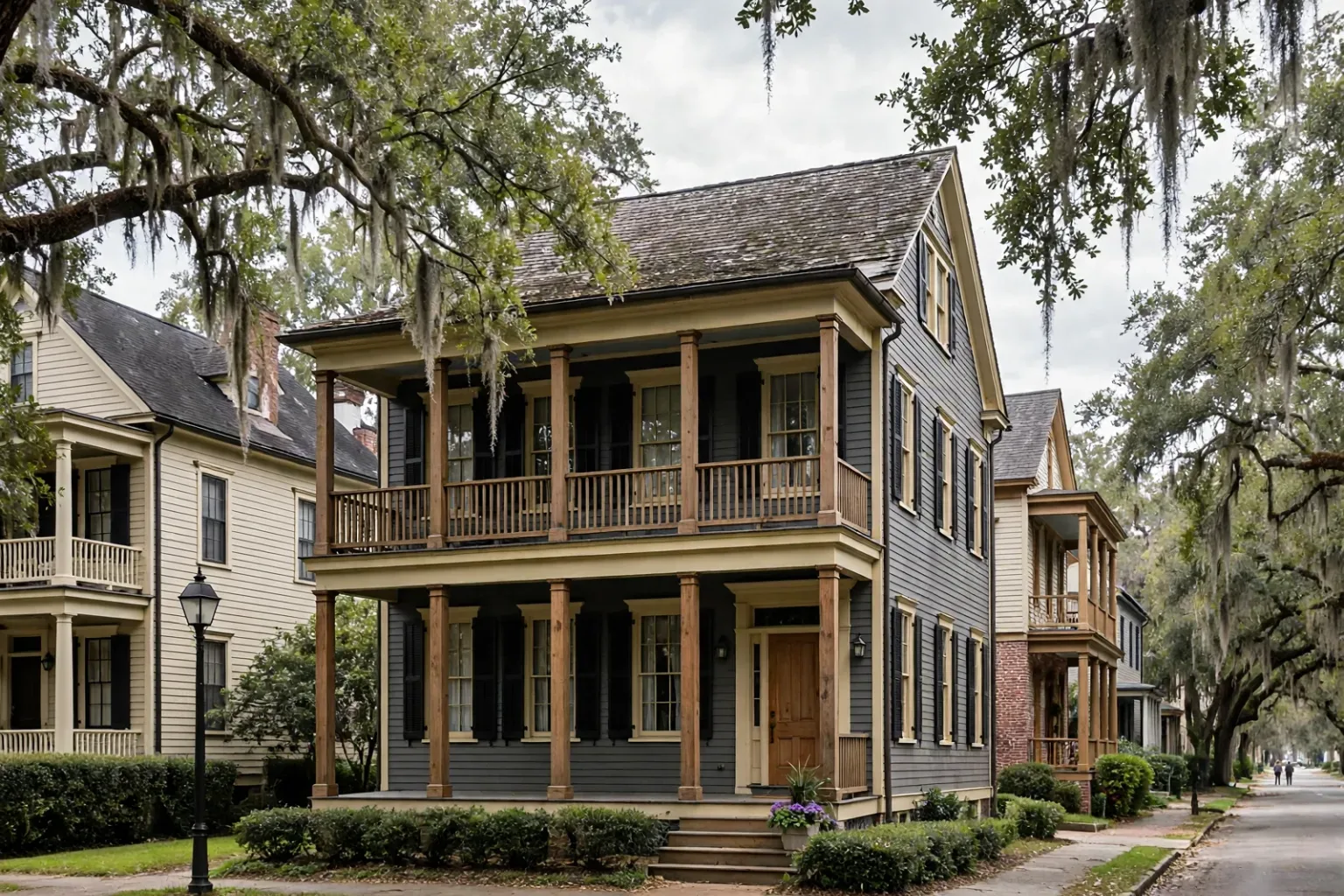
Georgia generates more DSCR loan volume per capita than nearly any other state in the South. Atlanta’s sheer scale, a landlord-friendly legal framework, one of the fastest non-judicial foreclosure timelines in the country, and a growing population base across secondary markets make this a state where DSCR loan underwriting is relatively clean. This guide breaks down the four primary investor markets, what lenders see when they look at a Georgia deal, and where deals actually fall apart.
Georgia market overview
The Georgia investment property market spans several distinct tiers. Atlanta metro is a top-five DSCR volume market nationally — deal flow is high, appraisers are experienced with income-approach methodology, and lenders who specialize in non-QM residential maintain active Georgia programs. Secondary markets like Macon, Augusta, and Savannah attract different investor profiles: more yield-focused, often more comfortable with Section 8 tenancy, and frequently dealing with lower absolute loan amounts.
Typical DSCR loan sizes in Georgia range from $100,000 to $1.5M for SFR and small multifamily. The Atlanta metro skews toward the higher end; secondary markets tend to cluster between $100K and $350K. Properties at the low end of that range can be financed through DSCR channels, though lenders with minimum loan amounts above $100K will pass.
Georgia’s population growth trajectory reinforces the investment thesis. The Atlanta-Sandy Springs-Alpharetta MSA added an estimated 70,000+ residents in 2024 (U.S. Census Bureau, 2025 estimate), creating persistent rental demand across both urban and suburban submarkets. Secondary metros are also growing: Savannah, driven by logistics and port expansion, and Huntsville-adjacent North Georgia continue to absorb in-migration from the Southeast.
Atlanta metro
Atlanta is the primary volume driver for Georgia DSCR lending. The market is large, liquid, and familiar to virtually every national DSCR lender. Deals within the perimeter (I-285) and in the immediate northern suburbs (Sandy Springs, Dunwoody, Roswell) tend to be appreciation-forward — cap rates in many Intown and north suburbs submarkets run 4.5%–6.5%, which means DSCR at 75–80% LTV requires strong rent relative to purchase price.
Airport-proximity submarkets around Hartsfield-Jackson (College Park, East Point, Hapeville, Union City) offer a different profile: lower purchase prices, higher gross yields (7%–9% cap rates are achievable), and strong STR demand from airline crews and business travelers. Several DSCR lenders active in Georgia specifically note these submarkets as favorable for STR underwriting because occupancy data from AirDNA and AIRDNA-adjacent platforms shows consistent demand tied to airport traffic rather than seasonal tourism.
The south Atlanta suburbs — Clayton, Henry, and Spalding Counties — represent an emerging DSCR market. Purchase prices in the $150,000–$250,000 range with rents in the $1,400–$1,800/month band produce DSCRs above 1.20 at 75% LTV even in the current rate environment, which is what draws both individual investors and small portfolio operators to these corridors.
Duplex and small multifamily in Atlanta
The Atlanta market has an active duplex and small multifamily stock. Investors using DSCR on 2–4 unit properties should review the 2–4 unit multifamily DSCR guide before underwriting — lender overlays on small multifamily (higher reserves, lower LTV caps on 3–4 units) apply in Georgia as elsewhere. Co-living structures in Atlanta are also viable; see the PadSplit DSCR guide for relevant lender restrictions.
Macon
Macon is an underrated DSCR market. Median home prices in 2025 remain in the $140,000–$190,000 range for investor-quality SFR, and market rents for 3BR properties cluster around $1,200–$1,500/month. Those economics produce gross cap rates above 8% on standard acquisitions, which is a DSCR-friendly profile even at conservative rent underwriting.
Lender appetite in Macon is narrower than Atlanta. Some lenders with MSA-level restrictions exclude Macon or apply higher reserve requirements to tertiary markets. The investors who succeed here typically work with lenders who explicitly underwrite secondary Georgia markets rather than assuming Atlanta-friendly terms carry over.
Section 8 / Housing Choice Voucher tenancy is common in Macon’s investor-grade stock. Lenders generally allow Section 8 tenants under DSCR programs, though a small number still prohibit voucher tenancy — flagging this upfront with any lender you engage saves time. See the Section 8 HAP DSCR guide for program-level details on which lenders accept and which do not.
Augusta
Augusta sits in the CSRA (Central Savannah River Area) and runs on a dual economic base: the Augusta National / tourism economy and the Fort Eisenhower (formerly Fort Gordon) defense/cyber economy. The military and government contractor presence creates year-round rental demand and dampens vacancy volatility compared to purely civilian employment markets.
Investors target the areas near Fort Eisenhower’s gates — Evans, Grovetown, and portions of Columbia County — where tenant demand from military families is reliable and lease renewals are common. Median purchase prices in these corridors run $200,000–$320,000 for newer construction, with rents at $1,600–$2,000/month producing DSCRs that work at 70–75% LTV with standard rate assumptions.
Augusta proper (Richmond County) offers higher yields on older stock but requires more careful property selection: deferred maintenance, environmental concerns on pre-1978 properties, and appraisal reliability are worth checking before committing to a deal. Lenders who underwrite Augusta will typically require a standard income-approach appraisal; desktop or hybrid appraisals are less commonly accepted in secondary Georgia markets.
Savannah
Savannah is a dual-market story: an active tourist and STR economy in the historic district, and a growing industrial/logistics economy tied to the Port of Savannah (the busiest export port in the US by tonnage, per the Georgia Ports Authority). These two economic pillars produce very different investment profiles.
STR in Savannah’s historic district generates strong revenue per night but faces city permitting requirements. As of 2025, Savannah requires a business license and a home occupation certificate for short-term rentals. Properties in owner-occupied zoning districts are restricted; non-owner-occupied STRs require compliance with specific zoning classifications. The regulations are less restrictive than Asheville, North Carolina (addressed separately in the NC article), but investors should confirm current zoning eligibility before underwriting STR income under DSCR. The STR DSCR calculator is useful here.
Long-term rental in logistics corridors near the Port and along I-95 offers a different profile — steadier demand from port workers and distribution employees, lower peak revenue, and fewer regulatory complications than the historic district STR market.
Georgia landlord-tenant law for DSCR investors
Georgia’s landlord-tenant framework is consistently favorable to property owners, which is a material factor in lender appetite for the state.
Non-judicial foreclosure: Georgia is a non-judicial foreclosure state. The process requires a 4-week newspaper publication period followed by a public auction on the first Tuesday of the month at the county courthouse. Total timeline from default to completed foreclosure: typically 60–90 days, one of the fastest in the country (National Mortgage Servicing Association data, 2025). Lenders price this risk mitigant into their programs — Georgia deals often qualify for slightly more favorable terms than comparable deals in judicial foreclosure states.
Eviction timeline: Georgia’s dispossessory process is efficient. After a written notice to vacate (typically 60 days for month-to-month tenants, or per lease terms for fixed-term), a landlord can file a dispossessory warrant in magistrate court. A hearing is typically scheduled within 7–10 days of filing. If the tenant does not answer, a default writ is issued within days; contested cases may take 30–45 days to hearing. Total eviction from filing to writ of possession: 3–6 weeks in most Georgia counties (Georgia Legal Aid, 2025). Compare this to 6–12 month timelines in tenant-protective states.
Security deposit: Georgia limits security deposits to the equivalent of 2 months’ rent (O.C.G.A. § 44-7-31). Deposits must be held in a separate trust account or the landlord must post a surety bond. Itemized accounting is required within 30 days of lease termination.
Rent control: None. Georgia preempts local rent stabilization ordinances statewide, so no city or county can impose rent control regardless of local political conditions.
No just-cause eviction requirement: Georgia does not require landlords to show cause for non-renewal of a lease. Investors have full discretion to decline renewal, though written notice requirements apply per the lease term.
Insurance dynamics in Georgia
Georgia’s insurance environment varies significantly by geography.
That decision sits inside our DSCR Loans by State hub, where DSCR Authority maps program fit and what investors usually prep before booking a strategy call.
That decision sits inside our DSCR Loans by State hub, where DSCR Authority maps program fit and what investors usually prep before booking a strategy call.
That decision sits inside our DSCR Loans by State hub, where DSCR Authority maps program fit and what investors usually prep before booking a strategy call.
That decision sits inside our DSCR Loans by State hub, where DSCR Authority maps program fit and what investors usually prep before booking a strategy call.
That decision sits inside our DSCR Loans by State hub, where DSCR Authority maps program fit and what investors usually prep before booking a strategy call.
That decision sits inside our DSCR Loans by State hub, where DSCR Authority maps program fit and what investors usually prep before booking a strategy call.
That decision sits inside our DSCR Loans by State hub, where DSCR Authority maps program fit and what investors usually prep before booking a strategy call.
That decision sits inside our DSCR Loans by State hub, where DSCR Authority maps program fit and what investors usually prep before booking a strategy call.
North Georgia (mountain counties) has standard property insurance without significant coastal premium loading. Average premiums for SFR investment properties run $1,200–$2,000/year depending on construction type and location.
Atlanta metro carries moderate premiums — hail and wind are the primary drivers, not hurricane risk. Many Atlanta-area insurers have increased premiums 15–25% over 2023–2025 due to hail claims frequency across the Southeast. Budget approximately $1,500–$2,500/year for a standard SFR in metro Atlanta.
Coastal Georgia (Chatham, Bryan, Liberty, Glynn, Camden Counties) requires windstorm coverage that can significantly increase total insurance cost. Savannah and the Golden Isles (St. Simons, Jekyll Island) carry coastal wind exposure. Investors in these markets should budget $3,000–$6,000/year for combined HO + wind coverage, potentially more for properties in FEMA flood zones. The Georgia FAIR Plan is available as a last-resort insurer. Lenders will require proof of windstorm coverage for coastal Georgia collateral.
Georgia-specific PPP considerations
Georgia has no state statute that prohibits or restricts prepayment penalties on investment property mortgages. DSCR loans in Georgia are underwritten to standard national DSCR PPP structures — typically 5-4-3-2-1 step-down, 3-2-1, or flat fee options.
The practical consideration for Georgia investors: Atlanta’s market has seen significant appreciation over 2020–2025, and many investors who entered at lower prices are now considering refinances or sales. If your strategy involves a hold period under 3–5 years, selecting a shorter PPP step-down (or paying the rate premium for a no-PPP loan) may be worthwhile. Use the DSCR calculator to model the rate-versus-PPP tradeoff for your specific hold period.
Route Your Georgia Deal to the Right Lender
Atlanta, Savannah, Macon, Augusta — we know which lenders are actively pricing Georgia DSCR right now.
Lender appetite snapshot — Georgia
The table below reflects our current lender network posture for Georgia investment properties (as of August 2026). Rate ranges are illustrative; actual pricing depends on FICO, LTV, DSCR, property type, and PPP selection.
| Lender stance | Min loan | Max LTV | Indicative rate range | Notes |
|---|---|---|---|---|
| National DSCR specialists (A-paper) | $100,000 | 80% | 6.50%–7.25% | Full Georgia coverage; strong Atlanta volume |
| National DSCR specialists (non-conforming) | $75,000 | 75% | 6.75%–7.50% | Accept Macon/Augusta secondary; higher reserves |
| Portfolio lenders (regional bank) | $150,000 | 75% | 7.00%–8.00% | Relationship-based; slower but more flexible on unusual properties |
| STR-specialist lenders | $150,000 | 75% | 7.00%–7.75% | Active in Savannah STR; require AirDNA + local permit verification |
| No-ratio programs | $150,000 | 70% | 7.50%–8.25% | 720+ FICO, 12 months reserves; for lease-up or sub-1.0 DSCR deals |
Rate ranges are illustrative, sourced from our lender network (August 2026). Individual pricing will vary.
Worked example: Atlanta south suburb SFR
Property: 3BR/2BA SFR in Clayton County, Georgia
Purchase price: $215,000
Loan amount (75% LTV): $161,250
Rate: 7.00% / 30-year fixed, 5-4-3-2-1 PPP
Monthly PITIA breakdown:
- Principal & interest (7.00%, $161,250): $1,073
- Property taxes (0.83% effective rate × $215,000 / 12): $149
- Homeowner’s insurance: $150
- Total PITIA: $1,372
Market rent: $1,750/month (3BR in the Clayton County corridor)
DSCR: $1,750 / $1,372 = 1.27
A 1.27 DSCR comfortably clears most lenders’ 1.20 threshold and provides a cushion for vacancy. At a $215,000 purchase price, down payment is $53,750. Assuming 6 months PITIA reserves ($8,232), total capital required at closing runs approximately $65,000–$70,000 including closing costs.
If the same investor used a no-ratio program (70% LTV), the loan drops to $150,500, P&I drops to $1,001, and total PITIA falls to $1,300 — improving DSCR math but requiring more equity and higher reserves (12 months, approximately $15,600).
Common mistakes Georgia investors make
Underestimating insurance in coastal submarkets. Investors underwriting Savannah deals with Atlanta-level insurance assumptions routinely miscalculate PITIA. A $1,500 Atlanta premium versus a $4,500 Savannah coastal premium changes DSCR meaningfully on a $200,000 loan.
Assuming all lenders underwrite Macon at Atlanta terms. Secondary market overlays are real. A lender who closes deals smoothly in Buckhead may require additional reserves, lower LTV, or decline entirely in Bibb County. Vetting lender appetite for your specific market before entering contract saves time and protects earnest money.
Ignoring STR permitting in Savannah historic district. Underwriting STR income from a property in a restricted zoning district creates compliance and revenue risk. Verify permit eligibility with the City of Savannah before the appraisal is ordered.
Not accounting for the HOA in newer suburban communities. Many newer Clayton, Henry, and Forsyth County subdivisions have HOAs with monthly fees of $75–$200. These fees are included in PITIA for DSCR purposes and reduce the ratio by 0.05–0.10 depending on loan amount.
Using list rent instead of market rent for underwriting. Lenders use the appraiser’s rent schedule or a lease in place, not the investor’s projected rent. If your deal depends on above-market rents to clear DSCR, verify that the rental market supports that number before committing.
Closing
Georgia remains one of the most lender-friendly states in the DSCR market — efficient foreclosure, no rent control, strong population growth, and multiple viable submarkets from cash-flow-focused secondary markets to appreciation-led Atlanta corridors. The differences between those submarkets, however, matter enough to route each deal to the right lender.
Atlanta investor? Let us route you to ATL-friendly lenders who actively close Georgia deals. Get matched today and we’ll identify which programs fit your market, loan size, and DSCR within 24 hours.