
How DSCR lenders haircut per-room co-living income vs a master lease — and how that changes your qualifying DSCR. See the lender matrix and a worked Atlanta PadSplit example.
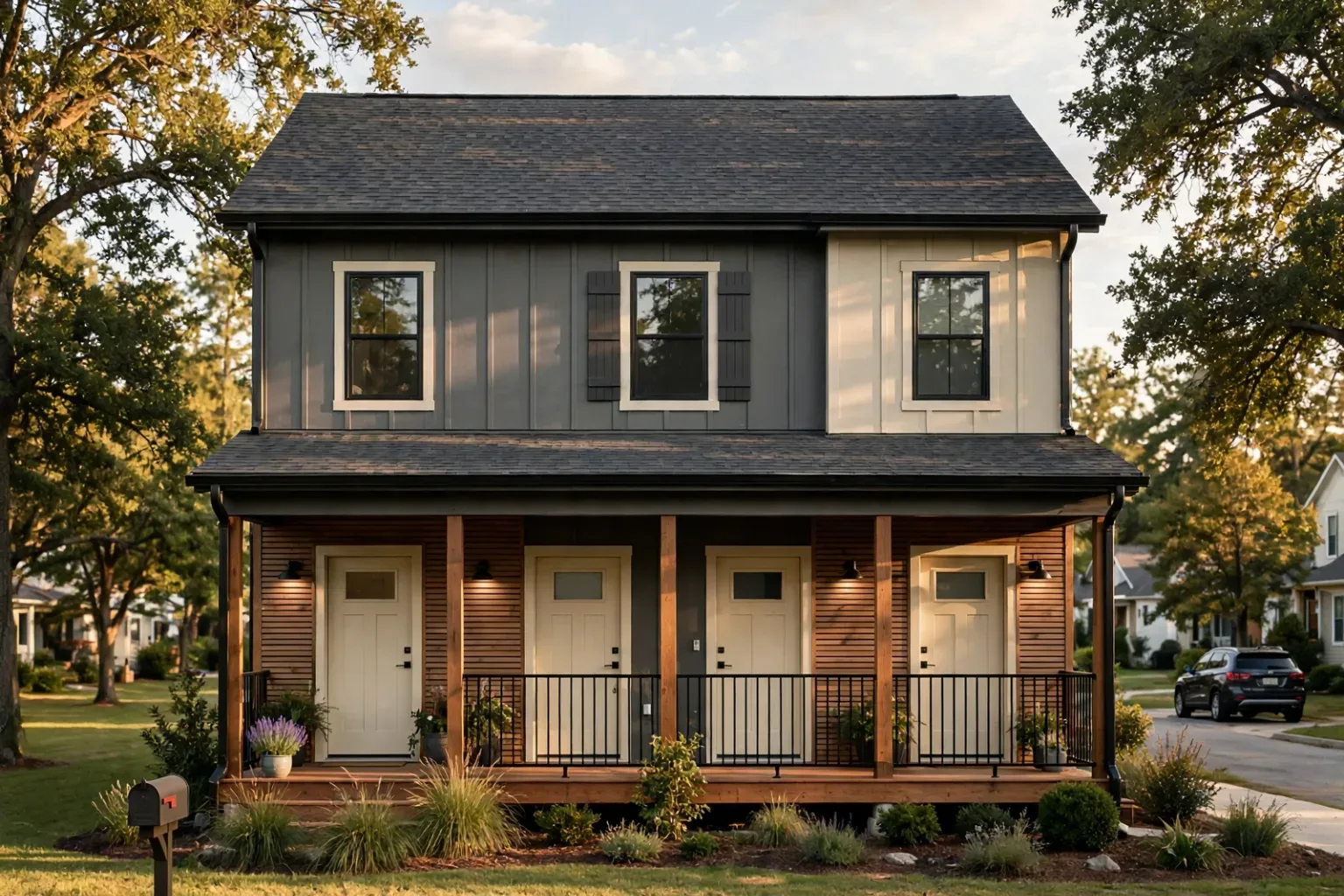
Co-living properties — houses operated room-by-room, often through platforms like PadSplit — can generate 30–60% more gross income than the same property on a standard single-family lease. That yield premium is exactly what attracts investors. But DSCR lenders don’t underwrite the gross room revenue. They underwrite the income they can verify and stress-test — and for most co-living properties, that income is significantly lower than what the operator’s projections suggest. Understanding the gap between gross revenue and qualifying income is the difference between a deal that closes and one that stalls at appraisal.
If you’re new to DSCR underwriting mechanics, read this first before working through the lender-specific details below.
The PadSplit Model — and Why DSCR Underwriters Distrust It
PadSplit markets homes as “affordable co-living” where members rent individual furnished rooms on a weekly basis. The economics for hosts are attractive: a 5-room Atlanta house that would rent for $1,800–$2,200/month on the open market might generate $5,000–$6,000/month in combined PadSplit member revenue, after PadSplit’s platform fee.
The underwriter’s distrust is structural, not arbitrary:
- Weekly billing. PadSplit members pay weekly. From a lender’s perspective, weekly tenancies are functionally the same as month-to-month — extremely short-term. The Form 1007 Comparable Rent Schedule, which DSCR appraisers use to establish qualifying income, is calibrated for monthly leases with 12-month terms.
- High turnover. PadSplit’s model depends on workforce housing demand; individual members cycle in and out faster than traditional renters. A lender looking at 12 months of PadSplit history may see 30–50% member turnover per room per year, which they treat as elevated vacancy risk.
- All-bills-paid. PadSplit hosts pay all utilities — electric, water, internet — and those costs are embedded in the member fee. The gross revenue figure includes utility recovery. Underwriters want to see net income after utilities before building the DSCR, which brings the effective income down further.
- Platform concentration risk. The income depends on PadSplit’s continued operation, member pipeline, and policy decisions. A lender who forecloses on the property inherits a co-living operation that requires PadSplit participation to maintain its income profile.
None of these concerns are hypothetical. They produce a predictable underwriting outcome: most lenders who technically allow co-living will recognize materially less income than the operator’s pro forma.
Per-Room Income vs. Master-Lease Income — The 1007 Problem
DSCR underwriting centers on the Form 1007, which an appraiser completes to establish the property’s fair market rent as a single residential unit. The appraiser surveys comparable rentals in the area and arrives at a market rent — typically what a standard single-family tenant would pay for the house.
This is the core problem: A 5-room PadSplit house in Atlanta’s West End might generate $5,500/month from PadSplit members. The 1007 appraiser, looking at comparable 4-bedroom houses in the same area on single-family leases, arrives at a market rent of $2,200/month. A DSCR lender who relies solely on the 1007 will underwrite the loan at $2,200/month income — less than 40% of the actual gross.
There are two ways lenders handle this:
Option 1 — 1007 only (most lenders). The lender accepts the 1007 market rent as the qualifying income. The DSCR calculation uses $2,200/month. If that doesn’t support the debt service, the loan doesn’t close — regardless of what the property is actually generating.
Option 2 — Operator P&L with haircut (minority of lenders). A subset of lenders, primarily those with specific co-living or PadSplit programs, will accept a documented 12-month operator P&L (owner’s ledger or PadSplit host dashboard) and apply a haircut to arrive at qualifying income. The haircut varies — typically 25–35% off gross — to account for vacancy and expense risk. This allows the lender to recognize income above the 1007 market rent while applying a buffer.
The gap between these two approaches is material. It determines whether your deal clears DSCR minimums.
The Income Haircut by Lender — Matrix
The following matrix represents the three lender stances we encounter in practice for co-living and PadSplit properties:
| Lender stance | Income recognized | Min DSCR | Notes |
|---|---|---|---|
| 1007-only (standard DSCR) | 1007 market rent | 1.20 | No co-living income credit; qualifies only on single-family rent |
| Operator P&L with haircut (co-living lender) | 65–75% of gross room revenue | 1.15–1.20 | Requires 12-month operator ledger; PadSplit host dashboard accepted at some lenders |
| Master-lease recognized (any lender) | PadSplit master-lease payment to host | 1.20 | Treats PadSplit payment as single-tenant rent; most accessible path |
For most investors, the master-lease path is the most accessible because it doesn’t require finding a specialty lender. The PadSplit payment to the host — documented on the host dashboard as a monthly disbursement — functions as a single-lease payment and is treated as such by lenders who accept PadSplit agreements.
Co-Living Property? We Model the Income Haircut by Lender.
Send us your PadSplit or operator P&L and we'll show you what each lender tier will qualify — before you go to underwriting.
PadSplit-Specific Issues Beyond Income Recognition
Even investors who clear the income hurdle run into secondary issues that are specific to co-living properties:
Room counts vs. bedroom counts. PadSplit sometimes converts living rooms, dining rooms, or large spaces into additional rooms. A property listed as a 3-bedroom on county records and the MLS may be operating as a 5-room PadSplit. This creates two problems: the 1007 appraiser may not be able to count the converted rooms as bedrooms (affecting the market rent comparables), and the lender may flag the discrepancy as a code-compliance or zoning concern.
Code compliance and zoning. Local zoning in many markets limits the number of unrelated occupants in a single-family dwelling — typically three to five individuals. A 7-room PadSplit with seven members may be operating in violation of local occupancy ordinances, which is both a legal exposure and a lender concern. Title companies in some markets have begun flagging co-living properties for zoning review before insuring. Check local occupancy limits before acquiring.
Habitability standards. Lenders require that the property meets standard habitability requirements. Converted spaces (e.g., a finished garage converted to a bedroom) may not meet egress, ceiling height, or HVAC requirements under local code — issues that surface in the appraisal’s property condition section.
That decision sits inside our DSCR Authority Blog hub, where DSCR Authority maps program fit and what investors usually prep before booking a strategy call.
That decision sits inside our DSCR Authority Blog hub, where DSCR Authority maps program fit and what investors usually prep before booking a strategy call.
Appraisal comparables. In markets where co-living is uncommon, the appraiser may have limited comparable data and may apply a downward adjustment for the property’s non-standard configuration. An inflated 1007 is less likely than an unusually low one when the appraiser applies a penalty for room-count conversion.
Worked Example: 5-Room PadSplit in Atlanta
The property: A 4-bedroom, 2-bathroom house in Atlanta’s West End, converted to a 5-room PadSplit (one bedroom divided into two smaller rooms). Purchase price $285,000.
Gross PadSplit member revenue:
- 5 rooms × $1,100/month average member rate = $5,500/month gross
- PadSplit platform fee (~30%): -$1,650/month
- Utilities (host pays all): -$650/month
- Net host income: $3,200/month = $38,400/year
PadSplit master-lease payment to host: approximately $2,900/month (PadSplit’s “guaranteed” payment to the host in this market tier)
1007 appraiser market rent: $2,200/month for a 4-bedroom in this location (the fifth room is not recognized in comps)
Loan at $228,000 (80% LTV), 7.25% rate, 30 years:
- Monthly PITIA: ~$1,556
- Annual PITIA: $18,672
| Income basis | Annual income | DSCR | Qualifies at 1.20? |
|---|---|---|---|
| 1007 market rent | $26,400 | 1.41 | Yes |
| PadSplit master lease | $34,800 | 1.86 | Yes |
| Gross room revenue (haircut 30%) | $46,200 | 2.47 | Yes |
In this example, even the 1007 market rent supports a 1.41 DSCR — the deal qualifies under any lender approach at 80% LTV. The question is which income basis the lender uses, because it determines how aggressive you can be on purchase price and loan amount.
If the purchase price rises to $340,000 and the loan is $272,000 (80% LTV):
- Annual PITIA: ~$22,272
- DSCR on 1007 rent only ($26,400): 1.19 — below the 1.20 minimum at most lenders
- DSCR on PadSplit master lease ($34,800): 1.56 — qualifies
- The lender’s income recognition policy determines whether this deal closes at 80% LTV.
Use our DSCR calculator to model this for your own property at different income bases. Then check what sub-1.0 DSCR options exist if your deal doesn’t clear the 1.20 minimum under any lender’s income treatment.
Common Mistakes With Co-Living DSCR Deals
Using PadSplit gross revenue in the DSCR calculation. The gross member revenue is not what you collect. Your income is the net disbursement after platform fees, utilities, and maintenance. Modeling DSCR on gross room revenue will produce a number that no lender will recognize.
Assuming any DSCR lender accepts PadSplit. Many do not. The lender’s guidelines may be silent on co-living (meaning the underwriter will make a judgment call based on the appraisal), or they may explicitly prohibit by-the-room properties. Submitting a PadSplit property to a lender without first confirming their co-living stance is a common way to waste four to six weeks.
Ignoring the room-count vs. bedroom-count problem before appraisal. If the property has been converted and the county records show fewer bedrooms than the operating configuration, this will surface in the appraisal. Get a local appraiser’s informal opinion on how they’d handle the configuration before ordering the full appraisal.
Underestimating operating costs. Co-living properties have higher utility, maintenance, and management costs than standard rentals because of higher occupancy intensity. A DSCR model that uses 25% expense ratio on a co-living property is almost certainly understating actual expenses. Use 35–40% on gross income for a more defensible figure.
Buying a co-living property requires more lender matching work than a standard SFR deal. We’ll model the income haircut across the lender tiers in our network and show you exactly which programs your deal qualifies under — submit your scenario at /get-matched/ to get started.