

Worked DSCR math on a Cleveland triplex — Form 1025 rents, reserve overlays, and LTV by unit count. Pair with our 2–4 unit reference guide for program limits.
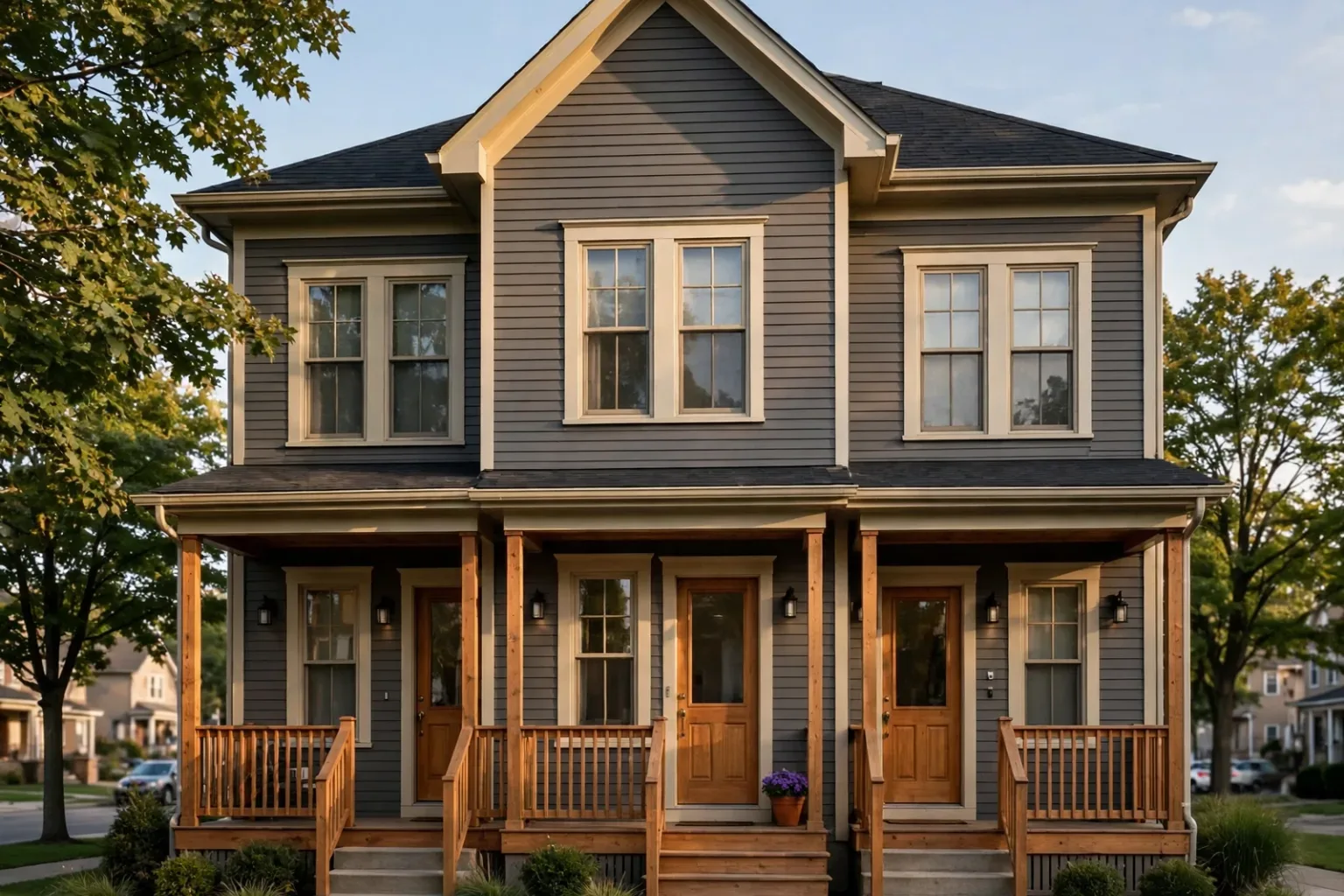
Comprehensive reference: See our 2–4 unit property guide for LTV ceilings, appraisal rules, and lender shortlists. This article walks through a real triplex scenario and common overlay traps.
The 2-4 unit property is the most underused product in the DSCR loan menu. Investors who know how the underwriting works have access to residential loan terms — 30-year fixed, up to 80% LTV — on properties generating two, three, or four rental income streams. The catch: lenders handle income documentation, appraisal forms, and reserve requirements differently on 2-4 units than on single-family, and the owner-occupancy rules create real traps for investors who didn’t read the fine print. This guide covers every material difference so you can close your duplex, triplex, or fourplex without surprises.
For a foundational overview of how DSCR loans work, see what is a DSCR loan.
Why 2–4 Unit Is the Highest-Leverage DSCR Product
A 2-4 unit property occupies a rare financing sweet spot: it qualifies for residential loan terms while delivering multifamily cash flow.
Here is the practical difference. A $600,000 single-family rental in Cleveland might generate $2,200/month in rent. A $600,000 fourplex in the same market might generate $4,800/month across four units. Both properties can use the same 30-year DSCR product at the same LTV. The fourplex produces dramatically better DSCR and cash flow, but the financing cost is the same.
That arithmetic is the reason experienced investors prioritize small multifamily when they can find it at the right price. The cash-on-cash returns on a well-bought fourplex almost always exceed an equivalent-price SFR in the same market.
Why residential DSCR terms matter. At 5+ units, a property crosses into commercial territory. Commercial DSCR loans typically carry shorter amortization (25 years instead of 30), higher rates, and more restrictive LTV caps. A fourplex at 75% LTV and a 30-year term generates materially different cash flow than a 5-unit building on a 25-year amortization at the same loan amount. The 1-unit difference in building size carries a significant financing cost.
The access argument. DSCR loans on 2-4 unit properties don’t require income documentation, tax returns, or debt-to-income analysis from the borrower. Qualification is property-based. This makes 2-4 unit DSCR accessible to investors with complex income structures — self-employed, high-earning W-2 investors who want to exclude rental activity from their DTI, or investors with multiple properties whose personal DTI would disqualify them for conventional financing.
How Form 1025 Income Works
When a DSCR lender orders an appraisal on a 2-4 unit property, the appraiser completes a Form 1025 (Small Residential Income Property Appraisal Report), not the Form 1007 (Single Family Comparable Rent Schedule) used for SFR properties.
The distinction matters because Form 1025 captures income and expense data differently:
Form 1025 income analysis:
- Market rent estimate per unit (from comparable rentals)
- Total projected gross annual income
- Vacancy and credit loss estimate (typically 5–10%)
- Operating expense estimate
- Net operating income
- Indicated overall capitalization rate
What the lender uses for DSCR. Most DSCR lenders use gross market rents from Form 1025 (not NOI) divided by PITIA to calculate DSCR. The vacancy and expense factors in the appraisal are the appraiser’s, not necessarily the lender’s — the lender may apply their own vacancy factor on top of market rents.
Actual rents vs. market rents. If the property has executed leases with actual rents higher than the Form 1025 market rent estimate, most lenders will use the lower of the two. If actual rents are below market, the lender may use market rents — giving investors in below-market tenancies a slight DSCR benefit.
Lease documentation. For properties with existing tenants, the lender will ask for current leases and a rent roll. A new appraisal will still be required. Do not assume that your existing leases define the DSCR — the appraiser’s market rent conclusion is the controlling number unless your leases are materially above market.
LTV by FICO and DSCR — The Full Matrix
Lender overlays vary significantly, but the following table reflects the ranges we see across our network for standard 2-4 unit DSCR programs.
| FICO | DSCR ≥ 1.25 | DSCR 1.0–1.24 | DSCR 0.75–0.99 | DSCR < 0.75 (no-ratio) |
|---|---|---|---|---|
| 740+ | 80% LTV | 75–80% LTV | 70% LTV | 70–75% LTV |
| 720–739 | 75–80% LTV | 75% LTV | 70% LTV | 70% LTV |
| 700–719 | 75% LTV | 70–75% LTV | 65–70% LTV | Not available |
| 680–699 | 70–75% LTV | 70% LTV | 65% LTV | Not available |
Notes:
- LTV caps are for purchase. Cash-out refinances are typically 5% lower across the board.
- No-ratio DSCR at 720+ FICO is available from a limited number of lenders — availability varies by property type and market.
- Fourplex purchases often carry a 5% LTV discount vs. duplex at the same FICO and DSCR, depending on lender.
- Properties in high-cost or declining markets may face additional 5% LTV overlays regardless of FICO or DSCR.
Use the DSCR calculator to model your deal before approaching lenders. The qualification estimator will map your FICO and DSCR to approximate LTV range based on current program data.
The Owner-Occupancy Trap
This is the most expensive mistake we see on 2-4 unit DSCR deals, and it comes in two forms.
Trap 1 — Declaring owner-occupancy at purchase to get better terms, then renting all units. If you buy a duplex with owner-occupied financing (FHA, conventional, or VA), you are representing to the lender that you intend to occupy the property as your primary residence. Moving out within 12 months of closing without lender notification is mortgage fraud. The solution is straightforward: if you intend to rent all units, use investor financing (DSCR) from the start.
Trap 2 — Refinancing an OO property into DSCR too soon. You legitimately purchased a duplex as your primary residence, lived there for a year, then moved out. Now you want to refinance into a DSCR investor loan. Most DSCR lenders require a 12-month seasoning period from the date you stopped occupying the property. Attempting to refinance before that 12-month window closes will either be declined or require a representation that you are no longer the primary occupant — which triggers additional lender scrutiny.
The fourplex misclassification problem. A related trap: investors sometimes purchase a property listed as a 4-unit and discover during underwriting that the county assessor classifies it as 3 units plus one illegal additional unit. A lender will underwrite based on legal, permitted units only. If one of four units was unpermitted, the lender treats it as a triplex — different DSCR math, potentially different LTV, and a compliance issue that could affect title insurance.
Check permitted unit count through the county assessor or building department before going under contract on any property presented as a 2-4 unit. This is especially important for older or converted properties.
Reserves and PITIA Expectations vs SFR
Reserves on 2-4 unit properties are higher than on single-family, and the difference is meaningful in terms of cash to close.
Standard reserve requirements:
- Single-family DSCR: 6 months PITIA (6 × monthly payment)
- Duplex DSCR: 6–9 months PITIA
- Triplex/fourplex DSCR: 9–12 months PITIA
On a fourplex with $3,500/month PITIA, 12 months of reserves equals $42,000 that must be in a verifiable account at closing. This is a post-closing reserve — it doesn’t go toward the down payment. It is in addition to your down payment and closing costs.
Reserve sourcing rules vary by lender. Most accept:
- Checking and savings accounts (100% of balance)
- Money market accounts (100%)
- Retirement accounts (60–70% of balance, to account for early withdrawal penalties)
- Brokerage accounts in liquid securities (70–80% of balance)
Gift funds are generally not accepted for reserves on investment properties, only for down payments at some lenders.
PITIA definition on 2-4 units. PITIA on a small multifamily includes principal, interest, property taxes (full annual amount / 12), landlord insurance (not renter’s insurance), and any HOA dues. Flood insurance, if required, is also included. The PITIA figure is what lenders use for DSCR calculation — not just PI.
Duplex/triplex under contract? We pre-qualify in 24 hours.
Tell us your numbers and we'll match you with the right DSCR lender for 2-4 unit deals.
Worked Example: $625K Cleveland Triplex
Property: Three-unit property in Cleveland, Ohio. Investor is purchasing with no tenant in Unit 1, current tenant paying $1,050/month in Unit 2, current tenant paying $1,100/month in Unit 3.
That decision sits inside our DSCR Property Types hub, where DSCR Authority maps program fit and what investors usually prep before booking a strategy call.
Appraisal (Form 1025) market rent conclusion:
- Unit 1: $1,150/month market rent
- Unit 2: $1,100/month (lease in place, matches market)
- Unit 3: $1,100/month (lease in place, matches market)
- Total gross market rent: $3,350/month
Lender income used for DSCR: $3,350/month (market rents from Form 1025, with vacancy built in by lender at 5%)
- Effective monthly income used: $3,182
Investor profile:
- FICO: 725
- Purchase price: $625,000
- Desired LTV: 75% → loan amount: $468,750
- Rate: 7.50% (illustrative, 30-year fixed, 5/1 step-down PPP)
- Monthly P&I: $3,279
- Property taxes (Cleveland rate): $510/month
- Landlord insurance: $185/month
- Total PITIA: $3,974/month
DSCR calculation:
- $3,182 / $3,974 = 0.80
At 0.80 DSCR and 725 FICO, the LTV table puts this deal at 65% LTV for a DSCR 0.75–0.99 / 720–739 FICO combination — meaning 75% LTV is not available. The investor needs to either:
- Bring more down payment (to 65% LTV → $406,250 loan)
- Find a lender with a 0.80 DSCR floor at 70% LTV (some exist in our network)
- Accept the no-ratio product at 70% LTV with 720+ FICO (this investor qualifies at 725)
No-ratio option at 70% LTV:
- Loan amount: $437,500
- Rate: 7.75% (no-ratio programs carry ~0.25% premium)
- PITIA: $4,082/month (at $437,500 loan)
- No minimum DSCR required
Cash to close (70% LTV, no-ratio):
- Down payment: $187,500 (30% of $625,000)
- Closing costs: ~$9,500 (origination, appraisal, title, recording)
- Reserves: 9 months PITIA = $36,738
- Total cash to close: ~$233,738
Monthly cash flow at stabilization (no-ratio, 70% LTV):
- Gross rent: $3,350
- Vacancy (5%): -$168
- Property management (8%): -$268
- Maintenance and CapEx reserve: -$200
- PITIA: -$4,082
- Net monthly cash flow: -$1,368
This deal is cash-flow negative at these terms, which is common in Cleveland given the low purchase price relative to operating costs. The investor’s thesis here is appreciation and BRRRR — refinancing in 3–5 years when rents have grown. If rents reach $1,350/unit (total $4,050/month), the no-ratio product breaks even and a standard DSCR product at 1.0+ becomes available.
Use the cap rate and NOI calculator to run your own triplex scenario before locking in terms.
Common Mistakes on 2-4 Unit DSCR
Using pro-forma rents from the listing sheet. A seller’s listing might project $3,600/month in rents for a triplex that the Form 1025 appraises at $3,000/month in market rents. The lender uses the appraiser’s conclusion, not the listing sheet. Build your DSCR model from comparable closed leases in the market, not the broker’s projections.
Wrong vesting at closing. If you close a DSCR loan in your personal name and then try to transfer it to an LLC, most DSCR notes contain a due-on-sale clause that triggers on transfer. Close in the entity you intend to own the property in, confirmed with the lender before you sign the purchase contract. Different lenders have different requirements — some allow LLC vesting from day one, others require personal-name vesting with a post-close transfer permitted by specific addendum.
Fourplex misclassification. As noted above, a 4-unit property with one unpermitted unit is a triplex for DSCR purposes, with different underwriting math. This isn’t just an appraisal issue — it’s a title insurance issue and potentially a zoning compliance issue. Resolve it before going under contract.
Assuming all four units qualify for DSCR income. If one of four units is an accessory dwelling unit (ADU) with a different legal classification than the main structure, some lenders will exclude that unit’s income from DSCR calculation. Verify unit classification in county records before closing assumptions.
5-Step Playbook: Offer to Close in 28 Days
DSCR loans on 2-4 unit properties move faster than bank commercial loans — 21–35 days is realistic on a clean deal. Here is the sequence:
-
Days 1–3: Pre-qualification. Before making an offer, run the DSCR calculation using Form 1025 market rents from comparable listings. Confirm the deal works at your target LTV. Identify the right lender category (standard, sub-1.0, or no-ratio) based on projected DSCR and your FICO.
-
Days 3–7: Submit loan application. DSCR applications require minimal documentation — property address, purchase contract, entity docs if using an LLC, 2 months of bank statements for reserves, credit authorization. Most lenders can issue a pre-approval within 3–5 business days.
-
Days 7–14: Appraisal ordered and completed. The lender orders the Form 1025 appraisal. On a 2-4 unit, appraisals typically take 7–10 business days to schedule and complete. Clear access for the appraiser immediately — delays here are the most common cause of missed close dates.
-
Days 14–21: Underwriting. Underwriter reviews the file, appraisal, title commitment, and insurance binder. Submit any conditions within 24 hours of receiving the conditions list. Common conditions: updated bank statements, lease copies, clarification on entity structure.
-
Days 21–28: Clear to close and fund. Wire instructions, closing disclosure review, and closing. Funds typically disburse the same day or next business day after signing. Get pre-qualified before you go under contract — having a pre-approval letter in hand strengthens your offer and compresses the timeline.
If your offer is contingent on financing, most purchase agreements allow 21–30 days for financing approval. A DSCR loan on a clean 2-4 unit deal fits comfortably within that window.
Whether you’re buying your first duplex or your fifteenth fourplex, the right lender selection matters as much as the deal itself. Get pre-qualified with us at DSCR Authority — we’ll match you with the lender whose overlay fits your DSCR, FICO, and deal structure, and we’ll tell you where you stand within 24 hours.