Property-type guide
DSCR Loans for 2-4 Unit Investment Properties
DSCR loans for 2-4 unit properties in 2026: 75-80% LTV, 0.85-1.0 DSCR minimums, and the duplex, triplex, and fourplex lender shortlist that actually funds.
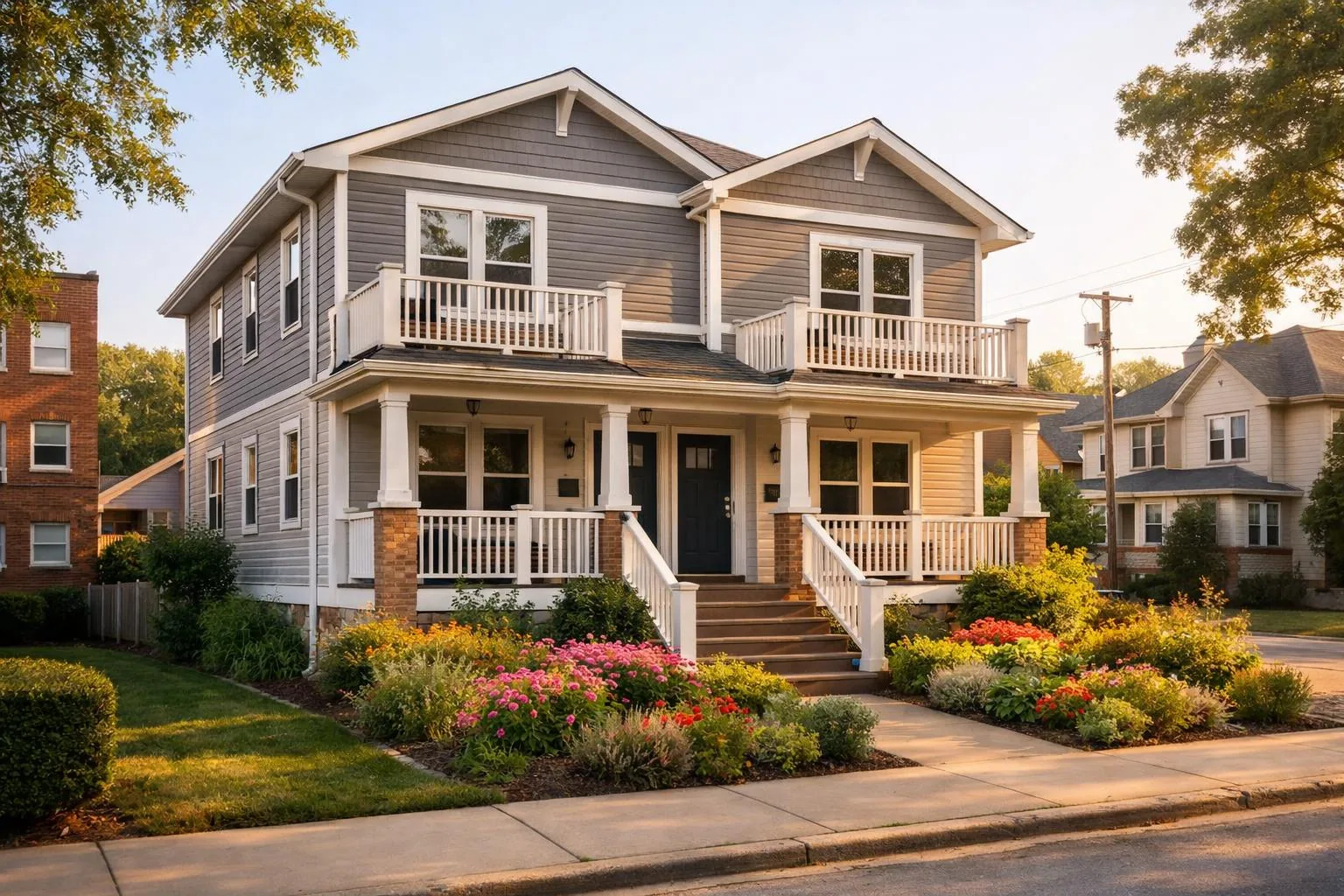
2-4 unit properties — duplexes, triplexes, and quadplexes — are the sweet spot for investors scaling from single-family rental into small multifamily without triggering commercial underwriting. Because 2-4 units are still classified as residential for Fannie/Freddie (and by extension, most DSCR loan lenders), they get residential appraisal forms, residential title, residential-style title insurance, and DSCR pricing only a few ticks higher than an SFR — a dramatically better economics profile than crossing into the 5+ unit commercial world.
Scenario & timing analysis: For a worked Cleveland triplex example and 2026 lender overlays, see DSCR on 2–4 units: worked scenario.
This guide is for investors targeting duplex through fourplex deals with a DSCR loan. The classification is clean, the lender pool is broad, and the qualification math is well-understood — but there are property-type-specific rules that catch new investors, especially around rent schedules, unit-mix scrutiny, and the prohibition on house-hacking. We cover all of it below.
Key DSCR parameters for 2-4 unit properties
| Parameter | Typical range (2026) | Best tier |
|---|---|---|
| Minimum DSCR | 0.85 – 1.00 | 1.20+ |
| Maximum LTV (purchase) | 75% – 80% | 80% |
| Maximum LTV (cash-out) | 70% – 75% | 75% |
| Minimum FICO | 660 – 700 | 740+ |
| Rate premium vs. SFR | +0.125% – +0.375% | — |
| Minimum loan amount | $100,000 – $150,000 | n/a |
| Maximum loan amount | $2M – $3.5M | n/a |
| Cash reserves required | 6 months PITI | 9 – 12 |
| Appraisal form | Form 1025 (Small Residential Income) | — |
| Appraisal cost | $1,500 – $3,500 | — |
The step-up from SFR to 2-4 unit is real but manageable. On the same borrower file, a typical investor sees roughly 5 points less LTV, about 10 DSCR points more required, and 0.125-0.375% more in rate. Appraisal cost roughly triples. In exchange you get 2-4x the cash flow, higher cap-rate entry, and economies of scale on management.
The 2-4 unit lender landscape
All the major SFR DSCR lenders also quote 2-4 units, typically as a secondary program tier. The pricing gap between lenders is wider on 2-4 units than on SFR — you should absolutely shop 3+ quotes.
Strong on 2-4 unit:
- Kiavi — Competitive on 2-4 unit at 75% LTV, 680 FICO floor, good on the 0.90 DSCR tier with modest rate add.
- Visio Lending — 2-4 unit is a core product line; strong on the 1.0 DSCR tier at 80% LTV.
- Lima One Capital — Offers 2-4 unit at 80% LTV on strong files; also does bridge-to-DSCR on 2-4 unit rehabs.
- LendingOne — 720+ FICO tier pricing is among the best; 80% LTV on qualifying files.
- CoreVest — Best for investors buying a fourplex as part of a portfolio blanket loan.
- Griffin Funding — No-ratio DSCR on 2-4 unit at 65-70% LTV; up to $5M loan amounts.
- Angel Oak — Flexible on foreign national 2-4 unit and on files with ITIN-only borrowers.
- New Silver — 30-year fixed 2-4 unit program, fast close, 700+ FICO for best pricing.
- Deephaven / Verus (broker channel) — Aggressive wholesale pricing on the 0.85-1.0 DSCR tier.
Where 2-4 units get harder: A handful of smaller DSCR lenders cap at 1-unit only or only accept 2-unit (skipping triplex/fourplex). Confirm unit eligibility in the first conversation. Quadplexes sometimes trigger extra reserve requirements (9-12 months PITI vs. 6) especially on loans above $1M.
Qualification details
- Entity vesting: LLC ownership is the standard; most lenders accept single-member and multi-member LLCs identically. Personal guarantee required.
- Landlord experience: Required by some lenders on 3-4 unit properties for first-time investors. Kiavi, Lima One, and Visio will close a first-time investor on a duplex without experience; fourplex is where experience requirements can appear.
- Reserves: 6 months PITI minimum; many lenders bump to 9-12 months on 3-4 unit loans over $1M.
- Short-term rental restrictions: Most lenders require that all 2-4 units operate as long-term rentals (or that STR income be backed out of DSCR). Mixed LTR/STR properties are accepted with underwriting overlays.
- Vacant units at close: If one unit is vacant, the 1025 appraiser’s market rent is used — you do NOT need all units leased before close.
- Delayed financing: Allowed by some lenders (Kiavi, Visio) on 2-4 units purchased with cash, up to purchase price, with documentation showing source of funds.
Appraisal and income verification
The 2-4 unit appraisal is the primary source of underwriting friction on this property type:
- Appraisal form: Form 1025 (Small Residential Income Property Appraisal). Includes unit-by-unit detail, individual rent comparables per unit type (1BR vs. 2BR, etc.), and gross rent multiplier (GRM) analysis.
- Cost: $1,500 – $3,500 typical. Rural, high-cost, or unusual configurations (e.g. a duplex with non-conforming in-law unit) can run $3,500 – $5,000.
- Turn time: 10 – 18 business days; faster in dense urban markets with heavy appraiser supply.
- Rent determination: For each unit, the underwriter uses the lower of actual lease or 1025 market rent. Blend across all units to get gross monthly rent; then apply the lender’s vacancy factor (usually baked into DSCR math at 100% occupancy with a reserve requirement offset).
- Unit mix scrutiny: If a fourplex is 3×1BR + 1×studio but the 1025 only provides 2BR comparables, underwriting will delay the file. Good appraisers source unit-type-matched comps.
- Short-term rental addendum: If any unit is operated as STR, the appraiser is typically asked to provide BOTH long-term market rent AND a note on STR activity. Lender decides which to use.
Rate and fee expectations
July 2026 ballparks on a clean 2-4 unit file (720+ FICO, 1.0 DSCR, 75% LTV, 5-year prepay):
- Duplex 30-year fixed: 6.50% – 7.50%
- Triplex 30-year fixed: 6.625% – 7.625%
- Fourplex 30-year fixed: 6.75% – 7.75%
- Interest-only 10-year intro: +0.125% – +0.25% over 30-year fixed
- Lender points/fees: 1.50 – 2.25 points
- Appraisal: $1,500 – $3,500
- Underwriting/processing: $1,500 – $2,250
- Title/settlement: $1,800 – $4,500
- Total closing costs (excluding down payment): 4.25% – 6.0% of loan amount
LTV pricing: Dropping from 80% LTV to 75% saves 0.25-0.375% in rate; dropping from 75% to 70% saves another 0.125-0.25%. Cash-out refinance adds 0.25% vs. rate/term at the same LTV.
Prepay structure: 5/4/3/2/1 prepayment penalty is standard; 3-year prepay typically adds 0.25%; no prepay adds 0.625-0.875%.
Common pitfalls on 2-4 unit DSCR loans
- Assuming SFR pricing: Investors who’ve done SFR deals often expect the same rate on a duplex. The 0.125-0.375% rate premium is real — rerun the DSCR math at the higher rate before committing.
- Unit-mix mismatch on the 1025: If appraiser comps are for 2BR/1BA units but your fourplex is 1BR/1BA, expect an underwriting delay while the appraiser sources matched comps. Flag this in the appraisal order.
- Non-conforming unit: A “duplex” with a mother-in-law unit (so 3 units, but only 2 on title) creates a tax-assessor vs. appraisal mismatch. Some lenders will decline outright; others will underwrite to legal unit count only, ignoring the non-conforming unit income entirely.
- Assumed leases: Existing leases that transfer with the property must be reviewed. Unusual clauses (lease options, below-market long-term leases, rent-controlled unit in a non-rent-controlled city) can surface in underwriting.
- House-hacking plans: If the LOI or contract has any language suggesting owner occupancy of any unit — DSCR lender will kick the file. DSCR is business-purpose only.
- Section 8 tenants: Accepted by most lenders, but the HAP contract must be provided and vouchered rent must match appraiser’s market rent (cannot be inflated above market).
- Self-managed declaration: Some lenders ask for a property management statement at close. If you self-manage, a signed self-management affidavit typically suffices.
- Small loan penalty: If the fourplex is in a low-cost market and the loan amount falls under $150K, pricing suffers and some lenders won’t touch it. Consider local bank/portfolio financing as an alternative.
Strategy notes
2-4 unit DSCR loans are the right tool when:
- You’re scaling from SFR into small multifamily and want to stay in residential underwriting (avoid commercial appraisal, commercial title, 5+ unit DSCR pricing).
- You’re buying a duplex/triplex/fourplex with 75-80% down payment ability and want 30-year fixed amortization.
- The property cash-flows at 1.0+ DSCR at 75% LTV.
- You’ve already maxed conventional Fannie/Freddie 10-property cap or need LLC vesting.
They’re the wrong tool when:
- You’ll live in any unit (use FHA/conventional owner-occupied instead).
- The property is 5+ units — that’s a commercial classification; see our 5-10 Unit Multifamily guide.
- DSCR falls below 0.85 even at 70% LTV and you can’t increase down payment — the deal likely doesn’t cash flow enough for this financing structure.
- You’re a first-time investor targeting a fourplex with no landlord experience — some lenders will decline; plan your lender shop accordingly.
Related tools
- Run the numbers on the DSCR Calculator
- Pre-qualify with the Qualification Estimator
- Today’s rates on the Rates page
- Lender side-by-side at Best DSCR Lenders
- Full eligibility checklist: DSCR Loan Requirements
- Closing cost breakdown: Closing Costs and Fees
Get 3+ matched quotes on your 2-4 unit deal. Get matched with DSCR lenders — 5 minutes, no credit pull.
Keep exploring
Hand-picked next steps — whether you want to go deeper on this topic, compare alternatives, or run the numbers.
Editor's picks
Hand-chosen follow-ups for this topic.
- Guide
What Is a DSCR Loan? The Complete 2026 Guide for Real Estate Investors
A DSCR loan qualifies a rental property on rental income ÷ PITIA — not personal income or tax returns. Full 2026 guide to ratios,…
- Property type
DSCR Loan for Single-Family Rental (SFR): 2026 Investor Guide
DSCR loan for single-family rentals in 2026: 80% LTV, 0.75+ DSCR, baseline pricing, and the exact SFR lender landscape to shop…
- Property type
DSCR Loan for 5-10 Unit Small Multifamily: Commercial Classification Guide
DSCR loans for 5-10 unit small multifamily in 2026: 70-75% LTV, 1.15-1.25 DSCR, commercial appraisal rules, and the specific…
- Loan type
DSCR Purchase Loan: Complete 2026 Guide for Investors
Everything real estate investors need to know about using a DSCR purchase loan — LTV limits, rent schedule requirements, closing…
Similar property types
How DSCR underwriting shifts when the asset class changes.
Loan products that fit this property type
- Loan type
DSCR Cash-Out Refinance: 2026 Playbook for Investors
DSCR cash-out refinance 2026: LTV limits, seasoning rules, tax impact, delayed financing, and when the math actually pencils —…
- Loan type
DSCR Rate-and-Term Refinance: Can You Refinance a DSCR Loan? (2026)
Yes — you can refinance a DSCR loan with rate-and-term or cash-out. Seasoning (often 3–6 months), LTV, DSCR floors, PPP costs,…
Popular states for this asset
- State guide
DSCR Loans in Florida
Complete 2026 guide to DSCR loans in Florida — rates, insurance crisis impact, condo rules, Miami/Orlando/Tampa markets, and the…
- State guide
DSCR Loans in Texas
Complete 2026 guide to DSCR loans in Texas — no state income tax, no prepayment penalties on 1-4 units, fast foreclosure, and the…
- State guide
DSCR Loans in California
Complete 2026 guide to DSCR loans in California — AB1482 rent control, Prop 13 reassessment, $800 LLC tax, LA/SF/San Diego…
- State guide
DSCR Loans in Georgia
Complete 2026 guide to DSCR loans in Georgia — PPP prohibition on 1-4 units, fast non-judicial foreclosure, Atlanta/Savannah…
Run the numbers
Free interactive tools to stress-test your deal.
- Interactive tool
DSCR Ratio Calculator
Calculate your DSCR in seconds and see pass/fail by lender tier.
- Interactive tool
DSCR Qualification Estimator
Estimate your rate range, LTV cap, and approval odds before you apply.
- Live rates
Today's DSCR Loan Rates
Live DSCR rate ranges by credit tier, LTV, and product type.
- Resource
Best DSCR Lenders of 2026
Head-to-head shortlist of the leading DSCR lenders with program details.
Finance This Asset Type With DSCR
Overlays change for SFR, 2–4, multifamily, and condo. Run the ratio, then get matched.
Shop every major DSCR lender in 60 seconds
Tell us about your deal once. We'll send you the top 3 lender offers within the hour.
Soft match — no credit pull, no spam. Your info stays with licensed brokers only.