Property-type guide
DSCR Loans for Mixed-Use Properties
DSCR loan for mixed-use property in 2026: 65-75% LTV, 1.20+ DSCR, the 50% residential rule, zoning verification, and the lender shortlist that actually funds.
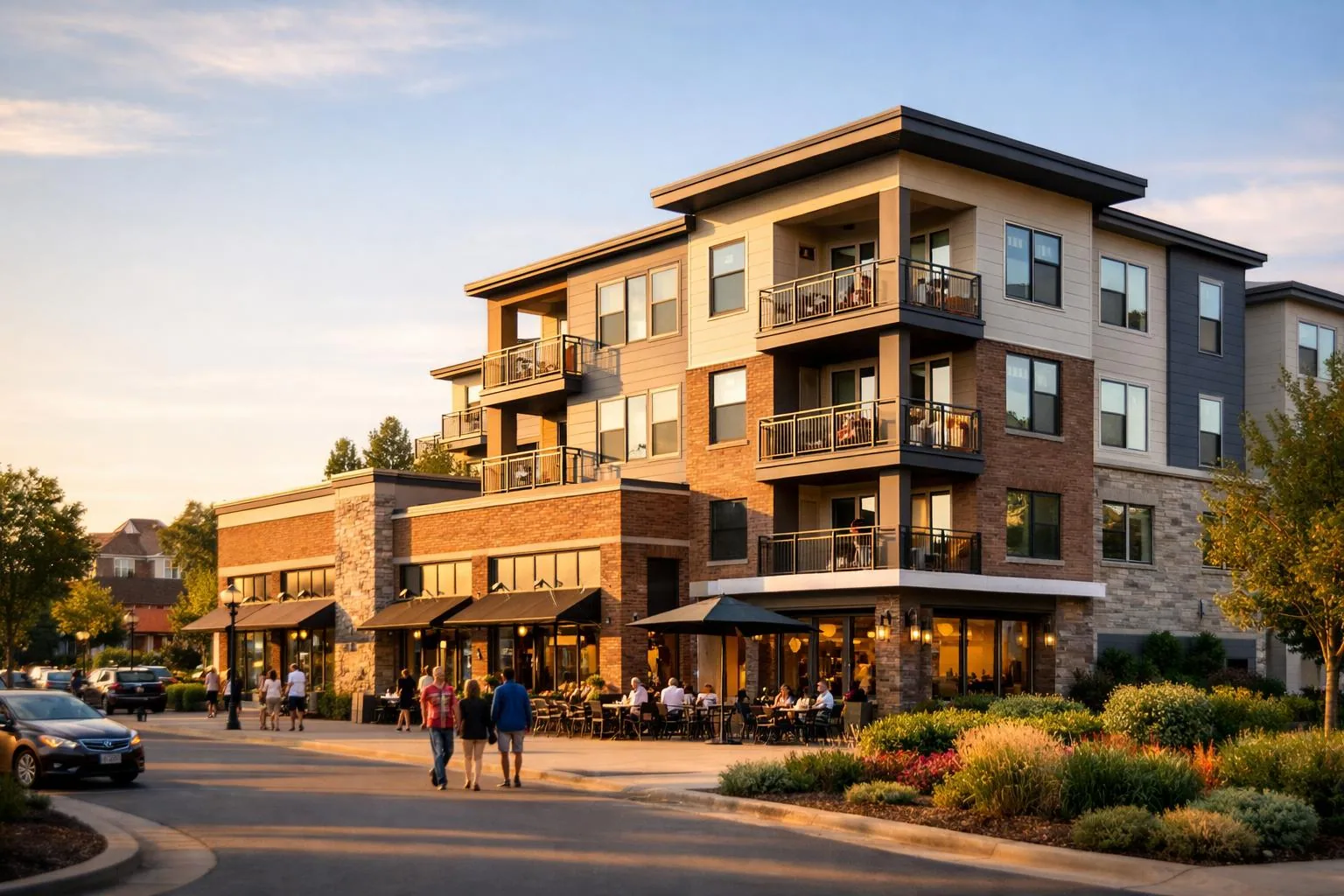
Mixed-use is the hybrid property type that trips up most DSCR loan conversations. It’s not quite residential, it’s not quite commercial, and the financing rules reflect that — you get commercial appraisal treatment (cost, timeline, complexity) with DSCR-style loan structure (30-year fixed, 5/4/3/2/1 prepayment penalty, LLC vesting). When it works, mixed-use is a high-yield property class with stable residential income stabilized by upside commercial rent; when financing fails, it’s usually because the property trips a zoning, environmental, or residential-percentage disqualifier.
This guide is for investors acquiring or refinancing mixed-use properties — the classic main-street storefront with apartments above, the live-work loft, or the restored historic commercial building with residential conversion. We cover the specific DSCR programs that accept mixed-use, the thresholds that make or break underwriting, and the mistakes that consistently slow or kill files.
Key DSCR parameters for mixed-use
| Parameter | Typical range (2026) | Best tier |
|---|---|---|
| Minimum DSCR | 1.20 – 1.25 | 1.35+ |
| Maximum LTV (purchase) | 65% – 75% | 75% |
| Maximum LTV (cash-out) | 60% – 65% | 65% |
| Minimum FICO | 680 – 720 | 740+ |
| Rate premium vs. SFR | +0.75% – +1.25% | — |
| Minimum residential % | 50% of sqft or income | 60%+ |
| Minimum loan amount | $250,000 | n/a |
| Maximum loan amount | $2M – $7.5M | n/a |
| Cash reserves required | 6 – 12 months PITI | 12+ |
| Appraisal type | Commercial (residential + commercial income) | — |
| Appraisal cost | $3,500 – $8,500 | — |
The headline item: mixed-use trades meaningfully worse on every parameter than an SFR. You get 5-15 points less LTV, 25-50 DSCR points more required, 0.75-1.25% more in rate, and appraisal costs that run 5-10x SFR. In exchange, mixed-use properties often carry higher cash-on-cash yields because of the commercial rent premium — so the model can still work, just with a tighter equity requirement and a longer close.
The mixed-use DSCR lender landscape
Mixed-use is a niche product; maybe 30-40% of the DSCR lender universe will quote it. The active national players:
- Kiavi — Mixed-use accepted up to 75% LTV on qualifying files; residential must be 50%+ of income and sqft.
- Griffin Funding — Mixed-use accepted as part of their commercial DSCR line; 65-70% LTV, up to $15M loan size on strong files.
- Lima One Capital — Quotes mixed-use 5+ unit with 50%+ residential; also offers bridge-to-DSCR for value-add mixed-use acquisitions.
- Visio Lending (CoreGrowth program) — Mixed-use accepted 70% LTV, 1.20 DSCR.
- CoreVest — Strong on mixed-use for investors with 3+ similar properties; portfolio blankets possible.
- Ready Capital — Small-balance commercial with mixed-use capability; competitive on sub-$2M loans.
- Verus / Deephaven / Acra (wholesale) — Mixed-use available through broker channel; program specifics vary.
Where mixed-use breaks: Most retail-DSCR lenders (New Silver, LendingOne, Angel Oak SFR product) don’t touch mixed-use. Don’t waste time pitching mixed-use to an SFR-only lender — confirm program fit first.
Qualification details
- Residential percentage test: The threshold question. Lenders use one of three measures: (a) residential sqft / total sqft, (b) residential gross rent / total gross rent, (c) both must be 50%+. Pull the rent roll and appraiser’s sqft allocation BEFORE submitting the file.
- Zoning documentation: Certificate of occupancy showing mixed-use permitted, or zoning letter from the municipality confirming legal use. Non-conforming/grandfathered uses require documentation of rebuild rights.
- Entity ownership: LLC/SPE standard. Commercial-grade DSCR typically requires single-purpose entity for the asset.
- Landlord experience: 2-3 years of residential rental ownership typical; some lenders require prior commercial tenant management experience for larger deals.
- Reserves: 6-12 months PITI; higher (12+) for loans >$1.5M or for properties with single commercial tenant representing >40% of income.
- Personal guarantee: Required on essentially every mixed-use DSCR program.
- Tenant lease review: Commercial leases must be disclosed with rent, expiration date, any options/kick-out clauses, and NNN structure. Underwriter often caps credit to lease for DSCR calculation (e.g. if lease expires in 18 months, underwriter may underwrite only to the current lease term).
Appraisal and income verification
The mixed-use appraisal is the slowest and most expensive part of the process:
- Type: Commercial narrative appraisal with both residential (direct cap on residential units) and commercial (direct cap on commercial NOI) approaches; then reconciled.
- Cost: $3,500 – $8,500, with $5,000 – $6,500 most common for a storefront-plus-2-4-apartment configuration.
- Turn time: 3 – 5 weeks typical.
- Environmental screen: Almost always required. Phase I if any commercial tenant is environmentally sensitive (gas, dry clean, auto, etc.) or if building history includes such uses. $1,800 – $3,500 for Phase I.
- Zoning verification: Zoning letter from municipality + CO. Some markets charge for expedited zoning letters; budget $150 – $750.
- Income determination: Residential units use market rent (1007-style comparables or direct cap); commercial units use the actual lease rent if in place, or market rent if vacant (with underwriter-applied vacancy haircut).
- Commercial vacancy treatment: Typical lender applies 10-20% vacancy factor to commercial pro forma income unless a long-term stable lease is in place.
Rate and fee expectations
July 2026 ballparks on a clean mixed-use file (720+ FICO, 1.25 DSCR, 70% LTV, 5-year prepay, 50%+ residential):
- Mixed-use 30-year fixed: 7.25% – 8.125%
- 5/6 ARM: 6.875% – 7.75%
- 10-year I/O intro: +0.125% – +0.25% over 30-year fixed
- Lender points: 1.50 – 2.50 points
- Appraisal: $5,000 – $6,500
- Phase I (if required): $1,800 – $3,500
- Commercial title: $3,000 – $7,500
- Survey: $1,500 – $3,000
- Zoning letter + CO: $150 – $750
- Legal / loan doc prep: $2,500 – $5,500
- Total closing costs (excluding down payment): 5.5% – 7.5% of loan amount
Common pitfalls on mixed-use DSCR loans
- Failing the 50% residential test. A property that’s 55% commercial sqft — even if residential rent is higher — can disqualify. Run the math both ways before going under contract.
- Illegal residential conversion. Buildings where an office or retail space was converted to an apartment without permits (common in older urban infill) are uninsurable and non-financeable. Verify CO matches actual use.
- Short-term commercial lease. Underwriter may only credit the lease to its current term. If the commercial tenant has 14 months left, underwriting can ignore anything beyond 14 months — killing pro forma DSCR.
- Environmental flag on commercial tenant. A current dry-cleaner tenant or historic gas station use = Phase I ESA mandatory, and Phase II recommendation likely. Can add 4-6 weeks and kill the deal.
- Triple-net (NNN) vs. gross lease confusion. A $2,500/mo NNN lease isn’t the same as $2,500/mo gross — in NNN the tenant pays taxes/insurance/CAM on top. Underwriter will normalize.
- Seller-financed ground-floor tenant. If the seller IS the commercial tenant under a below-market sale-leaseback, underwriter may require the lease to be re-underwritten at market rent.
- Non-conforming legal use. Zoning change means property can’t be rebuilt as-is after a total loss. Some lenders decline; most require clear rebuild-rights documentation or higher insurance (law-and-ordinance coverage).
- Underwriting as pure residential. Some borrowers try to pitch a mixed-use building to an SFR-DSCR lender as “just an investment property.” Underwriting will catch this at appraisal. Don’t waste the appraisal fee — disclose mixed-use upfront.
Strategy notes
Mixed-use DSCR loans are the right tool when:
- You’re acquiring a classic main-street storefront with apartments above and both components are legally zoned, permitted, and operating.
- Residential component is 50%+ of sqft and/or gross income.
- Commercial tenant is stable (3+ years remaining on lease, non-problematic use, performing).
- You have 25-35% down payment and 6-12 months reserves.
- DSCR pencils at 1.25+ at 70% LTV, giving margin for commercial vacancy.
They’re the wrong tool when:
- Residential component is less than 50% — you need a small-balance commercial loan instead.
- Commercial use is environmentally sensitive (gas, auto, dry clean) or legally restricted (cannabis in legal states — still declined by most DSCR lenders).
- Commercial tenant is month-to-month or has less than 12 months remaining — pro forma DSCR will underwrite below threshold.
- Residential units are unpermitted conversions — insurability and financeability both fail.
- You need a 45-day close — timeline is 60-75 days realistic.
Related tools
- Run mixed-use DSCR on the DSCR Calculator
- Quick eligibility check on the Qualification Estimator
- Today’s rate environment on Rates
- Lender comparison at Best DSCR Lenders
- Foundational: What Is a DSCR Loan
- Eligibility deep-dive: DSCR Loan Requirements
- Fee breakdown: Closing Costs and Fees
Mixed-use is a specialist product — most DSCR lenders decline it. Get matched with DSCR lenders to surface only the programs that actually fund mixed-use.
Keep exploring
Hand-picked next steps — whether you want to go deeper on this topic, compare alternatives, or run the numbers.
Editor's picks
Hand-chosen follow-ups for this topic.
- Guide
What Is a DSCR Loan? The Complete 2026 Guide for Real Estate Investors
A DSCR loan qualifies a rental property on rental income ÷ PITIA — not personal income or tax returns. Full 2026 guide to ratios,…
- Property type
DSCR Loan for 5-10 Unit Small Multifamily: Commercial Classification Guide
DSCR loans for 5-10 unit small multifamily in 2026: 70-75% LTV, 1.15-1.25 DSCR, commercial appraisal rules, and the specific…
- Property type
DSCR Loan for 2-4 Unit Properties: Duplex, Triplex & Quadplex Guide
DSCR loans for 2-4 unit properties in 2026: 75-80% LTV, 0.85-1.0 DSCR minimums, and the duplex, triplex, and fourplex lender…
- Comparison
DSCR vs Commercial Loan: 2026 Guide for Multifamily & Mixed-Use Investors
DSCR vs commercial 2026: DSCR wins 1-10 unit residential with 30-year fixed, no balloon. Commercial wins 10+ units, non-recourse,…
Similar property types
How DSCR underwriting shifts when the asset class changes.
Loan products that fit this property type
- Loan type
DSCR Purchase Loan: Complete 2026 Guide for Investors
Everything real estate investors need to know about using a DSCR purchase loan — LTV limits, rent schedule requirements, closing…
- Loan type
DSCR Cash-Out Refinance: 2026 Playbook for Investors
DSCR cash-out refinance 2026: LTV limits, seasoning rules, tax impact, delayed financing, and when the math actually pencils —…
- Loan type
DSCR Rate-and-Term Refinance: Can You Refinance a DSCR Loan? (2026)
Yes — you can refinance a DSCR loan with rate-and-term or cash-out. Seasoning (often 3–6 months), LTV, DSCR floors, PPP costs,…
Popular states for this asset
- State guide
DSCR Loans in Florida
Complete 2026 guide to DSCR loans in Florida — rates, insurance crisis impact, condo rules, Miami/Orlando/Tampa markets, and the…
- State guide
DSCR Loans in Texas
Complete 2026 guide to DSCR loans in Texas — no state income tax, no prepayment penalties on 1-4 units, fast foreclosure, and the…
- State guide
DSCR Loans in California
Complete 2026 guide to DSCR loans in California — AB1482 rent control, Prop 13 reassessment, $800 LLC tax, LA/SF/San Diego…
- State guide
DSCR Loans in Georgia
Complete 2026 guide to DSCR loans in Georgia — PPP prohibition on 1-4 units, fast non-judicial foreclosure, Atlanta/Savannah…
Run the numbers
Free interactive tools to stress-test your deal.
- Interactive tool
DSCR Ratio Calculator
Calculate your DSCR in seconds and see pass/fail by lender tier.
- Interactive tool
DSCR Qualification Estimator
Estimate your rate range, LTV cap, and approval odds before you apply.
- Live rates
Today's DSCR Loan Rates
Live DSCR rate ranges by credit tier, LTV, and product type.
- Resource
Best DSCR Lenders of 2026
Head-to-head shortlist of the leading DSCR lenders with program details.
Finance This Asset Type With DSCR
Overlays change for SFR, 2–4, multifamily, and condo. Run the ratio, then get matched.
Shop every major DSCR lender in 60 seconds
Tell us about your deal once. We'll send you the top 3 lender offers within the hour.
Soft match — no credit pull, no spam. Your info stays with licensed brokers only.