State guide · FL
DSCR Loans in Florida: 2026 Investor's Guide
Complete 2026 guide to DSCR loans in Florida — rates, insurance crisis impact, condo rules, Miami/Orlando/Tampa markets, and the fastest path to pre-approval.
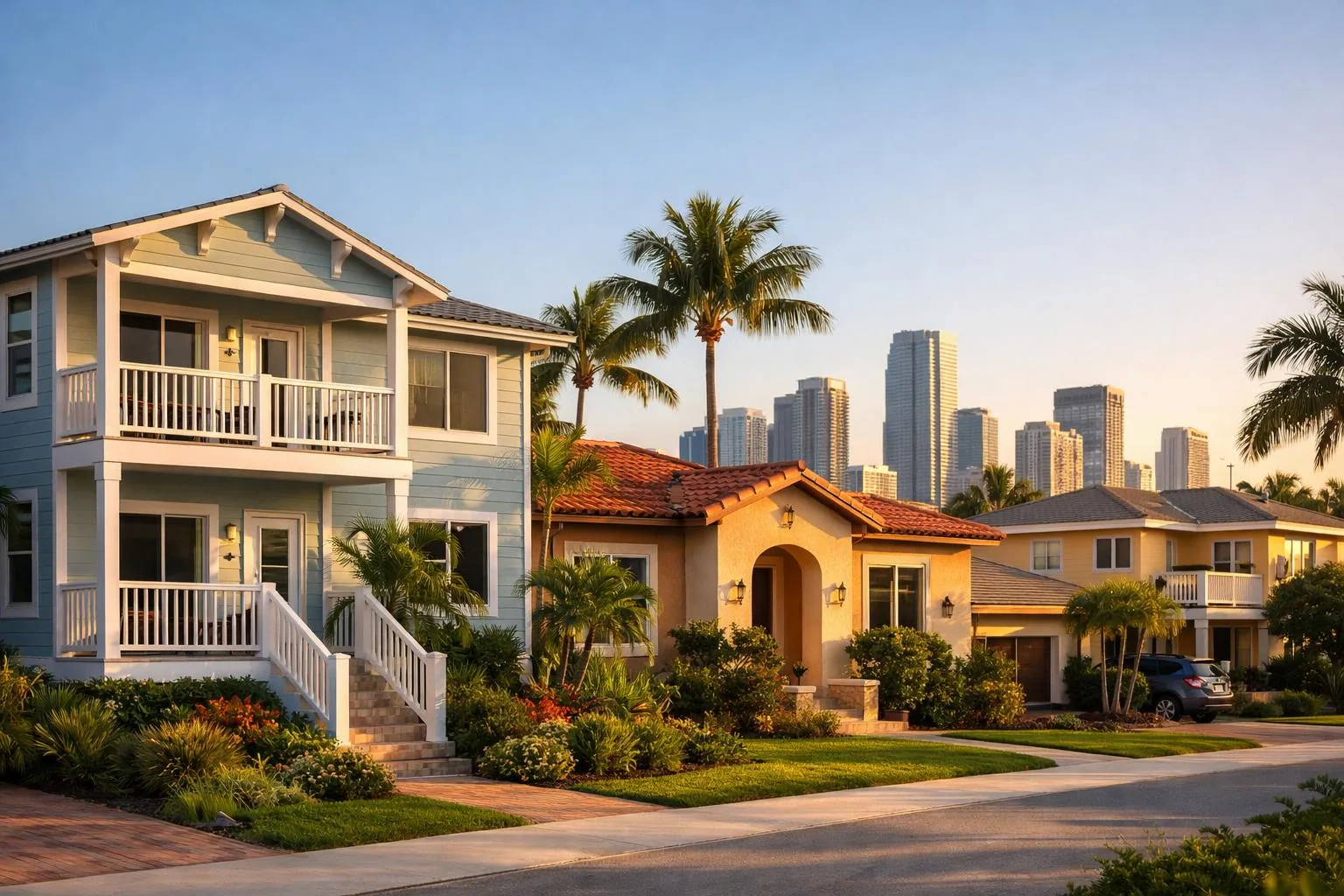
A DSCR loan in Florida is an investment-property mortgage qualified on rental income, offered in one of the nation’s highest-volume DSCR markets — with no state income tax but elevated insurance costs and condo underwriting rules that differ from most states.
Florida runs one of the country’s largest rental-property economies — net in-migration and tourism-driven short-term-rental demand make it a permanent priority market for DSCR lenders. The trade-offs are the 2020s insurance crisis and post-Champlain Towers condo underwriting, which differ sharply from most states.
Scenario & timing analysis: For insurance/STR market updates and lender appetite shifts in 2026, see DSCR loans in Florida: STR, insurance & lender appetite.
This guide covers what DSCR loans look like in Florida in 2026: who lends, what the state’s tax and legal environment does to your returns, which metros are driving the investor flow, and the specific local quirks — condo litigation reviews, Citizens Property Insurance, hurricane deductibles, condotel underwriting — that separate a smooth Florida close from one that falls apart in week 4.
Why Investors Choose Florida
Florida adds roughly 800-1,000 new residents per day. The state has no personal income tax, no estate tax, and a constitutional property-tax cap (Save Our Homes) that softens owner-occupied reassessment — though investor-owned property does not receive that cap and is reassessed to market at sale. Job growth in Tampa, Orlando, and Jacksonville has been concentrated in healthcare, logistics, and financial services relocation. Miami has become the country’s largest cash-buyer market: according to the Miami Association of Realtors, roughly 38.5% of Miami-Dade residential transactions in 2024 closed all-cash, which tells you how competitive an investor with a 30-day DSCR close needs to be.
Rental demand is pressurized on both sides: the short-term-rental economy (Orlando theme-park corridor, Miami Beach, Panhandle beaches, Gatlinburg-style mountain towns like Ocala) plus a permanent long-term population of retirees, medical staff, and service workers priced out of ownership.
DSCR Loan Rules in Florida
Florida has no state licensing carve-out that excludes a DSCR lender — any lender licensed under the Florida Office of Financial Regulation for business-purpose loans can fund here. Florida does not prohibit prepayment penalties on 1-4 unit investment property, so the industry-standard 5/4/3/2/1 step-down PPP is fully available and frequently required to access the best rate tier. If you want a reduced-PPP or no-PPP structure, expect a 0.25%-0.75% rate pickup.
STR regulation update. SB 280 — the 2024 effort to centralize short-term-rental regulation at the state level and preempt many local rules — was vetoed by Governor DeSantis in June 2024. As of July 2026, Florida’s vacation-rental landscape remains a patchwork of local ordinances under the 2011 partial-preemption framework. Underwrite to the specific city/county STR rules for your deal.
There is no state-specific DSCR minimum, but Florida lenders often tighten coverage on coastal properties — a 1.00 DSCR file in Tampa might price the same as a 1.15 DSCR file 30 miles inland because the insurance line item is so much larger.
| Typical Florida DSCR Terms, 2026 | Range |
|---|---|
| Minimum DSCR | 0.75 - 1.25 |
| Max LTV (purchase) | 75% - 80% |
| Max LTV (cash-out refi) | 70% - 75% |
| Minimum FICO | 620 - 680 |
| Prepayment penalty | 5/4/3/2/1 standard (optional buy-downs) |
| Short-term rental allowed | Yes, with 12mo AirDNA/platform statements |
Taxes & Carrying Costs
No state income tax. That is the headline. Your rental LLC’s profits flow through to your federal return and Florida keeps nothing extra.
Property tax is moderate at an effective rate of roughly 0.89% statewide, but there is enormous county variation — Miami-Dade, Broward, and Palm Beach run above 1.0% effective, while Collier and some Panhandle counties run below 0.70%. Investor-owned property is reassessed to full market value at sale; plan for the Year 1 tax bill to jump 30-50% off the prior owner’s basis.
Florida LLC fees. $125 to form, $138.75 annual report. Cheap, fast, and no state franchise tax on the LLC itself.
The insurance line is now the dominant carrying cost on any Florida DSCR file. In 2024, 15+ carriers stopped writing new Florida policies or exited the state; State Farm and Farmers made material pullbacks; Citizens Property Insurance (the state-run insurer of last resort) ballooned to 1.2M+ policies. Premium on a $400K coastal SFR commonly runs $4,500-$8,000/yr; condos with windstorm exposure can be higher. Lenders pull a live quote during underwriting — you cannot qualify against the seller’s old premium.
Foreclosure & Eviction Landscape
Florida is a judicial foreclosure state, meaning the lender must file and prosecute a lawsuit. The typical foreclosure runs 8-14 months uncontested; contested files stretch to 18-24. That is considered middle-of-pack nationally and is already priced into Florida DSCR rate sheets.
Eviction is faster. Florida Statute 83 allows a 3-day notice for non-payment of rent (excluding weekends/holidays), followed by a 5-day summons period if the tenant answers. A cooperative county clerk and unopposed tenant can get a writ of possession in 15-30 days. That fast eviction clock is a real advantage over New York or California.
Landlord-Tenant Law
No statewide rent control. Florida law (Fla. Stat. 125.0103 and 166.043) preempts municipal rent control except in a declared housing emergency. Orange County’s 2022 ballot attempt was struck down. There are no statewide security deposit caps beyond statutory interest/segregation rules. Lease terms, late fees, and renewal policies are near-fully freedom-of-contract.
Notice to terminate a month-to-month tenancy is 15 days. Notice for non-payment is 3 days. Notice to cure a lease violation is 7 days. These are among the landlord-friendliest clocks in the country.
Top Florida Markets
Miami-Dade. The state’s deepest and most-cash-intensive market — 38.5% of 2024 transactions closed all-cash. Brickell and Edgewater condos, Little Havana and Allapattah duplexes, and the Miami Beach STR market anchor investor flow. Insurance and condo-review friction is highest here. Miami’s rental vacancy is approximately 4.9% — the tightest of Florida’s major metros — reflecting persistent demand and limited affordable supply despite broader state-level softness.
Orlando. The theme-park corridor and Lake Buena Vista submarkets drive the nation’s largest vacation-home STR economy. Kissimmee’s Reunion, Solara, and Champions Gate communities are purpose-built for DSCR STR files. Also a strong long-term market on the back of Medical City and Lake Nona.
Tampa Bay. Job-growth leader in the state — healthcare, logistics, defense. South Tampa and St. Petersburg SFR, New Tampa and Wesley Chapel BRRRR, and Ybor/Seminole Heights duplex conversions all feed DSCR pipelines. Post-Hurricane Helene/Milton (Oct 2024), insurance underwriting on flood-zone Pinellas properties has tightened significantly. Tampa’s multifamily rental vacancy reached approximately 10.7% in Q1 2026 — elevated due to a surge of new apartment supply combined with hurricane-related displacement and slow lease-up; underwrite conservatively on stabilized occupancy.
Jacksonville. Lowest price points of the four majors, strong cash-flow market in the state. Port-driven employment, a deep Navy footprint, and aggressive BRRRR volume in Arlington and Westside ZIPs. Vacancy is moderating — running approximately 8.8% in Q1 2026 and trending year-over-year improvement as supply normalizes.
Sarasota / Fort Myers. Retirement and seasonal demand; higher insurance costs after Hurricane Ian; strong long-term appreciation.
Special Considerations
The condo review gauntlet. After the Surfside/Champlain Towers collapse in 2021, Florida enacted SB 4-D requiring structural inspections at 25/30 years and fully-funded reserve studies for buildings 3+ stories. DSCR lenders now require a Form 1076 plus the current reserve study, the last two years of board minutes, and any pending litigation schedule before clearing a condo. Plan for 2-4 extra weeks on any condo file. Projects that have not completed mandatory milestone inspections are increasingly uninsurable and unfinanceable.
Condotel underwriting. Condotels (Miami Beach oceanfronts, Kissimmee theme-park condos, Panama City Beach towers) are a distinct asset class. Not every lender funds them. Those that do — Easy Street Capital, Visio, select private capital — typically cap LTV at 65%-70% and require the project’s rental-pool agreement plus an AirDNA revenue study.
Hurricane season stress-testing. Coastal counties require hurricane/windstorm coverage as a separate line on the policy with its own deductible (often 2%-10% of dwelling value). Your DSCR calculation has to include the full stacked premium.
FEMA/flood compliance. If the property is in Flood Zone A, AE, V, or VE, flood insurance is required by every DSCR lender. Many Florida properties quietly sit in mapped zones — always pull a FEMA zone determination before you sign the contract.
Entity Formation
Florida is one of the cleanest states in the country to form your holding LLC in. Filing is online through Sunbiz, $125 to form, $138.75 annual report, no state franchise tax, and member privacy is reasonable (manager names are public, member names generally are not required on the formation document). Most Florida investors form directly in Florida rather than using a Wyoming or Delaware parent — the structure is already competitive and the foreign-qualification overhead is avoided.
If you want anonymity, the common structure is a Wyoming holding LLC that owns a Florida operating LLC that holds title. Your Florida LLC’s manager can be the Wyoming holding LLC. See our entity-structure guide for the full walkthrough.
How to Get Started
Florida is a commodity DSCR market — the rate spread between a smart-match lender and the wrong one is routinely 0.50%-1.25%, and the difference is rarely visible on a generic rate sheet. Our free matching tool at /get-matched sends your scenario to Florida-active lenders that fit your fingerprint (condo vs. SFR vs. condotel, coastal vs. inland, STR vs. long-term) and returns term sheets typically within 48 hours.
Start with the DSCR calculator to sanity-check your ratio, then the qualification estimator to see your likely LTV band. Investors building a multi-state portfolio often pair Florida with Texas, Georgia, or Tennessee for geographic diversification.
Keep exploring
Hand-picked next steps — whether you want to go deeper on this topic, compare alternatives, or run the numbers.
Editor's picks
Hand-chosen follow-ups for this topic.
- Guide
What Is a DSCR Loan? The Complete 2026 Guide for Real Estate Investors
A DSCR loan qualifies a rental property on rental income ÷ PITIA — not personal income or tax returns. Full 2026 guide to ratios,…
- Guide
DSCR Loan LLC Guide: Entity Structure, Vesting & Personal Guarantees
DSCR loan LLC guide: single-member, multi-member, S-Corp, trusts, personal guarantees, state selection, and lender requirements —…
- Property type
DSCR Loan for Airbnb & Short-Term Rentals: 2026 Complete Guide
DSCR loan for Airbnb and short-term rentals in 2026: AirDNA underwriting, 20% income haircut, STR lender shortlist, and every…
- Property type
DSCR Loan for Non-Warrantable Condos & Condotels: Lender List & Pricing
DSCR loan for non-warrantable condos and condotels in 2026: 65-70% LTV, 1.20+ DSCR, and the specialist lender pool for Miami,…
- Investor profile
Foreign National DSCR Loan Guide: US Rental Property Financing for Non-Residents
2026 DSCR guide for foreign nationals: qualify without US credit, specialist lenders, 65-75% LTV, US LLC setup, FIRPTA, and the…
Compare other states
DSCR rules, rates, and tax posture in similar markets.
- State guide
DSCR Loans in Arizona
Complete 2026 guide to DSCR loans in Arizona — Phoenix, Scottsdale, Tucson markets, fast non-judicial foreclosure, low property…
- State guide
DSCR Loans in Georgia
Complete 2026 guide to DSCR loans in Georgia — PPP prohibition on 1-4 units, fast non-judicial foreclosure, Atlanta/Savannah…
- State guide
DSCR Loans in North Carolina
Complete 2026 guide to DSCR loans in North Carolina — Charlotte, Raleigh, Asheville markets, non-judicial foreclosure, and the…
- State guide
DSCR Loans in Texas
Complete 2026 guide to DSCR loans in Texas — no state income tax, no prepayment penalties on 1-4 units, fast foreclosure, and the…
DSCR loan products for your next deal
The financing structures investors use most in this market.
- Loan type
DSCR Purchase Loan: Complete 2026 Guide for Investors
Everything real estate investors need to know about using a DSCR purchase loan — LTV limits, rent schedule requirements, closing…
- Loan type
DSCR Cash-Out Refinance: 2026 Playbook for Investors
DSCR cash-out refinance 2026: LTV limits, seasoning rules, tax impact, delayed financing, and when the math actually pencils —…
- Loan type
DSCR Rate-and-Term Refinance: Can You Refinance a DSCR Loan? (2026)
Yes — you can refinance a DSCR loan with rate-and-term or cash-out. Seasoning (often 3–6 months), LTV, DSCR floors, PPP costs,…
Property types investors finance here
- Property type
DSCR Loan for Single-Family Rental (SFR): 2026 Investor Guide
DSCR loan for single-family rentals in 2026: 80% LTV, 0.75+ DSCR, baseline pricing, and the exact SFR lender landscape to shop…
- Property type
DSCR Loan for 2-4 Unit Properties: Duplex, Triplex & Quadplex Guide
DSCR loans for 2-4 unit properties in 2026: 75-80% LTV, 0.85-1.0 DSCR minimums, and the duplex, triplex, and fourplex lender…
Run the numbers
Free interactive tools to stress-test your deal.
- Interactive tool
DSCR Ratio Calculator
Calculate your DSCR in seconds and see pass/fail by lender tier.
- Interactive tool
DSCR Qualification Estimator
Estimate your rate range, LTV cap, and approval odds before you apply.
- Live rates
Today's DSCR Loan Rates
Live DSCR rate ranges by credit tier, LTV, and product type.
- Interactive tool
Short-Term Rental DSCR Analyzer
Run Airbnb income through lender STR haircuts with LTR fallback.
Is There a DSCR Lender in This Market?
Coverage, foreclosure timelines, and local overlays decide whether the deal funds. Get matched now.
Shop every major DSCR lender in 60 seconds
Tell us about your deal once. We'll send you the top 3 lender offers within the hour.
Soft match — no credit pull, no spam. Your info stays with licensed brokers only.