Property-type guide
DSCR Loans for 5-10 Unit Small Multifamily Properties
DSCR loans for 5-10 unit small multifamily in 2026: 70-75% LTV, 1.15-1.25 DSCR, commercial appraisal rules, and the specific programs that fund up to $20M.
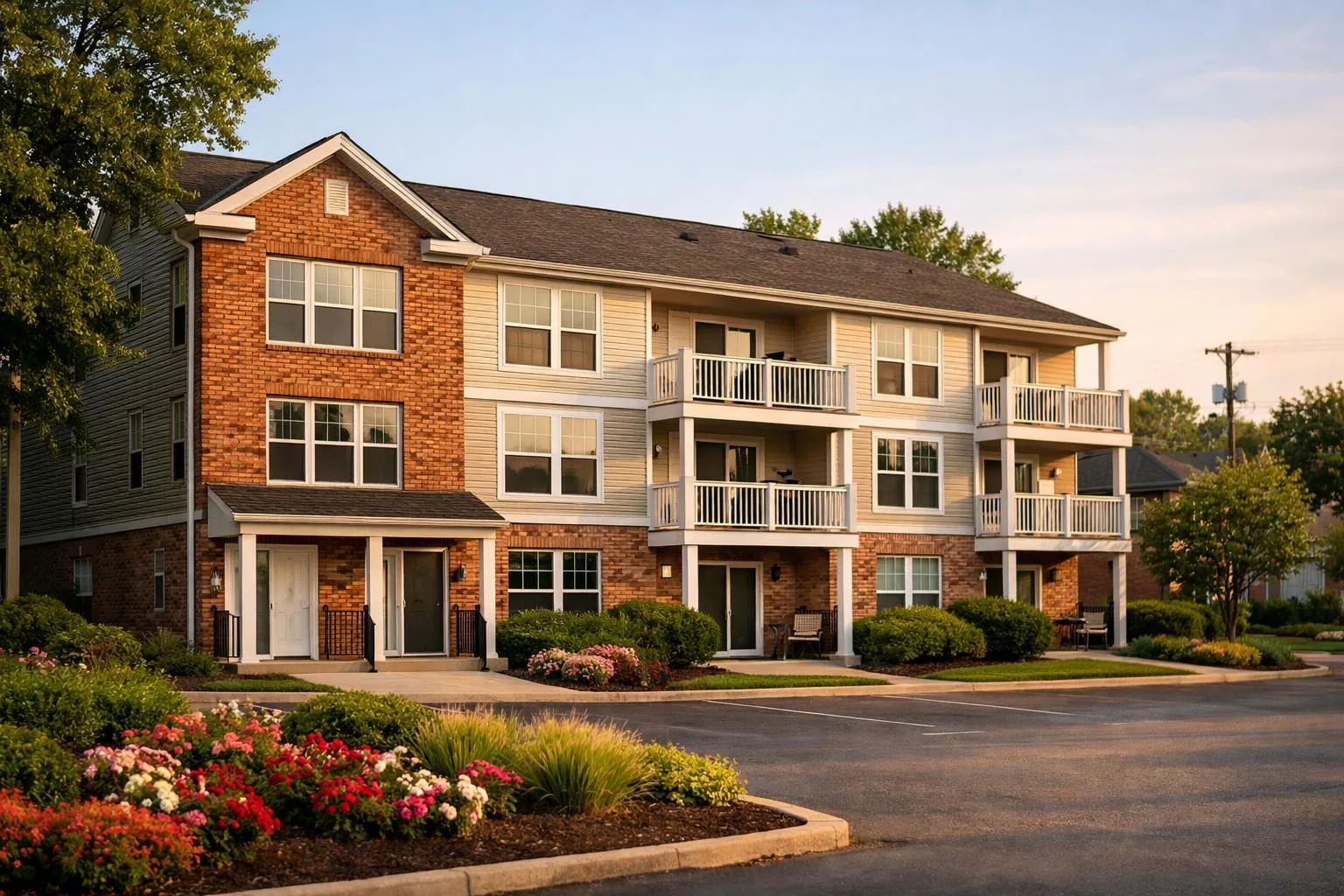
Small multifamily — 5 to 10 units — is where investors cross from residential into commercial financing. The property type doesn’t look much different from a fourplex on paper, but the underwriting apparatus changes dramatically: commercial appraisal, income-based valuation, environmental screens, stricter DSCR floors, and a smaller but more specialized lender pool. Done right, the economics are excellent — 5-10 unit small multifamily trades at higher cap rates than institutional-sized assets and commands meaningful NOI per door. Done wrong (or financed wrong), the higher closing costs and slower timeline eat into the thesis.
This guide is written for investors evaluating or acquiring 5-10 unit small multifamily properties with DSCR financing. We cover the commercial DSCR programs that actually fund this product, the key underwriting overlays that differ from residential DSCR, and the common mistakes that slip files into the “no-bid” pile.
Key DSCR parameters for 5-10 unit multifamily
| Parameter | Typical range (2026) | Best tier |
|---|---|---|
| Minimum DSCR | 1.15 – 1.25 | 1.35+ |
| Maximum LTV (purchase) | 70% – 75% | 75% |
| Maximum LTV (cash-out) | 65% – 70% | 70% |
| Minimum FICO | 680 – 720 | 740+ |
| Rate premium vs. SFR | +0.50% – +1.00% | — |
| Minimum loan amount | $250,000 – $500,000 | n/a |
| Maximum loan amount | $3M – $20M | n/a |
| Cash reserves required | 6 – 12 months PITI | 12+ |
| Appraisal type | Commercial narrative (income + sales + cost) | — |
| Appraisal cost | $3,000 – $10,000 | — |
| Phase I ESA | Case-by-case; $1,800 – $3,500 if required | — |
| Amortization options | 30-year fixed, 5/6 ARM, 7/6 ARM, 10-year I/O | — |
Two things to internalize: (1) the rate premium over SFR is real — plan for 0.50-1.00% higher, which on a $2M loan is $10,000-$20,000 in extra annual interest; and (2) closing costs scale up dramatically. A $2M 6-unit deal can easily see $40K-$60K in total closing costs vs. $12K-$18K on a comparable-loan-size SFR.
The 5-10 unit DSCR lender landscape
The field shrinks dramatically at 5 units. Most of the 30+ DSCR wholesale lenders drop out. The active players in 2026:
National volume leaders for 5-10 unit:
- Griffin Funding — Published 5+ unit DSCR program up to $20M loan size; 1.0 DSCR tier available with rate adds; 65-75% LTV depending on file strength. Among the most aggressive on DSCR floor.
- CoreVest — Small multifamily is a core product. Typical $500K-$15M range; portfolio loans for investors buying 2-5 small-multifamily buildings on one blanket note.
- Lima One Capital — 5-10 unit DSCR up to $7.5M; also offers bridge-to-DSCR for value-add acquisitions.
- Visio Lending — CoreGrowth program quotes 5+ unit at 70-75% LTV, 1.20+ DSCR, up to ~$5M.
- Kiavi — Has pulled in and out of 5+ unit over the years; check current guidelines before marketing their program.
- Ready Capital — Strong on 5-30 unit small-balance commercial; competitive on 5-10 unit sub-$3M loans.
- Arbor Realty Trust — Agency-focused (Fannie SBL / Freddie SBL) for loans $750K+; technically not DSCR branding but the math is identical and pricing is often superior.
- Verus / Deephaven (wholesale channel) — Broker-distributed DSCR on 5-10 unit with wider program guidelines.
Agency alternatives (compare side-by-side):
- Fannie Mae Small Balance Loan (SBL): $1M – $9M, DSCR 1.20-1.25, LTV up to 80% on qualifying assets, typically cheaper than DSCR on strong files.
- Freddie Mac Small Balance Loan: $1M – $7.5M, similar structure.
The agency SBL programs are not DSCR loans in the non-QM sense, but they’re priced on the same NOI/DS coverage metric and should be part of any 5-10 unit financing conversation above $1M.
Qualification details
- Entity ownership: LLC is standard. Commercial multifamily DSCR loans often require a Special-Purpose Entity (SPE) — a single-purpose LLC owning only the subject property. Holding-company structures (parent LLC → subject SPE) are broadly accepted.
- Personal guarantee: Required on nearly every non-agency 5-10 unit DSCR. Agency SBL can be non-recourse above certain loan sizes with carve-out guarantees for fraud/misrepresentation only.
- Experience requirement: Most lenders require 2-3 years of rental property ownership documented via Schedule E or rent rolls. First-time commercial multifamily investors typically see LTV reductions (60-65%) or required co-guarantors.
- Reserves: 6-12 months PITI; 12+ on large loans. Some lenders require an additional replacement reserve (e.g. $250-$350/unit/year) held on the loan ledger.
- Tenant verification: Most commercial DSCR lenders require a signed rent roll, current lease abstracts, and sometimes a 2-3 month trailing rent receipt verification. T12 (trailing 12 months operating statements) is standard.
- Occupancy at close: Most lenders require 85%-90% occupancy at closing. Vacant units are permitted but underwriting uses appraiser’s market rent for pro forma (not an aspirational figure).
- ADA compliance: For properties built post-1991, ADA is implied. Older buildings generally escape ADA scrutiny on DSCR underwriting but may surface in Phase I or property condition report (PCR).
Appraisal and income verification
This is the single biggest operational difference from residential DSCR:
- Appraisal type: Commercial narrative appraisal; typically 60-120 pages.
- Valuation approaches: Sales comparison, cost, and income (direct capitalization). The income approach usually drives value — the appraiser determines market NOI and divides by a market cap rate.
- Cost: $3,000 – $10,000, with most files $4,500 – $7,500. 10-unit in a dense market can run higher.
- Turn time: 3 – 6 weeks typical. Plan the lock/close date accordingly.
- Environmental screen: Required on nearly every 5+ unit deal. Ranges from a desktop screen ($500-$800) to a full Phase I ESA ($1,800-$3,500). Phase I triggered by a history of gas station, dry cleaner, manufacturing, auto repair, or similar within a defined radius.
- Property condition report (PCR): Required by some lenders, especially on loans above $2M. $2,000-$4,500 typical. Engineer walks the property documenting roof life, HVAC condition, and structural items.
- Rent schedule: T12 operating statements plus current rent roll. Lender pro forma DSCR uses appraiser’s market rent adjusted for actual occupancy and underwriter-applied vacancy factor (typically 5-7%).
Rate and fee expectations
July 2026 ballparks on a clean 5-10 unit file (720+ FICO, 1.25 DSCR, 70% LTV, 5-year prepay):
- 6-unit 30-year fixed: 7.00% – 7.875%
- 10-unit 30-year fixed: 7.125% – 8.00%
- 5/6 ARM: 6.75% – 7.50% (often the better pick if holding <5 years)
- 7/6 ARM: 6.875% – 7.625%
- Lender points: 1.50 – 2.50 points
- Appraisal: $4,500 – $7,500
- Phase I (if required): $1,800 – $3,500
- Property condition report (if required): $2,000 – $4,500
- Commercial title / title insurance: $3,500 – $9,000+
- Survey (often required): $1,500 – $3,500
- Legal / loan doc prep: $3,000 – $7,500
- Total closing costs (excluding down payment): 5.5% – 8.0% of loan amount
LTV pricing: 75% LTV typically adds 0.25-0.375% over 70%. Cash-out at 70% adds 0.125-0.25% vs. rate/term refi.
Prepay buydown: Stepping from 5-year prepayment penalty to 3-year typically adds 0.25-0.375%; removing prepay entirely adds 0.75-1.25%.
Common pitfalls on 5-10 unit DSCR loans
- Underestimating closing costs. A 5% closing cost load on a $2M loan is $100K — significantly more than most SFR investors expect. Model total closing costs above 5% on your pro forma.
- Appraisal timeline drag. A 4-5 week commercial appraisal can blow a 45-day close. Order the appraisal IMMEDIATELY after contract ratification and environmental scope in parallel.
- Phase I surprises. Subject property adjacent to a former gas station (even closed 20 years ago) triggers Phase II recommendations and can kill a deal. Scope the environmental history during due diligence, not after contract.
- Occupancy at close. Buying a 70%-occupied 8-unit with plans to fill up the vacancies post-close? Most lenders require 85%+ at close. You may need to stabilize before financing.
- Rent-roll discrepancies. Seller-provided rent roll vs. appraiser-verified tenant interview can diverge by 10%+. Underwriting uses the lower.
- Below-market leases. Long-term below-market leases that don’t expire for 3-5 years are underwritten as-is (to lease, not market). Model DSCR on in-place rents.
- Shared systems. Master-metered utilities, shared boiler, single water heater for all units — these are red flags in the property condition report and can lead to replacement reserve requirements.
- Assuming residential-style speed. 45-day close on 5-10 unit is aggressive. 60-75 days is more realistic. Negotiate seller timeline accordingly.
- Over-leveraging on agency alternatives. At $1M+ loan size, Fannie SBL or Freddie SBL may price 0.25-0.75% better than non-QM DSCR. Always pull both quotes.
Strategy notes
5-10 unit DSCR loans are the right tool when:
- You’re acquiring a stabilized 85%+ occupied small multifamily with DSCR ≥1.20 at 70-75% LTV.
- You want LLC/SPE vesting, which is nearly mandatory in commercial multifamily.
- You’ve done 2-3 years of residential investing and are scaling to your first commercial asset.
- Loan size falls in $500K-$3M range where DSCR is typically as or more competitive than agency SBL.
They’re the wrong tool when:
- Occupancy is below 80% at close (use bridge/value-add financing for stabilization, then DSCR refi).
- DSCR is under 1.15 — the deal doesn’t cash flow enough for commercial DSCR pricing; consider a larger equity check or a different asset.
- Loan size exceeds $3M and the property qualifies for Fannie SBL or Freddie SBL — agency pricing is usually better.
- You’re a first-time investor with no prior rental ownership — program fit is difficult; consider starting with 2-4 unit first.
Related tools
- Run commercial DSCR math on the DSCR Calculator
- Pre-qualify with the Qualification Estimator
- Today’s rate environment on the Rates page
- Compare lenders at Best DSCR Lenders
- Foundational reading: What Is a DSCR Loan
- Requirements deep-dive: DSCR Loan Requirements
- Fee breakdown: Closing Costs and Fees
Ready to source quotes for your 5-10 unit deal? Get matched with DSCR lenders and we’ll surface the 3-4 programs that actually fit this property class.
Keep exploring
Hand-picked next steps — whether you want to go deeper on this topic, compare alternatives, or run the numbers.
Editor's picks
Hand-chosen follow-ups for this topic.
- Guide
What Is a DSCR Loan? The Complete 2026 Guide for Real Estate Investors
A DSCR loan qualifies a rental property on rental income ÷ PITIA — not personal income or tax returns. Full 2026 guide to ratios,…
- Property type
DSCR Loan for 2-4 Unit Properties: Duplex, Triplex & Quadplex Guide
DSCR loans for 2-4 unit properties in 2026: 75-80% LTV, 0.85-1.0 DSCR minimums, and the duplex, triplex, and fourplex lender…
- Loan type
Portfolio DSCR Loan / Blanket Mortgage: Scale Beyond 10 Properties (2026)
Portfolio DSCR loans (blanket mortgages) finance 5+ rentals under one note. Blended DSCR, release provisions, lender landscape,…
- Comparison
DSCR vs Commercial Loan: 2026 Guide for Multifamily & Mixed-Use Investors
DSCR vs commercial 2026: DSCR wins 1-10 unit residential with 30-year fixed, no balloon. Commercial wins 10+ units, non-recourse,…
Similar property types
How DSCR underwriting shifts when the asset class changes.
- Property type
DSCR Loan for Mixed-Use Property: 50% Residential Rule & Lender List
DSCR loan for mixed-use property in 2026: 65-75% LTV, 1.20+ DSCR, the 50% residential rule, zoning verification, and the lender…
- Property type
DSCR Loan for Single-Family Rental (SFR): 2026 Investor Guide
DSCR loan for single-family rentals in 2026: 80% LTV, 0.75+ DSCR, baseline pricing, and the exact SFR lender landscape to shop…
Loan products that fit this property type
- Loan type
DSCR Purchase Loan: Complete 2026 Guide for Investors
Everything real estate investors need to know about using a DSCR purchase loan — LTV limits, rent schedule requirements, closing…
- Loan type
DSCR Cash-Out Refinance: 2026 Playbook for Investors
DSCR cash-out refinance 2026: LTV limits, seasoning rules, tax impact, delayed financing, and when the math actually pencils —…
- Loan type
DSCR Rate-and-Term Refinance: Can You Refinance a DSCR Loan? (2026)
Yes — you can refinance a DSCR loan with rate-and-term or cash-out. Seasoning (often 3–6 months), LTV, DSCR floors, PPP costs,…
Popular states for this asset
- State guide
DSCR Loans in Florida
Complete 2026 guide to DSCR loans in Florida — rates, insurance crisis impact, condo rules, Miami/Orlando/Tampa markets, and the…
- State guide
DSCR Loans in Texas
Complete 2026 guide to DSCR loans in Texas — no state income tax, no prepayment penalties on 1-4 units, fast foreclosure, and the…
- State guide
DSCR Loans in California
Complete 2026 guide to DSCR loans in California — AB1482 rent control, Prop 13 reassessment, $800 LLC tax, LA/SF/San Diego…
- State guide
DSCR Loans in Georgia
Complete 2026 guide to DSCR loans in Georgia — PPP prohibition on 1-4 units, fast non-judicial foreclosure, Atlanta/Savannah…
Run the numbers
Free interactive tools to stress-test your deal.
- Interactive tool
DSCR Ratio Calculator
Calculate your DSCR in seconds and see pass/fail by lender tier.
- Interactive tool
DSCR Qualification Estimator
Estimate your rate range, LTV cap, and approval odds before you apply.
- Live rates
Today's DSCR Loan Rates
Live DSCR rate ranges by credit tier, LTV, and product type.
- Resource
Best DSCR Lenders of 2026
Head-to-head shortlist of the leading DSCR lenders with program details.
Finance This Asset Type With DSCR
Overlays change for SFR, 2–4, multifamily, and condo. Run the ratio, then get matched.
Shop every major DSCR lender in 60 seconds
Tell us about your deal once. We'll send you the top 3 lender offers within the hour.
Soft match — no credit pull, no spam. Your info stays with licensed brokers only.