Comparison
DSCR vs Commercial Loan: Which Is Right for Small Multifamily and Beyond?
DSCR vs commercial 2026: DSCR wins 1-10 unit residential with 30-year fixed, no balloon. Commercial wins 10+ units, non-recourse, CMBS. Small-MF overlap compared.
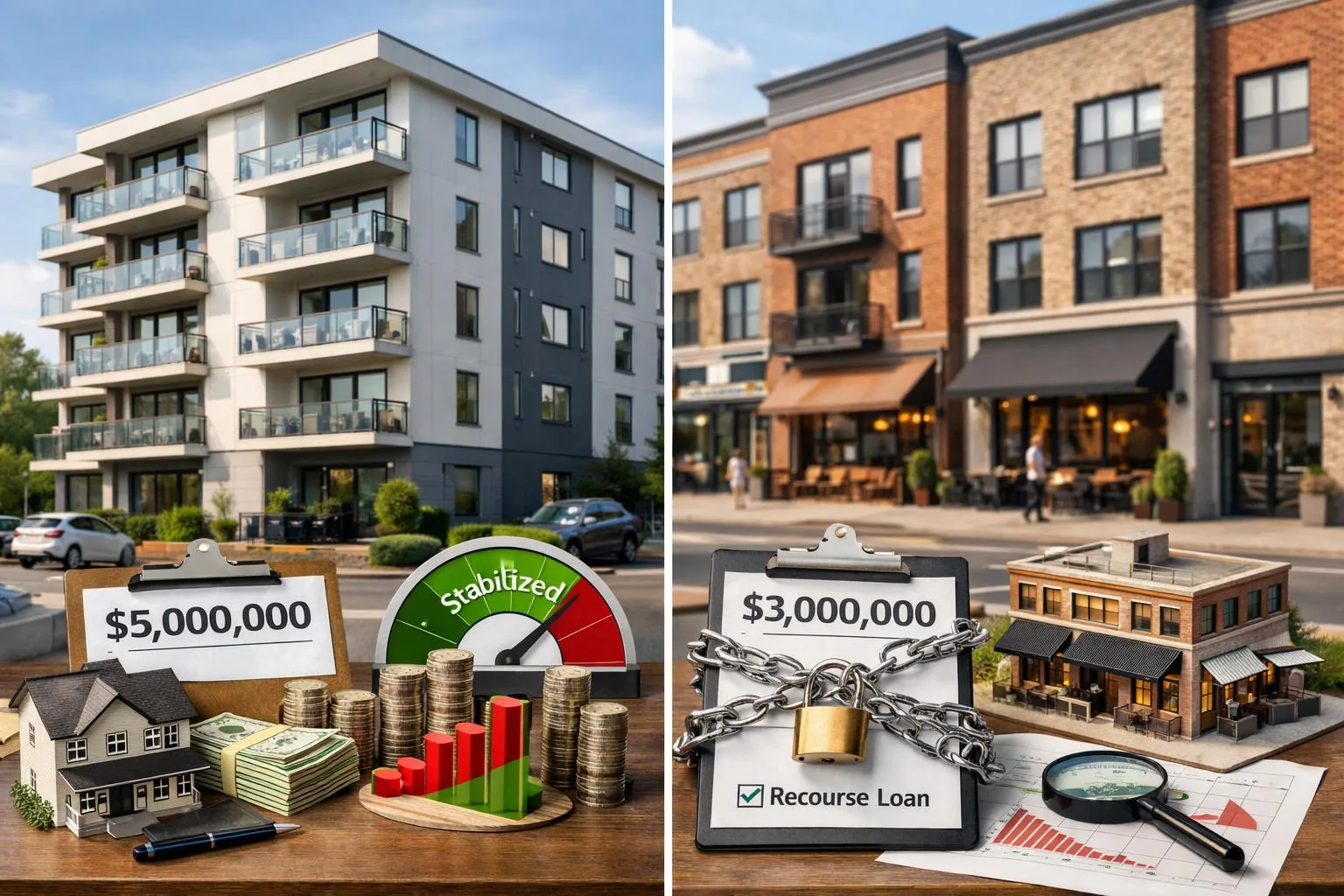
DSCR loans and commercial loans are both tools for investment-property financing, but they occupy different parts of the commercial real estate spectrum. For 1-4 unit rentals (and many 5-10 unit small multifamily deals), DSCR wins on simplicity, full 30-year amortization, no balloon risk, and easier qualification. For 10+ unit apartments, mixed-use with major commercial components, retail, office, industrial, or loans above $3 million, commercial loans are the right tool — often with non-recourse options, CMBS financing, or longer-term hold structures that DSCR can’t match. The 5-10 unit overlap zone is where the choice gets interesting — and where most investors benefit from running both options side-by-side.
DSCR Authority is an independent editorial resource. We help investors compare DSCR lenders and can route small-commercial deals to appropriate lenders through our matching network. This is educational content, not loan advice.
The Two Products in One Sentence Each
DSCR loan: A business-purpose residential mortgage priced like a conforming loan but underwritten on property rent-to-PITIA ratio, typically 30-year fixed, fully amortizing, recourse, for 1-10 unit investment properties.
Commercial loan: An income-property mortgage underwritten on NOI-to-debt-service, typically 5-10 year term with 25-30 year amortization (with a balloon at maturity), available as recourse or non-recourse, for 5+ unit multifamily and all other commercial asset classes.
Side-by-Side Comparison Table
| Feature | DSCR Loan | Commercial Loan |
|---|---|---|
| Typical asset types | 1-4 unit SFR/MF, 5-10 unit small MF, condos, STRs | 5+ unit MF, retail, office, industrial, mixed-use, hospitality |
| Loan amount range | $75K - $5M | $500K - $100M+ |
| DSCR formula | Gross monthly rent / PITIA | Annual NOI / Annual debt service |
| Minimum DSCR | 0.75 - 1.25 (residential); 1.15-1.25 (small MF) | 1.20 - 1.30+ |
| Typical term | 30 years | 5, 7, 10 years with balloon |
| Amortization | 30 years, fully amortizing | 25-30 years (usually longer than term → balloon) |
| Rate (July 2026) | 6.250% - 7.875% | 7.00% - 9.00% (varies widely by asset class) |
| Max LTV | 75% - 80% | 65% - 75% |
| Appraisal type | URAR + 1007 rent schedule | Commercial appraisal (income, sales comp, cost approaches) |
| Recourse | Recourse with personal guarantee | Recourse or non-recourse (often $1M+ for NR) |
| Prepayment structure | 3-5 year step-down PPP | Yield maintenance, defeasance, or step-down; often lockouts |
| Interest-only option | Yes, 10-year IO common | Yes, 2-10 year IO common |
| Origination fees | 1-2 points | 0.5-1.5 points |
| Typical close time | 21-45 days | 45-90 days |
| Environmental review | Not required | Phase I ESA often required |
| Property management review | No | Yes, often required |
| Foreign national option | Yes | Limited, case-by-case |
| Non-recourse availability | Rare (most are recourse) | Standard on CMBS and many bank deals $1M+ |
The DSCR Formula Difference
Residential DSCR:
DSCR = Gross Monthly Rent / PITIASimple, property-level, gross-rent-based. A $2,400/month rental with $2,000 PITIA = 1.20 DSCR.
Commercial DSCR:
DSCR = Net Operating Income (NOI) / Annual Debt ServiceNOI = Gross rental income − Vacancy − Operating expenses (property management, repairs, utilities, insurance, taxes, reserves). Annual debt service = 12 × monthly P&I payment.
Example — 8-unit building:
- Gross rent: $96,000/year
- Vacancy/credit loss (7%): ($6,720)
- Effective gross income: $89,280
- Operating expenses (35% of EGI for small MF): ($31,250)
- NOI: $58,030
- Annual debt service at 7% on $600K: $47,900
- DSCR = $58,030 / $47,900 = 1.21
A commercial lender at 1.25 minimum DSCR would decline this deal without either a higher down payment, lower rate, or improved operations. The same building underwritten on residential 5-10 unit DSCR using gross rent / PITIA might clear 1.30+ because operating expenses aren’t subtracted.
This is why small multifamily often qualifies on residential DSCR when it wouldn’t qualify on pure commercial.
Commercial Loan Structure: Balloons and Amortization Mismatch
The single biggest structural difference: commercial loans typically have a term/amortization mismatch that creates a balloon payment.
- 10/25 structure: 10-year term, 25-year amortization. You make monthly P&I payments as if it were a 25-year loan, but at year 10 the remaining principal balance comes due.
- 7/30 structure: 7-year term, 30-year amortization. Same concept — 7 years of payments, then balloon.
- 5/25 structure: 5-year term, 25-year amortization. Common on bank portfolio loans and bridge-to-perm structures.
Example balloon impact:
A $1,000,000 commercial loan at 7% on a 25-year amortization pays down to roughly $820,000 after 10 years. At maturity, the borrower owes a balloon of $820,000. They must either sell, refinance, or (on some products) extend at the lender’s option with updated terms.
DSCR loans have no balloon. A 30-year DSCR pays down to zero over its full term. This eliminates refinance risk — a major consideration given that commercial refinance markets can be tight when the balloon comes due (as many 2015-2017 vintage CMBS borrowers learned during 2020-2022).
Recourse vs Non-Recourse
Recourse means the lender can pursue the borrower’s personal assets beyond just the property in the event of default. Most DSCR loans are recourse (with a personal guarantee from the LLC’s member) and most commercial bank portfolio loans are recourse.
Non-recourse means the lender can only foreclose on the property itself — the borrower’s other assets are protected. Non-recourse loans typically include “bad-boy carve-outs” that convert to recourse under specific conditions (fraud, waste, environmental contamination, unauthorized transfers).
Non-recourse availability:
- DSCR: Rare. A handful of DSCR lenders offer limited non-recourse at 0.50-1.00% higher rates, usually on stronger files.
- Commercial bank portfolio: Sometimes available on larger, stronger deals ($1-5M+, strong sponsors).
- Commercial CMBS: Standard non-recourse (with bad-boy carve-outs) on loans typically $3M+.
- Commercial life company: Standard non-recourse on institutional-quality assets, usually $5M+.
For high-net-worth investors with significant personal assets to protect, non-recourse is a major driver toward commercial structures.
CMBS (Commercial Mortgage-Backed Securities)
CMBS is a capital-markets execution for commercial loans — originators underwrite to CMBS guidelines, pool loans, and sell them as bonds to institutional investors.
CMBS characteristics:
- Non-recourse (with standard bad-boy carve-outs)
- 10-year term, 25-30 year amortization (sometimes full-term IO or partial IO)
- Rates priced at a spread over 10-year Treasuries (typically 200-375 bps in July 2026 over the 4.65% 10-year)
- Strict underwriting: NOI scrub, reserves, replacement cost accounts
- Defeasance or yield maintenance for prepayment (expensive, often $100K+)
- Loan sizes typically $3M+
CMBS is not for small deals. Below $3M, the execution cost and complexity outweigh the benefits. Above $5-10M, CMBS is often the most competitive execution for stabilized commercial assets.
Bridge-to-Perm Structures
Commercial lending commonly uses a two-stage structure:
- Bridge loan: 6-36 months, higher rate, funds acquisition + stabilization
- Permanent loan (CMBS, agency, bank): Takes out the bridge once the property hits stabilized NOI
For small residential investors, the DSCR parallel is bridge → DSCR (covered in DSCR vs Bridge). For larger commercial deals, the equivalent is commercial bridge → CMBS or agency (Fannie Mae DUS, Freddie Mac SBL) takeout.
The 5-10 Unit Overlap Zone
This is where the choice matters most. Both DSCR (as “residential commercial DSCR” or “small multifamily DSCR”) and commercial loans are available. Here’s how to think about it:
5-10 unit DSCR advantages:
- 30-year fixed, no balloon
- Simpler documentation
- Faster close (21-45 days vs 45-90 for commercial)
- No Phase I environmental in most cases
- Typically higher LTV (75% vs 70% for commercial)
- Fully amortizing — predictable, building equity
5-10 unit commercial advantages:
- May offer non-recourse at stronger files
- Often lower rates on institutional-quality properties
- More lenient DSCR calculation methods (expense assumptions, etc.)
- Longer runway for value-add plans (IO periods, release provisions)
- More familiar to institutional buyers at exit
Rule of thumb for the 5-10 unit band:
- Loan size under $1M: DSCR almost always wins
- Loan size $1-2M: DSCR usually wins for buy-and-hold; commercial for value-add
- Loan size $2M+: Compare both; commercial starts to win on pricing
- Non-recourse required: Commercial
Small Multifamily Rate Comparison
Actual July 2026 pricing for a well-qualified 6-unit stabilized acquisition at $1.2M loan amount:
| Product | Rate | Term | Amortization | Balloon? |
|---|---|---|---|---|
| 5-10 unit DSCR | 7.00% - 7.75% | 30 years | 30 years | No |
| Bank commercial portfolio | 7.00% - 8.00% | 5-7 years | 25 years | Yes |
| Freddie Mac SBL (small balance) | 6.50% - 7.25% | 5-10 years | 30 years | Yes |
| Life company | 6.25% - 7.00% | 10 years | 25 years | Yes |
| CMBS | 6.75% - 7.50% | 10 years | 30 years | Yes |
Freddie Mac SBL (Small Balance Loan) is often the sweet spot for stabilized 5-50 unit multifamily in the $1M-$7.5M range — non-recourse, agency-priced, 30-year amortization. DSCR competes effectively at the lower end of that band and wins on term simplicity.
When DSCR Wins
1. 1-4 unit residential rentals. Default choice. Commercial doesn’t even compete here.
2. 5-10 unit small multifamily under $1.5M loan amount. Simpler, cheaper execution than commercial at this size.
3. You want 30-year fully amortizing debt with no balloon. Certainty of term.
4. You don’t need non-recourse. Most small investors can accept recourse + personal guarantee; it doesn’t change operating reality on a cash-flowing property.
5. Speed matters. DSCR closes in 21-45 days; commercial often 60-90+ days.
6. Mixed-use with heavy residential component. A 4-unit building with ground-floor retail often qualifies on DSCR if residential dominates.
7. Foreign national. DSCR has dedicated foreign-national programs; commercial is case-by-case.
When Commercial Wins
1. 10+ unit multifamily. DSCR programs typically cap at 10 units.
2. Pure commercial asset classes. Retail, office, industrial, hospitality — commercial only.
3. Loan size $3M+ on stabilized assets. CMBS and life company executions beat DSCR on pricing at this size.
4. Non-recourse is required. DSCR non-recourse is rare and expensive; commercial has several standard non-recourse channels.
5. Value-add business plan with IO periods. Commercial bridge-to-perm structures support 2-5 year IO periods that DSCR doesn’t offer.
6. Highly complex deal (ground lease, TIF, HUD, tax credits). These require commercial expertise that residential DSCR lenders don’t carry.
Common Misconceptions
“DSCR is only for single-family homes.” False. DSCR actively covers 2-4 unit, and many lenders cover 5-10 unit small multifamily. It’s primarily a residential-adjacent product, not a single-family-only product.
“Commercial loans are always cheaper because they’re ‘real’ commercial.” False. Under $2M, residential DSCR often prices tighter than commercial because the underwriting is simpler and non-recourse isn’t being priced in.
“I need a commercial loan for any LLC purchase.” False. DSCR loans routinely close in LLCs with personal guarantees.
“Commercial loans have no prepayment penalty because they’re short-term.” False. Commercial prepayment structures (yield maintenance, defeasance) can be far more expensive than DSCR step-down PPPs on an early exit.
“Non-recourse means I have no personal liability.” Partially false. Non-recourse loans include “bad-boy carve-outs” that convert to recourse under specific borrower misconduct (fraud, waste, environmental contamination, unauthorized transfer). Good behavior keeps them non-recourse.
Decision Matrix
| Your Scenario | Recommended Product |
|---|---|
| 1-4 unit rental purchase or refinance | DSCR |
| 5-8 unit small MF, $800K loan, stabilized | DSCR (small multifamily) |
| 6-10 unit small MF, $1.5M loan, stabilized | Compare both |
| 10+ unit apartment building | Commercial |
| Mixed-use (residential dominant) | DSCR |
| Mixed-use (retail/office dominant) | Commercial |
| Retail strip center | Commercial |
| Office building | Commercial |
| $3M+ loan, stabilized, want non-recourse | Commercial (CMBS or life company) |
| Value-add with 2-year IO needed | Commercial bridge-to-perm |
| Foreign national on 6-unit MF | DSCR |
| Need to close in 30 days | DSCR |
Next Steps
If your deal fits the DSCR or small-multifamily DSCR profile, get matched with lenders — free, no obligation. For larger commercial deals, our intake will note that you need commercial quoting and we’ll route accordingly.
Run your numbers: DSCR Calculator (works for 1-4 unit) or Qualification Estimator. Scale planning: Portfolio Builder. Current pricing: DSCR rates.
Bottom line: DSCR for 1-10 unit residential; commercial for true commercial assets. The 5-10 unit overlap zone is where you genuinely benefit from comparing both — and where most investors are surprised that DSCR wins more often than they expected.
Keep exploring
Hand-picked next steps — whether you want to go deeper on this topic, compare alternatives, or run the numbers.
Editor's picks
Hand-chosen follow-ups for this topic.
- Guide
What Is a DSCR Loan? The Complete 2026 Guide for Real Estate Investors
A DSCR loan qualifies a rental property on rental income ÷ PITIA — not personal income or tax returns. Full 2026 guide to ratios,…
- Investor profile
DSCR Portfolio Builder Guide: Scaling a Rental Portfolio Past 10 Properties
Scale past Fannie's 10-property cap with DSCR: blended DSCR, blanket loans, Wyoming holdings, reserves, and capital recycling…
- Loan type
Portfolio DSCR Loan / Blanket Mortgage: Scale Beyond 10 Properties (2026)
Portfolio DSCR loans (blanket mortgages) finance 5+ rentals under one note. Blended DSCR, release provisions, lender landscape,…
- Comparison
DSCR vs Bridge Loan: Which Is Right for Your Deal in 2026?
DSCR vs bridge loan 2026: 6-7% 30-year permanent vs 9-11% 6-24 month bridges. Rates, LTV, speed, and the bridge-to-DSCR takeout…
- Property type
DSCR Loan for 5-10 Unit Small Multifamily: Commercial Classification Guide
DSCR loans for 5-10 unit small multifamily in 2026: 70-75% LTV, 1.15-1.25 DSCR, commercial appraisal rules, and the specific…
Other DSCR comparisons
- Comparison
DSCR vs Bank Statement Loan: 2026 Non-QM Comparison
DSCR vs bank statement loan 2026: both are non-QM for self-employed. DSCR wins rentals; bank statement wins owner-occupied.…
- Comparison
DSCR vs Conventional Loan: The Investor's 2026 Decision Guide
Should you use a DSCR loan or a conventional investment mortgage? Side-by-side rates, LTV, DTI, property limits, documentation,…
Run the numbers
Free interactive tools to stress-test your deal.
- Interactive tool
DSCR Ratio Calculator
Calculate your DSCR in seconds and see pass/fail by lender tier.
- Interactive tool
DSCR Qualification Estimator
Estimate your rate range, LTV cap, and approval odds before you apply.
- Interactive tool
Portfolio DSCR Analyzer
Blend DSCR across your rental portfolio and preview blanket-loan structure.
- Live rates
Today's DSCR Loan Rates
Live DSCR rate ranges by credit tier, LTV, and product type.
Stop Comparing in the Abstract — See Offers
Run the numbers, then get matched to real DSCR lenders for your deal.
Shop every major DSCR lender in 60 seconds
Tell us about your deal once. We'll send you the top 3 lender offers within the hour.
Soft match — no credit pull, no spam. Your info stays with licensed brokers only.