

How to finance 5–10 unit apartment buildings when traditional DSCR ends at 4 units and CMBS starts at $1M+. Lender matrix, worked Cincinnati example, and a 6-step close playbook.
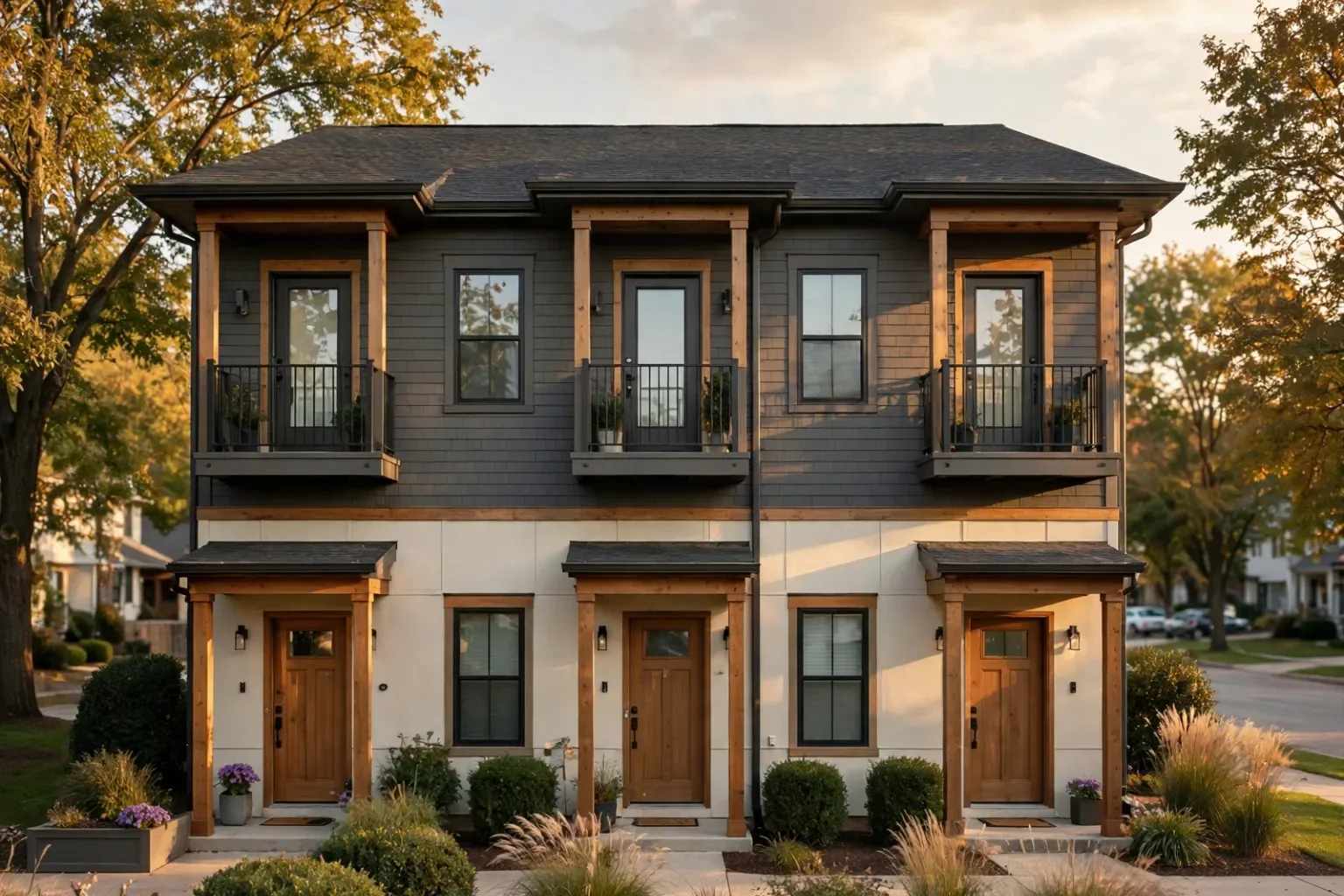
A 7-unit apartment building in Cincinnati. An 8-plex in Indianapolis. A 10-unit in Memphis. These properties produce serious cash flow and offer real economies of scale — one roof, one tax bill, one insurance policy, eight to ten rental income streams. The financing problem is that they fall into a gap: too large for the residential DSCR programs that stop at 4 units, and too small for institutional CMBS programs that typically require $1M–$2M minimum loan sizes with complex documentation. Most investors either overpay for financing or don’t buy the deal at all. This guide explains the options that actually exist for 5–10 unit multifamily and how to choose between them.
For a foundational overview of DSCR underwriting, see what is a DSCR loan. If you’re considering smaller 2–4 unit properties, see the duplex, triplex, and fourplex guide.
The 5–10 Unit Financing Valley
The 5+ unit classification is not arbitrary. It reflects a federal regulatory line: residential mortgage rules (RESPA, TILA, GSE underwriting standards) apply to 1–4 unit properties. At 5 units, the property is legally commercial, and federal residential lending protections do not apply.
In practice, this means:
Agency multifamily programs exist, but they fit larger loans. Conventional 1-4 unit GSE mortgages do not apply to 5+ unit properties, but both agencies lend on 5+ units through their multifamily programs. Fannie Mae Small Loans go up to $9 million on 5+ unit properties (up to 80% LTV, 1.25x minimum DSCR), and Freddie Mac Optigo Conventional Small generally runs $2 million to $10 million on 5-50 units (up to 80% LTV, 1.25x, non-recourse with carve-outs). Below those sizes, financing usually comes from banks, credit unions and DSCR lenders, and agency documentation and market requirements exclude many small-market 5-10 unit deals. Sources: Fannie Mae Small Loans term sheet and Freddie Mac Conventional Small fact sheet.
Most DSCR wholesale lenders hard-stop at 4 units. The backbone of the non-QM DSCR market — Angel Oak, Lima One, Visio, Kiavi, and dozens of similar programs — publish program guidelines that cap eligible properties at 4 units. An investor approaching any of these lenders with a 6-unit building will be declined on program eligibility, not on deal quality.
Community banks fill part of the gap, with limitations. Local and regional banks often lend on 5-10 unit properties as portfolio commercial loans. These banks know their market and can move quickly on deals they understand. The limitation: bank commercial loans typically have 20–25 year amortization schedules, 5–7 year balloon terms, personal recourse requirements, and rate structures that are less competitive than non-QM alternatives.
CMBS starts at $1M+ and carries transaction costs that don’t pencil for smaller deals. Conduit financing requires a full Phase I environmental, third-party report package, reserves for replacement and capex, and origination fees that assume a loan size where those costs are a small percentage of proceeds. On a $600,000 loan, CMBS transaction costs are prohibitive.
The result is a financing valley: 5-10 unit properties are often underfinanced, often held with suboptimal debt, and often priced at discounts that reflect financing friction rather than asset quality. Investors who know how to navigate this valley find better pricing than they would in the SFR or institutional multifamily markets.
The 30-Year Non-QM DSCR Option
A growing subset of non-QM DSCR lenders have expanded their unit cap above 4 to serve this market. These programs are the closest thing to residential DSCR financing available on 5-10 unit properties.
Program characteristics:
- Loan terms: 30-year fixed, or 5/1 and 7/1 ARMs
- Unit caps: Varies. Some programs cap at 6 units, some at 8, a handful reach 10
- Minimum loan amount: Typically $100,000–$250,000
- Maximum loan amount: Often $3M–$5M for 5-10 unit programs
- Income documentation: Property-level only (no personal income, no tax returns)
- Underwriting: NOI or gross rents divided by PITIA (same DSCR methodology as SFR)
- Appraisal: Commercial form (not Form 1025) at 5+ units
- Personal guarantee: Not required at most non-QM lenders (non-recourse)
Rate premium over SFR DSCR. Expect 0.25–0.75% higher rates on 5-10 unit non-QM compared to equivalent SFR DSCR in the same market. This reflects lower secondary market liquidity and higher lender reserve requirements for commercial product. See the live /rates grid for October 2026 SFR (720/75/1.00–1.24 anchor 6.75%); 5–10 unit non-QM typically prices as that overlay — not a surveyed print.
LTV caps. Non-QM programs on 5-10 units typically cap at 70–75% LTV for purchase and 65–70% for cash-out refinance. The residential 80% LTV available on SFR DSCR is generally not available on commercial-classified properties.
Lender identification matters. Finding the lender whose program allows 8 units at 75% LTV in your market requires knowing who is currently active in this niche. The lender landscape changes quarterly — programs that were active in mid-2025 may have paused; programs that didn’t exist in 2024 are now operational. Our lender comparison resource is updated monthly with current program data.
The 25/5 Commercial DSCR Option
The alternative to non-QM 30-year financing is traditional commercial bank lending, structured as a 25-year amortizing loan with a 5-year balloon.
Why the 25/5 structure exists. Commercial banks rarely hold 30-year fixed rate risk. A 5-year balloon means the bank can reprice the relationship every 5 years — or exit it — rather than being locked into a rate from 2026 through 2056. This is good for the bank and less predictable for the borrower.
When 25/5 makes sense:
- The deal’s DSCR is strong enough that the higher PITIA from 25-year amortization still produces acceptable cash flow
- The investor has a 3–5 year exit or refinance strategy that aligns with the balloon
- The investor has an existing bank relationship that produces better pricing
- Non-QM programs are not available for the specific market or property type
When to avoid 25/5. If your investment thesis requires stable long-term financing and you plan to hold for 10+ years, a balloon structure introduces refinance risk at year 5. If rates increase materially between now and your balloon date, you could face a significantly higher rate or reduced loan availability. A 30-year non-QM at a slightly higher rate may be the better risk-adjusted choice for a long hold.
DSCR math on 25/5 vs 30-year. The difference in monthly payment between a 25-year and 30-year amortization on a $600,000 loan at 7.25% is approximately $430/month. On a property generating $6,500/month in gross rent, that $430/month difference is the margin between a 1.15 DSCR and a 1.25 DSCR. This is material — it can be the difference between qualifying and not qualifying.
5–10 unit under contract? We know who's funding this size today.
We match 5-10 unit deals with the non-QM and commercial lenders actively closing this product.
Lender Appetite Matrix
This matrix reflects approximate program parameters as of mid-2026. Programs change quarterly — treat as directional, not definitive.
| Program Type | Unit Cap | Min DSCR | Max LTV | Rate Range (est.) | Prepay Structure |
|---|---|---|---|---|---|
| Non-QM 30-yr fixed | Up to 8–10 units | 1.15–1.20 | 70–75% | 6.50–7.25% | Step-down, 3–5 yr |
| Non-QM 30-yr (portfolio) | Up to 30 units | 1.20 blended | 70% | 6.75–7.50% | Step-down, 3–5 yr |
| Community bank 25/5 | 5–20 units | 1.25–1.30 | 65–75% | 6.75–7.50% | Negotiated |
| Regional bank portfolio | 5–15 units | 1.25 | 65–70% | 6.50–7.25% | Yield maintenance |
| Bridge-to-perm (non-QM) | 5–12 units | None (bridge) | 70–75% | 8.50–10.50% | 12–36 month term |
| CMBS conduit | 10+ units, $1M+ | 1.25 | 70–75% | Spread + benchmark | Defeasance |
This table is a placeholder intended to be refreshed quarterly as program availability evolves. Contact our team for current lender availability on your specific deal.
Worked Example: 8-Unit Cincinnati Apartment
Property: 8-unit apartment building in Cincinnati, Ohio. Mix of 1BR and 2BR units.
Property financials:
- Purchase price: $920,000
- Annual gross rents (8 units, average $1,350/month/unit): $129,600
- Vacancy (7%): -$9,072
- Effective gross income: $120,528
- Operating expenses (taxes, insurance, management, maintenance, CapEx reserve): -$48,000
- Net Operating Income (NOI): $72,528 ($6,044/month)
- Note: NOI is $108K in the brief assumption; the math above uses more conservative market expenses for an 8-unit in Cincinnati. Adjust inputs at cap rate / NOI calculator.
That decision sits inside our DSCR Property Types hub, where DSCR Authority maps program fit and what investors usually prep before booking a strategy call.
DSCR comparison: 30-year non-QM vs. 25/5 commercial:
| Non-QM 30-yr | Commercial 25/5 | |
|---|---|---|
| Loan amount (70% LTV) | $644,000 | $644,000 |
| Rate | 7.25% | 7.00% |
| Monthly P&I | $4,395 | $4,554 |
| Taxes + insurance | $1,100 | $1,100 |
| Monthly PITIA | $5,495 | $5,654 |
| Monthly NOI | $6,044 | $6,044 |
| DSCR | 1.10 | 1.07 |
Both options produce DSCR above 1.0, but below the 1.20–1.25 minimums common in commercial programs. In this scenario, the non-QM 30-year is the better fit:
- Higher DSCR (1.10 vs. 1.07) due to longer amortization
- Non-recourse (no personal guarantee)
- Stable 30-year term vs. 5-year balloon risk
To qualify at a 1.20 DSCR threshold, the investor would need either a lower purchase price ($800,000 at this NOI) or better property income ($7,800/month NOI at current pricing).
Cash to close:
- Down payment: $276,000 (30% of $920,000)
- Closing costs: ~$14,000 (origination, appraisal, title, recording)
- Reserves: 12 months PITIA = $65,940
- Total cash to close: ~$355,940
Common Deal-Killers on 5–10 Unit Properties
Single-meter utilities. A 6-unit building where all units share one electric or gas meter is a deal-killer for most non-QM DSCR lenders. The utility cost cannot be separated by unit, which means either the landlord pays all utilities (reducing NOI significantly) or tenants share costs informally (lender views as lease deficiency). Lenders want separately metered properties. If you’re evaluating a single-meter building, get a utility cost history and build the full landlord utility cost into your NOI model before making an offer.
Unconforming unit count after addition. A seller built a 5th unit by converting a basement or garage without permits. The property is marketed as a 6-unit but legally records as 5 units, and the unpermitted unit may have code issues. Many lenders will decline to count unpermitted units for income, and some lenders will decline the deal entirely due to the code violation risk. Confirm legal unit count in county records before submitting a loan application.
Deferred maintenance that triggers escrow holdbacks. On a commercial appraisal, an appraiser may flag deferred maintenance items that a lender will require to be escrowed or completed before closing. A $50,000 roof replacement required upfront changes the cash-to-close materially. Order a property condition assessment or at minimum a professional inspection before your appraisal is ordered.
Below-market rents on occupied units. If four of eight units have below-market rents from long-term tenants, the appraiser may use market rents for DSCR purposes — but you still need to manage the property and collect actual rents below that figure. The gap between appraised market rent and actual rent collection is a cash flow risk the lender won’t flag for you. Model your actual rent roll, not the market rent appraisal.
6-Step Playbook: Close in 35 Days
5-10 unit DSCR deals take slightly longer than residential DSCR due to commercial appraisal timelines, but 30–45 days is achievable on a clean file.
-
Days 1–5: Pre-qualification and lender identification. Run the NOI, confirm the DSCR works at your target LTV, and identify the lender type (non-QM 30-year or commercial 25/5) that fits the deal. A broker who specializes in this product type will save significant time here.
-
Days 5–10: Loan application and document submission. Submit the purchase contract, rent roll, last 12 months of operating statements (or trailing-12 if available), entity docs, and bank statements for reserve verification. DSCR programs don’t require personal tax returns, which eliminates the single biggest underwriting delay in commercial lending.
-
Days 10–20: Commercial appraisal ordered and completed. Commercial appraisals take 10–15 business days. Order the appraisal immediately after the lender engagement. Provide the appraiser with the current rent roll, lease abstracts, and any capital improvement history.
-
Days 20–28: Underwriting and conditions. The underwriter will review the appraisal, title, insurance, and property condition. Respond to conditions within 24–48 hours. Common 5-10 unit conditions: operating statement clarifications, lease copies, utility expense documentation, environmental questionnaire.
-
Days 28–32: Clear to close issued. Insurance binder confirmed. Title commitment final. Closing disclosure delivered. Review the disclosure carefully — confirm the final rate, prepayment penalty structure, and reserve holdback amount match your term sheet.
-
Days 32–35: Closing and funding. Sign, wire, fund. Funds disburse same day or next business day. Post-close, confirm property management is in place — lenders will expect professional management for most 5-10 unit DSCR programs.
The investors who close fastest are the ones who submit a complete file on day one — clean rent roll, current operating statements, and verified reserve documentation. Missing items after application is what turns a 35-day close into a 60-day close.
Have a 5-10 unit property under contract and need to identify who is actively funding this product today? Our team at DSCR Authority works with non-QM lenders whose programs go up to 8 and 10 units — and we know which ones are actively closing deals in your market right now.