
2026 Ohio DSCR market brief: Cleveland/Columbus submarkets, Section 8 HAP underwriting, judicial foreclosure, PPP restrictions, and small-balance lender appetite.
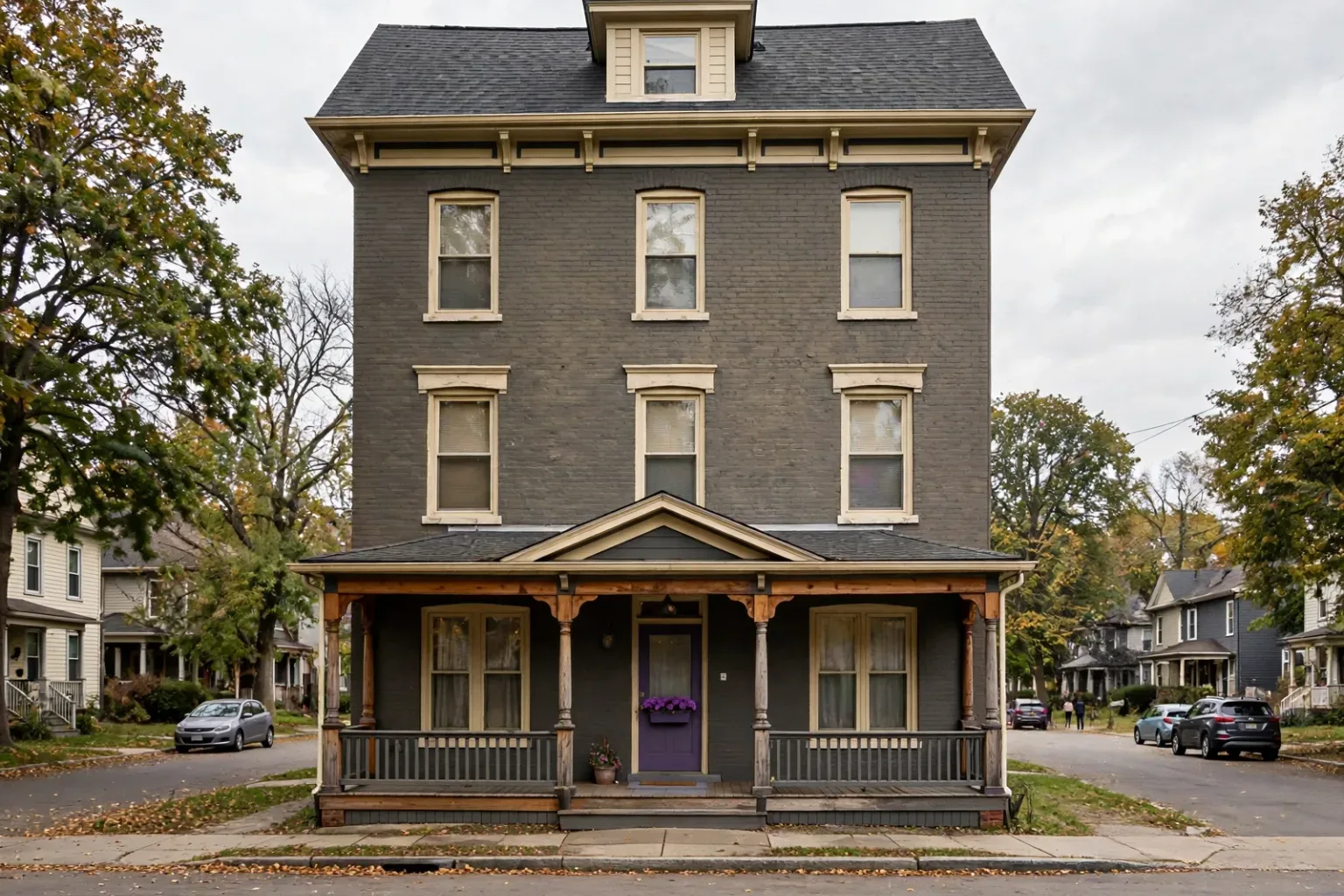
Ohio has a quiet reputation in DSCR investing circles as one of the best states in the country for sub-$150,000 cash-flow deals. Cleveland’s east-side and south-side suburbs, Dayton’s affordable inventory, and Cincinnati’s underappreciated cash-flow corridors produce DSCR loan Ohio ratios that investors from coastal markets find remarkable. But Ohio also has complications: judicial foreclosure timelines that make some lenders cautious, prepayment penalty statutory considerations, and a Section 8 market that requires lenders with specific program experience. Here’s the full picture.
Ohio Investment Market Overview
Ohio’s population has been roughly stable — slight growth in Columbus, slight decline in Cleveland and Dayton — but the rental market is structurally active because homeownership rates lag national averages in many Ohio metro areas (particularly Cleveland), keeping rental demand persistent.
The defining characteristic of Ohio DSCR lending is price accessibility. While coastal and Sunbelt markets have seen significant price appreciation since 2020, Ohio’s core investor markets have remained affordable. Cleveland’s investor-grade SFR market is largely concentrated in the $65,000–$150,000 range. Dayton and Toledo go even lower, with meaningful inventory under $80,000. Columbus and Cincinnati are pricier but still below national medians.
Our Ohio DSCR deal flow ranges from roughly $65,000 to $400,000, with the median around $110,000. The distribution skews toward the low end — Cleveland, Dayton, and Toledo inventory drives a high volume of sub-$100,000 deals, which creates a lender selection challenge because many national DSCR programs have $100,000 or $150,000 minimums.
Ohio has a state income tax on rental income (rates range from 2.75% to 3.99% as of 2026), which is a modest negative versus no-income-tax states like Texas and Tennessee but is not typically a deal-breaker for investors comparing absolute cash-on-cash returns.
Top Ohio Cities: Cash Flow vs. Growth vs. STR
Cleveland
Cleveland is the alpha cash-flow market of the Midwest. The metro’s bifurcated geography — the higher-cost west side and inner-ring suburbs versus the higher-yield east side and south-side suburbs — gives investors a choice between safer, lower-yield assets and higher-yield, higher-management-intensity assets.
Best DSCR submarkets:
- Euclid, Maple Heights, Garfield Heights, Bedford: Acquisition prices of $70,000–$110,000 with rents of $950–$1,200/month. Strong Section 8 voucher concentration. DSCR ratios of 1.30–1.55 at 75% LTV are common.
- Parma, Brooklyn, Middleburg Heights: More stabilized workforce housing. Prices $100,000–$160,000, rents $1,100–$1,450/month. Lower Section 8 concentration, more market-rate tenants.
- Lakewood, Ohio City (near downtown): Emerging appreciation/STR play. Prices $150,000–$250,000, tighter DSCR coverage but better tenant quality.
DSCR profile: Strong. Cleveland’s east-side cash-flow markets produce DSCR ratios that rival Memphis — often 1.25–1.55 on sub-$120,000 deals. The challenge is minimum loan size — many national DSCR lenders won’t go below $100,000, which eliminates significant Cleveland inventory.
Investor strategy: Cash-flow primary, Section 8 concentration in east-side submarkets. Portfolio investors frequently accumulate 5–15 properties in outer-ring Cleveland within a single LLC structure.
Columbus
Columbus is Ohio’s growth story. The metro has added approximately 250,000 people since 2020, driven by The Ohio State University (largest university in the US by enrollment), Intel’s $20 billion chip manufacturing investment in Licking County, and corporate relocations. Columbus is more similar to a secondary Sunbelt market than to Cleveland in its DSCR profile.
DSCR profile: Tighter than Cleveland. Investor-grade SFRs in Columbus proper run $180,000–$300,000 with rents of $1,500–$2,000. DSCR ratios of 1.0–1.15 are typical at 75% LTV — passable but not the cash-flow knockout that Cleveland offers. Far-east suburbs in Licking County (near the Intel campus in New Albany) have become active investor markets with improving rent fundamentals.
Investor strategy: Appreciation-forward with cash-flow stability. Columbus is the Ohio market for investors who want market growth alongside rental income, and who are comfortable with DSCR ratios closer to 1.05 than 1.35.
Cincinnati
Cincinnati is Ohio’s most underrated DSCR market. The metro straddles Ohio and Kentucky, and many investors look at Northern Kentucky (Covington, Newport) alongside Cincinnati proper. On the Ohio side, several Cincinnati submarkets offer cash-flow fundamentals comparable to second-tier Cleveland neighborhoods.
Best DSCR submarkets:
- Price Hill, Westwood: Acquisition prices $80,000–$140,000, rents $900–$1,150/month. High Section 8 concentration.
- Norwood: Mid-tier. Prices $130,000–$200,000, rents $1,100–$1,500.
- Middletown (Warren County, adjacent metro): True cash-flow play. Prices $70,000–$120,000, rents $850–$1,100/month. Small and mid-size industrial employer base.
DSCR profile: Ranges from strong (Price Hill, Middletown) to moderate (Norwood, Hyde Park). The presence of UC Health and Cincinnati Children’s Hospital creates stable healthcare-worker rental demand in mid-tier neighborhoods.
Investor strategy: Cash-flow in Price Hill and Middletown. Appreciation-forward in Norwood and Oakley. Northern Kentucky is worth a separate look — different state law, lower property taxes.
Dayton
Dayton is one of the most frequently cited markets for sub-$100,000 SFR DSCR investment. The Wright-Patterson Air Force Base and associated defense contractors provide stable blue-collar employment. Acquisition prices for investor-grade SFRs run $60,000–$110,000 in Trotwood, Kettering, and Huber Heights, with rents of $800–$1,050/month.
DSCR profile: Extremely strong on a ratio basis. At $80,000 acquisition and $900/month rent, DSCR at 75% LTV clears most minimum thresholds with substantial margin. The challenge is minimum loan size — at $60,000 acquisition, a 75% LTV loan is $45,000. Almost no national DSCR lenders go below $75,000–$100,000, meaning Dayton’s lowest-priced properties require portfolio lenders or local banks, not national DSCR programs.
Investor strategy: Cash-flow. Best suited for investors who can accumulate multiple properties under a blanket loan or portfolio lender structure.
Ohio Landlord-Tenant Law
Ohio’s landlord-tenant law (Ohio Revised Code Chapter 5321) is a mixed picture — more tenant-protective than Tennessee or Texas, but not as burdensome as New York or California.
Eviction timeline: For nonpayment of rent, Ohio requires 3 days written notice. After notice, the landlord can file a forcible entry and detainer action in Municipal Court or County Court. In an uncontested case, a hearing is scheduled within 5–10 days of filing. A writ of restitution (physical eviction) can be issued after the judgment. Total timeline in an uncontested case: 3–5 weeks. In Cuyahoga County (Cleveland), court backlogs can extend contested cases to 8–16 weeks (Ohio State Bar Association, 2025 survey). Columbus (Franklin County) moves faster.
Security deposit limits: Ohio caps security deposits at 1.5 months’ rent (Ohio Revised Code §5321.16) for tenancies of 6 months or more. This is one of the more tenant-favorable deposit caps in the Midwest — investors cannot collect 2–3 months’ deposits as they could in states without caps. Deposits must be returned within 30 days.
Rent control: No Ohio city has rent control, and the Ohio General Assembly has no preemption statute on the books — but no major Ohio city has moved toward rent control as of 2026.
Habitability standards: Ohio’s habitability requirements (RC §5321.04) are actively enforced in Cleveland through the city’s Rental Registry program, which requires registration and inspection of rental properties. Investors should factor registration and compliance costs into their operating budget.
Cleveland Rental Registry: City of Cleveland requires registration of rental properties and random inspections. Properties with code violations can be cited and fines imposed. Portfolio investors with multiple Cleveland units should be current on the Rental Registry as part of their management workflow.
Ohio STR Regulation
Ohio does not have a strong STR market in the way that Florida, Tennessee, or California coastal markets do. The primary STR activity is concentrated in lake-adjacent communities (Lake Erie’s Put-in-Bay and Kelleys Island), southeast Ohio’s vacation cabin market, and to a limited extent in Columbus near The Ohio State campus and downtown.
Columbus: Requires STR registration. No hard permit cap, but compliance enforcement is active. STR in residential zones is permitted with registration.
Cleveland: Negligible STR market in investor terms. Some activity near downtown and the waterfront, but this is not a DSCR-relevant STR submarket.
That decision sits inside our DSCR Loans by State hub, where DSCR Authority maps program fit and what investors usually prep before booking a strategy call.
That decision sits inside our DSCR Loans by City hub, where DSCR Authority maps program fit and what investors usually prep before booking a strategy call.
That decision sits inside our DSCR Loans by City hub, where DSCR Authority maps program fit and what investors usually prep before booking a strategy call.
That decision sits inside our DSCR Loans by State hub, where DSCR Authority maps program fit and what investors usually prep before booking a strategy call.
Put-in-Bay / Kelleys Island (Lake Erie): Active seasonal STR. These are small communities with informal registration requirements. The market is summer-seasonal and requires significant seasonal management infrastructure.
STR is not a primary DSCR investment thesis in Ohio the way it is in Florida or Tennessee.
Ohio Insurance Dynamics
Ohio’s property insurance market is relatively stable and affordable compared to coastal states. No major hurricane exposure, no wildfire risk, and a mature claims history make Ohio an attractive insurance market.
Key considerations:
- Annual premiums: Typical SFR landlord policy in Cleveland, Columbus, or Cincinnati runs $800–$1,600/year — significantly lower than Florida ($4,000–$12,000) or Gulf Coast Texas.
- Tornado risk: Ohio’s weather risk is primarily tornado and severe storms, particularly in the western part of the state (Dayton, Lima). Wind coverage is included in standard homeowner/landlord policies, not a separate endorsement.
- Flood zones: Portions of Cincinnati (along the Ohio River) and Columbus (Scioto River floodplain) carry NFIP requirements. Most Cleveland and Dayton investor submarkets are outside major flood zones.
- Vacancy/vandalism riders: For properties with extended vacancy (common in value-add/BRRRR workflows before stabilization), Ohio investors should carry vacancy/vandalism endorsements, as standard landlord policies exclude damage during vacancy periods.
Lower insurance costs are a meaningful contributor to Ohio’s favorable DSCR ratios — where Florida’s insurance adds $400–$600/month to PITIA, Ohio’s adds $70–$135/month on comparable properties.
Cleveland or Columbus Rental? Get a DSCR Quote Today
We work with lenders who go to $75K minimums on Ohio SFR — and who accept Section 8 income in Cleveland and Toledo markets.
Ohio Prepayment Penalty Rules
Ohio’s prepayment penalty framework deserves specific attention because it is more complex than most states. Under Ohio Revised Code §1343.011, certain restrictions apply to prepayment penalties on residential mortgage loans in Ohio — the statute is primarily designed to protect owner-occupant borrowers but can interact with how some lenders structure investment loan products in the state.
The practical effect for DSCR investors: Most national DSCR lenders have reviewed their Ohio programs and structured compliant PPP terms. However, some lenders have conservative interpretations of the Ohio statute and limit step-down prepayment penalties to 3-year maximum structures on Ohio residential investment properties, even where 5-year PPPs would be legally permissible on clear investment property classification.
If you’re offered a 5-year step-down PPP on an Ohio DSCR deal, verify that your lender has specifically approved this structure for Ohio. Our prepayment penalty guide covers the national landscape; Ohio-specific nuances should be confirmed with your lender’s compliance team or your real estate attorney.
The rate differential for taking no PPP on Ohio deals runs approximately 0.35–0.50% in current market conditions — more meaningful for cash-flow-focused investors holding long-term than for value-add investors planning to sell or refinance within 3–5 years.
Lender Appetite Snapshot
Ohio has broad DSCR lender participation but notable gaps at the low end of deal size that reflect the sub-$100,000 inventory challenge.
| Lender Stance | Min Loan | Max LTV | Rate Range | Notes |
|---|---|---|---|---|
| Aggressive (OH-friendly, sub-$100K accepted) | $65,000 | 80% | ~6.35–6.90% | Section 8 accepted, 0.75 min DSCR, judicial foreclosure state pricing |
| Mainstream (standard DSCR) | $100,000 | 75–80% | ~6.50–7.10% | 1.0 DSCR min, 660 FICO, 6 months reserves |
| Conservative (min loan/judicial overlay) | $150,000 | 70–75% | ~6.75–7.35% | 720 FICO, avoids Cleveland east-side concentration risk |
| Portfolio/blanket (multiple OH properties) | $500,000 portfolio | 70% | ~6.90–7.50% | Blanket loan structure across multiple OH units |
| No-ratio programs | $100,000 | 70–75% | ~7.25–7.85% | 720 FICO, 12 months reserves |
Rate ranges are illustrative (mortgage-info.com, August 2026). Ohio’s judicial foreclosure timeline can add 0.10–0.25% at lenders who price state foreclosure risk explicitly.
Worked Example: Cleveland East-Side SFR with Section 8
Scenario: 3-bedroom SFR in Garfield Heights, Cuyahoga County. Purchase price $90,000. Section 8 HAP tenant.
| Item | Monthly | Annual |
|---|---|---|
| Cuyahoga County HAP (3BR FMR, 2026) | $1,050 | $12,600 |
| Loan: 75% LTV ($67,500 at 7.0%, 30yr) | $449 | $5,388 |
| Property tax (Cuyahoga County ~1.7% of assessed) | $128 | $1,530 |
| Insurance (landlord policy) | $100 | $1,200 |
| Total PITIA | $677 | $8,118 |
| DSCR = $1,050 / $677 | = 1.55 | — |
At 1.55, this deal clears every mainstream DSCR lender’s minimum requirements by a wide margin. The critical lender variable is minimum loan size — at $67,500, many national DSCR programs won’t fund this loan. We work with lenders who operate at $65,000 minimums on Ohio SFR.
Sensitivity to rate increase: If the rate rises from 7.0% to 7.5% (for example, due to lower credit score or no-PPP pricing):
- Monthly payment on $67,500 at 7.5% = $472/month
- PITIA = $700/month
- DSCR = $1,050 / $700 = 1.50
Still strong. Cleveland’s low acquisition prices create substantial rate sensitivity protection — the DSCR margin is wide enough to absorb reasonable rate variation.
Common Mistakes Ohio Investors Make
Applying to lenders with $150,000 minimums for Cleveland or Dayton deals. This is the most common and avoidable mistake. National lender minimums frequently exclude a majority of Ohio’s investable inventory. Know your lender’s minimum before submitting a scenario.
Not modeling judicial foreclosure risk in the deal hold analysis. Ohio’s 12–18 month foreclosure timeline in Cuyahoga County means that a problem tenant can consume 12–15 months of gross rent before you regain possession. Security deposits capped at 1.5 months partially offset this, but the total exposure is real. Budget for one extended eviction event per 10–15 units per year in your operating model.
Assuming all DSCR lenders accept Section 8 income in Ohio. Some lenders have geographic restrictions on Section 8 income acceptance — they may accept it nationally but exclude specific counties or cities (sometimes Cleveland or Toledo) due to historical vacancy or collection performance in their loan pools. Verify acceptance explicitly before modeling.
Ignoring Cleveland’s Rental Registry requirements. Investors who acquire Cleveland properties without registering with the city’s Rental Registry face fines and, in some cases, inability to collect rent during non-compliance periods. This is a routine compliance matter for experienced Ohio investors but a blind spot for out-of-state buyers.
Underestimating property management costs on scattered-site portfolios. Ohio’s low acquisition prices are compelling, but managing 10 properties in Garfield Heights requires either a strong local property management relationship or significant owner attention. Out-of-state investors frequently underestimate management costs (typically 8–12% of gross rent for professional management), which affects post-DSCR cash-on-cash returns.
Closing: Ohio DSCR Loans
Ohio’s cash-flow fundamentals are genuinely exceptional at the sub-$150,000 price point. Cleveland, Dayton, and Cincinnati offer DSCR ratios that rival any market in the country — the friction is lender minimum loan sizes and the judicial foreclosure timeline. Working with a broker who specifically covers Ohio sub-$100,000 DSCR programs removes the biggest obstacle.
If you have a Cleveland or Columbus rental scenario ready to underwrite, get a quote from our network. We’ll identify which lenders in our current network go to the loan sizes your deal requires, accept Section 8 income where applicable, and are pricing Ohio most competitively right now.