

2026 Michigan DSCR market brief: sub-$100K Detroit files, Grand Rapids and Lansing cash-flow, and lenders who will actually close small-balance deals.
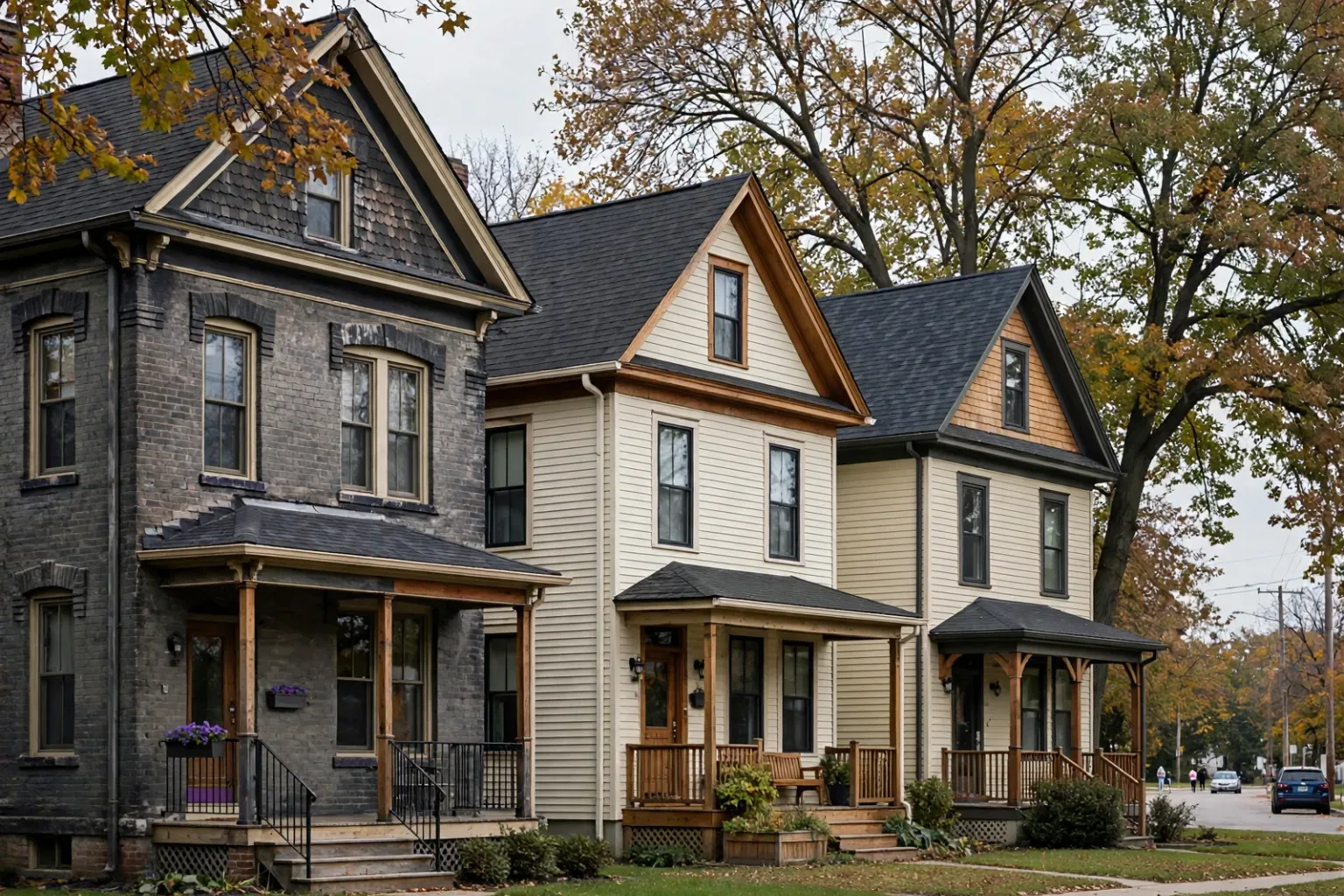
Michigan’s DSCR market is defined by a problem most investors don’t encounter elsewhere: a substantial portion of Detroit’s investor-grade housing stock trades below $100,000, and most national DSCR lenders won’t touch a sub-$100K loan. Understanding where that threshold is, which lenders cross it, and how the Detroit, Grand Rapids, and Lansing markets differ structurally is the prerequisite for productive Michigan DSCR investing. This guide covers the full picture — from DSCR loan mechanics to state landlord-tenant law to the specific lender matrix for sub-$100K Detroit deals.
Michigan market overview
Michigan’s residential investment market splits into three distinct zones. Detroit occupies a category of its own: exceptionally high gross yields, sub-$100K acquisition prices in investor-favored neighborhoods, dense Section 8 population, elevated property taxes by Michigan standards, and a city-specific landscape of lender restrictions. Grand Rapids is a recovering Midwest city that has moved from distressed to appreciating over the past decade — rents and prices have both risen, narrowing yield spreads but creating a more conventional DSCR market. Lansing anchors the state capital and university market (Michigan State University in East Lansing), with different demand drivers than the Detroit or West Michigan economies.
Typical DSCR loan sizes in Michigan range from $50,000 to $600,000, a wider range than most states. Detroit pulls the floor down; Grand Rapids and Lansing deals cluster in the $100,000–$350,000 range; higher-end lakefront and Ann Arbor-area properties push to $500,000+. The sub-$150K segment of the market has specific lender requirements that differ materially from standard DSCR programs.
Michigan’s population dynamics are complex. Detroit has experienced population decline over decades, with a modest stabilization trend since 2020. Grand Rapids has seen consistent in-migration from younger workers drawn to its growing healthcare, manufacturing, and technology economy. Lansing benefits from government employment stability and the MSU student/faculty rental market.
The Detroit sub-$100K DSCR problem
This is the central underwriting challenge for Michigan investors, and it deserves detailed treatment.
Why it exists: Detroit’s housing stock — particularly investor-grade SFR and duplexes in eastside, northwest, and southwest neighborhoods — trades in the $35,000–$110,000 range. At 75% LTV, these properties generate loans of $26,000–$82,500. Most national DSCR programs have hard minimum loan amounts of $100,000–$150,000, which they set to ensure deal economics make sense for the operational overhead of originating and servicing the loan.
The consequence: An investor purchasing a Detroit SFR for $80,000 with an excellent DSCR profile (renting at $1,000–$1,200/month against a $60,000 loan) cannot access most DSCR programs despite having superior debt coverage. The property’s fundamentals are sound, but the loan size disqualifies it from the mainstream market.
Lenders who cross the threshold: We work with specific lenders who originate Michigan DSCR loans starting at $50,000–$75,000. These programs typically require:
- Maximum 70% LTV (not 75–80%)
- Minimum 700–720 FICO
- 12 months PITIA reserves (vs. 6 months on standard programs)
- Proof of current lease (no vacant-property DSCR on sub-$100K loans)
- Property condition standards: no deferred maintenance, functional utilities, no code violations
The rate premium for sub-$100K DSCR programs in Detroit runs approximately 0.50%–1.00% above standard DSCR pricing, reflecting the operational cost of servicing smaller loans and the concentration risk in a single-employer-city property market. Even with the premium, the gross yield on Detroit properties is high enough that the math works.
The Detroit property tax problem
Detroit’s property tax structure is a specific DSCR friction that investors frequently underestimate. Detroit’s millage rate is among the highest in Michigan, and Michigan’s taxable value cap (Proposal A, 1994) means properties with long-term owners have artificially low assessed values that reset to State Equalized Value (SEV) upon sale. When an investor purchases a Detroit property, the taxable value resets — sometimes doubling or tripling the prior owner’s tax bill.
Practical impact: An investor purchasing a Detroit property for $80,000 may face taxable value of $40,000 (Detroit SEV is typically 50% of market value per Michigan assessment law). At Detroit’s millage rate of approximately 70 mills, the annual tax bill runs approximately $2,800/year ($233/month). Add to a $500/month P&I and $100/month insurance, and PITIA is $833/month against $1,100/month rent — a DSCR of 1.32. The math still works, but the tax component is substantial relative to the loan size, and investors using statewide average tax estimates ($131 on a $120,000 property at Michigan’s 1.31% average) will significantly undercalculate Detroit’s actual tax burden.
Investors should obtain a current tax bill estimate from the Detroit Assessor’s office using the post-sale SEV before finalizing DSCR underwriting. The DSCR calculator can model this with custom PITIA inputs.
Detroit neighborhoods and DSCR viability
Detroit’s investment neighborhoods are not uniform. Certain corridors have active markets and reasonable lender acceptance; others are challenged by property condition, environmental issues, or lender geographic restrictions.
Strong investor corridors: Northwest Detroit (Rosedale Park, Grandmont), East English Village, and portions of Southwest Detroit (Mexicantown, Springwells) have experienced investment activity, renovation, and improved tenant quality. Properties in these areas tend to clear lender property-condition requirements and have more consistent rental demand.
Section 8 concentration: Detroit Housing Commission voucher tenancy is prevalent across much of Detroit’s investor stock. Investors underwriting Detroit deals on Section 8 rent should confirm DSCR lender acceptance of voucher tenancy before engaging. Review the Section 8 HAP DSCR guide for which lenders specifically accept versus prohibit Housing Choice Voucher tenants.
Lender geographic restrictions: Some DSCR lenders have blanket restrictions on properties in Detroit city limits (not metro Detroit — specifically the city). These restrictions stem from historical default rates, appraisal complexity, and property condition concerns in parts of the city. Investors working in Detroit proper should route deals through lenders known to actively originate in Detroit rather than lenders who technically have no geographic exclusion but rarely close Detroit deals.
Grand Rapids
Grand Rapids has emerged as one of the better cash-flow DSCR markets in the Midwest outside of the distressed-city category. The Grand Rapids MSA economy diversified significantly over 2015–2025: Spectrum Health (now Corewell Health), Amway (Alticor), furniture and manufacturing, and a growing tech sector anchor employment.
Median SFR prices in Grand Rapids have risen substantially — from approximately $140,000 in 2018 to $250,000–$320,000 by mid-2025 for investor-quality properties. This appreciation compresses current yields compared to a decade ago, but the market still produces workable DSCR results:
A representative deal in Grand Rapids proper or Kent County suburbs: 3BR SFR at $270,000, 75% LTV, $202,500 loan at 7.0%. P&I is $1,347. Property taxes at Michigan’s 1.31% effective rate on $270,000: $295/month. Insurance: $160/month. Total PITIA: $1,802. Market rent for 3BR in Grand Rapids market corridors: $1,800–$2,200/month. DSCR: 1.00–1.22.
The range reflects the market heterogeneity in Grand Rapids. Investors buying in the highest-appreciated neighborhoods (Eastown, East Hills, Creston) face the tightest DSCR math. Investors targeting Wyoming, Kentwood, and Walker (adjacent suburbs within Kent County) find slightly better yield spreads with similar tenant demand.
Grand Rapids loan amounts consistently clear DSCR lender minimums. The sub-$100K Detroit problem does not apply here. National DSCR programs active in Michigan generally underwrite Grand Rapids without secondary-market overlays.
Lansing
Lansing’s investment market draws from two demand sources: state government employment (Michigan’s capital) and Michigan State University in East Lansing. These two drivers create distinct rental cohorts — government employees who rent long-term versus students and faculty with more transient demand patterns.
For DSCR investors, the practical distinction: long-term-tenant properties near the Capitol and government office corridors behave like standard residential rentals, while proximity to MSU creates demand for student housing configurations (more bedrooms, higher occupancy) that some DSCR lenders underwrite differently. See the 2–4 unit DSCR guide for how lender overlays apply to small multifamily near university markets.
Price points in Lansing run $130,000–$220,000 for standard investor-grade SFR. Rents in established Lansing neighborhoods: $1,100–$1,600/month for 3BR. The DSCR math is comparable to Birmingham, Alabama — 1.25–1.45 at 75% LTV with 7.0% rate assumptions.
Michigan property taxes, however, are higher than Alabama’s (1.31% vs. 0.41% effective rate), which increases PITIA and compresses DSCR compared to markets with similar rents and purchase prices. A $180,000 Lansing property carries approximately $197/month in property taxes; an $180,000 Birmingham property carries approximately $62/month. That $135/month difference translates to a DSCR of approximately 0.10 at standard loan sizes.
Detroit Sub-$100K Deal? We Have Lenders for That.
Most DSCR lenders won't go below $100K. We work with those who do — and who actively close in Detroit.
Michigan landlord-tenant law
Foreclosure: Michigan uses non-judicial (foreclosure by advertisement) for the majority of residential mortgage defaults. The process requires a minimum 4-week publication in a local newspaper before the sheriff’s sale. The key Michigan-specific factor: statutory redemption period. After the sheriff’s sale, the borrower has 6 months to redeem the property (pay off the full debt). In certain circumstances (property abandoned or more than 1/3 of loan balance already paid), the redemption period may be shortened to 30 days by court order.
The 6-month redemption period means that even after a completed sheriff’s sale, an investor or lender does not have clear control of the collateral for 6 months. This is longer than Georgia (no redemption period), Alabama (no redemption period), and North Carolina (no redemption period). Lenders who are familiar with Michigan account for this; lenders less familiar with the state may apply conservative overlays or require additional reserves to compensate.
Total effective timeline from default to clear title: 8–14 months in Michigan for standard residential foreclosures. This is materially longer than the Southern non-judicial states, and some lenders price Michigan deals with a modest rate premium reflecting this extended timeline.
Eviction: Michigan evictions for non-payment follow a demand-then-file procedure. After a 7-day notice to pay or quit, the landlord may file a summary proceedings complaint in district court. A hearing is typically scheduled within 10–14 days of filing. If judgment is for the landlord, the tenant has 10 days to vacate; a writ of restitution is then issued. Standard non-contested eviction timeline from notice to possession: 30–45 days (Michigan Courts, 2025).
Security deposit: Michigan limits deposits to 1.5 months’ rent (MCL 554.602). Deposits must be held in a financial institution and the landlord must provide written notice of the depository within 14 days of receiving the deposit. The landlord has 30 days after termination to return the deposit or provide itemized deductions.
Rent control: Michigan state law prohibits local rent control ordinances (MCL 123.411). No Michigan city — including Detroit, Grand Rapids, or Ann Arbor — may impose rent stabilization.
Insurance dynamics in Michigan
Michigan’s insurance environment does not carry the hurricane or wildfire risk of coastal or western states, but it is not without friction.
Property insurance for standard SFR in Michigan averages approximately $1,100–$1,800/year for investor properties depending on construction type, age, and location. Metro Detroit and Grand Rapids properties without significant deferred maintenance insure without unusual difficulty.
Detroit-specific insurance considerations: Detroit properties — particularly older stock — face two specific challenges. First, several major carriers have reduced their appetite for Detroit properties due to vacancy, crime statistics, and property condition. The Michigan FAIR Plan serves as a last-resort insurer for Detroit properties that cannot obtain private coverage. FAIR Plan premiums are typically higher than private market; budget $2,000–$3,000/year for Detroit properties on the FAIR Plan. Second, properties with deferred maintenance or non-functional systems (heating, plumbing) may face coverage limitations or refusals — a lender requiring proof of insurance on a property in poor condition will require remediation before closing.
Flooding in metro Detroit: Several Detroit-area municipalities have experienced significant infrastructure flooding events (2014, 2021 extreme rainfall events). FEMA flood zone maps have been updated in some areas. Investors in low-lying portions of metro Detroit should verify current flood zone status and budget for flood insurance if applicable.
Roof age considerations: Michigan’s freeze-thaw cycle is hard on roofing systems. Properties with roofs over 15–20 years old frequently face coverage limitations or refusals from standard insurers. Budget for roof inspection and potential replacement as a condition of financing on older Detroit and Lansing properties.
Michigan-specific PPP and foreclosure redemption considerations
Michigan’s 6-month redemption period has a secondary implication: lenders who hold Michigan paper cannot freely sell or transfer collateral during the redemption period. This has influenced some lenders to add Michigan to lists of states where they apply conservatively — lower LTV caps, higher reserves, or rate premiums — to compensate for the extended timeline.
From a prepayment penalty standpoint, Michigan has no statute restricting investment property PPPs. Standard DSCR PPP structures apply. Investors in Detroit who anticipate refinancing as property values appreciate (the Detroit appreciation story has been inconsistent — real for some neighborhoods, stagnant for others) should be especially careful about modeling PPP cost relative to expected hold period. Detroit’s appreciation timeline is harder to predict than Charlotte or Raleigh.
Lender appetite snapshot — Michigan
| Lender stance | Min loan | Max LTV | Indicative rate range | Notes |
|---|---|---|---|---|
| National DSCR specialists (Grand Rapids/Lansing) | $100,000 | 80% | 6.75%–7.50% | Active in Grand Rapids/Lansing; strong Kent County volume |
| National DSCR specialists (Detroit metro) | $100,000 | 75% | 7.00%–7.75% | Cover metro Detroit; Wayne, Oakland, Macomb Counties |
| Sub-$100K specialists (Detroit city) | $50,000 | 70% | 7.75%–8.75% | Detroit city limits; require 720 FICO, 12 months reserves, occupied property |
| Portfolio lenders (Michigan-focused) | $75,000 | 70% | 7.50%–8.50% | Michigan-chartered banks and credit unions; relationship-based |
| No-ratio programs | $150,000 | 70% | 8.00%–8.75% | 720+ FICO, 12 months reserves; not available below $150K |
Rate ranges are illustrative, sourced from our lender network (September 2026). Individual pricing will vary.
Worked example: Detroit SFR — sub-$100K deal
Property: 3BR/1.5BA SFR in Northwest Detroit (Rosedale Park corridor)
Purchase price: $85,000
Loan amount (70% LTV): $59,500
Rate: 8.25% / 30-year fixed, 5-4-3-2-1 PPP (sub-$100K program rate)
Monthly PITIA breakdown:
- Principal & interest (8.25%, $59,500): $447
- Property taxes (Detroit post-sale estimate, $2,800/year): $233
- Homeowner’s insurance (FAIR Plan, estimated): $200
- Total PITIA: $880
Market rent: $1,050/month (Section 8 voucher payment for 3BR, Detroit Housing Commission current schedule)
DSCR: $1,050 / $880 = 1.19
A 1.19 DSCR is within range but tighter than the Greensboro or Birmingham examples. The investor’s down payment at 30% is $25,500. With 12 months PITIA reserves ($10,560 for the sub-$100K program requirement), closing costs of approximately $3,000–$4,000, and any pre-closing repairs to meet lender condition standards, total capital at closing runs approximately $40,000–$43,000.
At $43,000 all-in capital and $1,050/month rent, the gross yield on invested capital exceeds 29%. Even net of expenses (vacancy, maintenance, property management), the cash-on-cash return profile is materially higher than standard market-rate DSCR investments. This is why Detroit attracts yield-focused investors willing to navigate the specific lender and operational complexity of the market.
Contrast with Grand Rapids: A $270,000 Grand Rapids deal at 75% LTV requires approximately $77,000+ in total capital (down payment + reserves + closing costs). Rent at $2,000/month against $1,802 PITIA produces a DSCR of 1.11 and a cash-on-cash return in the 8%–12% range. Better absolute returns on the Detroit deal; higher liquidity and lower operational complexity on the Grand Rapids deal.
Common mistakes Michigan investors make
Using standard DSCR lenders for Detroit sub-$100K deals. Engaging a national lender with a $100,000 minimum on a Detroit deal that produces a $60,000 loan wastes 2–3 weeks and potentially costs earnest money. Identifying a sub-$100K lender before going under contract on Detroit properties is standard operating procedure.
Underestimating property tax on post-sale reassessment. Michigan’s Proposal A caps taxable value increases for existing owners, but the cap resets on sale. Investors who model taxes using the prior owner’s tax bill — sometimes 30–50% below what the investor will pay — significantly overstate DSCR. Pull the assessor’s current SEV and calculate post-sale taxes before underwriting.
Ignoring the redemption period in exit planning. If a Michigan investment goes to foreclosure, the 6-month redemption period means delayed recovery of capital. Investors buying distressed or rehabilitation properties should account for this in their risk modeling. Lenders who hold Michigan paper know this — it is one reason rates in Michigan may be 0.25%–0.50% higher than in Southern non-judicial states with no redemption period.
Applying Detroit insurance assumptions across all Michigan markets. Detroit FAIR Plan premiums are not representative of Grand Rapids or Lansing insurance costs. Using Detroit-level insurance estimates for Grand Rapids properties overstates PITIA and understates DSCR for those deals.
Not verifying lender coverage for Detroit city limits versus metro Detroit. Several DSCR lenders who state “Michigan coverage” operate exclusively in Oakland, Macomb, and suburban Wayne County. Detroit city limits are a separate approval that requires specific lender confirmation. Always verify city-limit coverage before ordering an appraisal.
Closing
Michigan’s DSCR market rewards investors who understand its specific friction points: the sub-$100K loan floor problem in Detroit, the post-sale property tax reset, the 6-month foreclosure redemption period, and the insurance complexity for Detroit’s older housing stock. With the right lender relationships, these friction points are navigable, and the yield profile — particularly in Detroit — is among the strongest of any major US metro.
Detroit investor with a sub-$100K deal? We have lenders for that. Get matched and we’ll route your Detroit deal to the right program — sub-$100K specialists who actively close in Wayne County, at terms the mainstream market won’t offer.