
How DSCR underwriting works for self-storage facilities under $3M — occupancy treatment, DSCR vs SBA vs CMBS comparison table, and a worked 240-unit facility example.
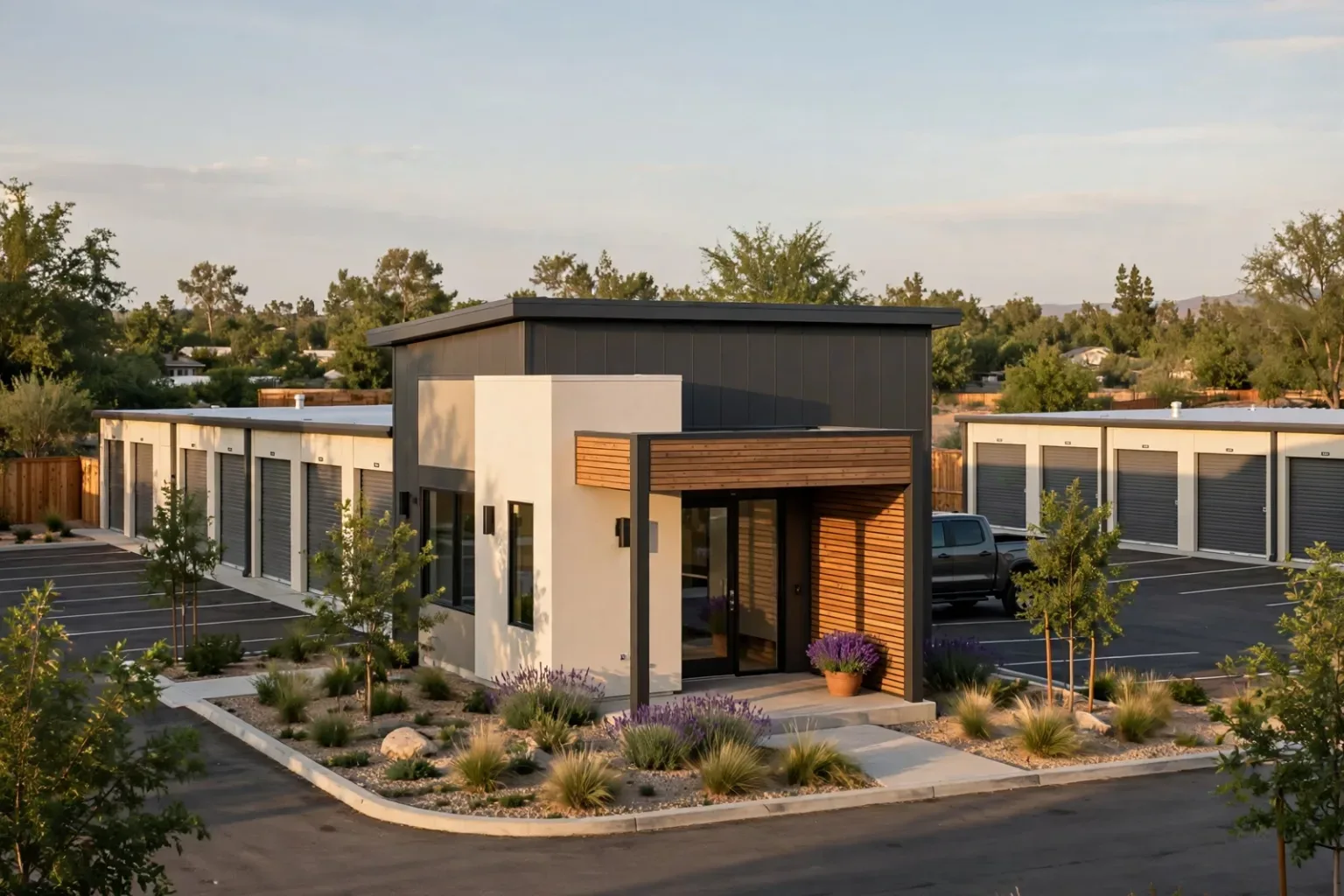
The self-storage industry is dominated at the institutional level by large REITs and private equity — Public Storage, Extra Space, CubeSmart. But below $3M, facilities change hands regularly, and most buyers have no institutional backing. Traditional CMBS won’t touch a $1.5M storage deal. Regional banks will lend but typically offer 5-year balloons with local market quirks. SBA 7(a) adds recourse. DSCR-style financing fills the gap, but the lender pool is narrow and the underwriting logic differs from residential DSCR in ways that matter. This article covers how lenders think about self-storage, where the traps are, and how the financing structures compare head to head.
For the baseline on how DSCR underwriting works, see what is a DSCR loan. For a comparison of DSCR vs. traditional commercial mortgages, see DSCR vs. commercial mortgage.
The Sub-$3M Self-Storage Market — Too Small for Institutional, Right for DSCR
The institutional investment threshold for self-storage is roughly $5M–$10M for individual facilities in most markets. Below that, deals fall to local and regional buyers: individuals, small partnerships, and emerging operators. The financing options shift accordingly.
CMBS originators prefer larger loan sizes ($3M+) because the fixed costs of securitization don’t scale down gracefully. Agency programs (Fannie/Freddie) don’t cover commercial property types. That leaves four realistic options for a $1M–$3M storage facility:
- DSCR / business-purpose non-QM
- SBA 7(a)
- Community bank portfolio loan
- Seller financing
Of these, DSCR offers the best combination of non-recourse structure, speed, and standardized underwriting — for facilities that can document stabilized performance. The critical caveat: most residential DSCR lenders exclude self-storage. This is a commercial property type, and the lenders who handle it are commercial DSCR or business-purpose lenders, not the same programs used for SFR and small multifamily.
Use the cap rate and NOI calculator to validate your facility’s income before engaging any lender — accurate NOI is the foundation of every DSCR conversation.
How DSCR Underwriters Treat Self-Storage Occupancy Data
Self-storage occupancy has a specific structure that differs from residential vacancy. Instead of whole-unit vacancy (the unit is either leased or empty), storage facilities have unit-mix occupancy across multiple unit types — 5x5, 5x10, 10x10, 10x20, climate-controlled, drive-up, etc. The revenue is unit rent × occupancy per type, plus premium rates for climate-controlled and drive-up units.
Lenders handle this in three ways:
Trailing-12 (T-12) actuals. Most preferred. The lender reviews 12 months of monthly operating statements and rent rolls, calculates average occupancy across the period, and applies that occupancy rate to current unit rents. If the facility ran at 87% average occupancy over T-12, the DSCR is calculated at 87% of potential gross income — not at current 92% if occupancy has recently increased.
Trailing-3-month actuals with discount. Some lenders accept T-3 data but apply a 5–10% haircut to current income to stress-test against recent performance. This can be more favorable than T-12 if the facility recently went through a lease-up or renovation that depressed historical occupancy.
Pro-forma or stabilized projection: not accepted. This is the single most common mistake in self-storage DSCR submissions. An offering memorandum may project income at “stabilized” 92% occupancy when the facility has been running at 72% for the past 12 months. DSCR lenders will not underwrite to the pro-forma — they underwrite to what the facility has actually done. Submitting a deal with projected stabilized income as the DSCR basis will result in a dead file.
Lease-up facilities. For facilities below 80% economic occupancy on T-12, most DSCR lenders will decline or require a significant LTV reduction (50–60%) and higher reserves. The exception is conversions (retail or industrial space being converted to storage), which have specific underwriting treatment covered below.
DSCR vs. SBA 7(a) vs. CMBS for Self-Storage
For a sub-$3M self-storage acquisition, the realistic comparison is between DSCR, SBA 7(a), and community bank portfolio loans. CMBS is included for reference on deals approaching $3M:
| Structure | Max loan | Term / Amort | Prepay | Recourse |
|---|---|---|---|---|
| DSCR (commercial non-QM) | Up to $3M at most lenders | 5-year fixed / 30-year amort; some 10-year available | 3-2-1 or 5-4-3-2-1 step-down | Non-recourse at most lenders |
| SBA 7(a) | Up to $5M | 25 years fully amortizing | None (first 3 years on loans >15 years: 5%–3%–1%) | Full personal recourse |
| CMBS | $2M practical minimum; no cap | 10-year IO then 30-year amort | Yield maintenance or defeasance | Non-recourse with bad-boy carve-outs |
| Community bank portfolio | Typically $500K–$2M | 5–7 year balloon, 20–25 year amort | Varies; often 1–3% declining | Full recourse; guarantor required |
Reading the table for a typical sub-$2M deal:
DSCR wins on recourse and flexibility. If you do not want personal liability exposure, DSCR is essentially the only option in this size range — SBA and community bank loans require recourse, and CMBS minimum loan sizes put most sub-$2M deals out of reach.
SBA wins on term certainty. The 25-year fully amortizing structure means no balloon refinance risk. For investors who plan to hold the facility for 10+ years, this matters more than the recourse obligation.
CMBS is relevant if the facility is valued above $2.5M and you want long-term fixed financing. Yield-maintenance prepayment is punitive if you sell early, but for a 10-year hold, the rate differential may justify it.
Storage Deal Under Contract? We'll Quote DSCR and SBA in Parallel.
Send us the T-12 and we'll model both structures — closing timeline, monthly payment, recourse exposure, and total cost — before you commit.
Conversions (Retail → Storage) — The Lease-Up DSCR Problem
Retail-to-storage conversions are one of the more active niches in self-storage right now, driven by high vacancy rates in small-box retail and the relative simplicity of converting these spaces to climate-controlled storage units. From an operational standpoint, conversions often pencil well — the acquisition price for a closed retail property can be low relative to the storage income it will generate once stabilized.
From a DSCR financing standpoint, conversions are difficult for one reason: the property has no T-12 storage operating history.
Most DSCR lenders require documented operating history at or above the minimum DSCR. A conversion property, by definition, cannot provide this until it has been operating as storage for at least 12 months. The implications:
That decision sits inside our DSCR Authority Blog hub, where DSCR Authority maps program fit and what investors usually prep before booking a strategy call.
That decision sits inside our DSCR Authority Blog hub, where DSCR Authority maps program fit and what investors usually prep before booking a strategy call.
- At acquisition: DSCR financing is generally not available. Bridge financing (hard money or bank construction/conversion loan) is the typical vehicle.
- After 12 months of operation above 85% occupancy: DSCR financing becomes available for a refinance.
- During lease-up (0–85% occupancy): DSCR lenders may offer a “lease-up program” at 55–65% LTV with reserves, but these are specialty programs with narrow availability.
The capital stack for a conversion typically looks like this: bridge loan at acquisition → conversion capex → 12 months lease-up → DSCR refinance to take out the bridge. Investors who plan to use DSCR at conversion acquisition are working from an incorrect assumption about the product’s availability.
Additionally, climate-control capex is consistently underestimated in conversion pro-formas. HVAC for climate-controlled storage runs $2–$4 per square foot annually in operating cost, and the upfront conversion cost for a 20,000 sq ft retail space can exceed $300,000. Lenders see these numbers and require them to be reflected in the operating expense model — not hidden in pro-forma net income projections.
Worked Example: 240-Unit Facility, $480K NOI, $2.1M Ask
The facility: 240 units, mix of 5x10, 10x10, and 10x20 in a mid-sized Ohio market. Current average rent per unit: $125/month blended. T-12 economic occupancy: 88%.
Income calculation:
- Potential gross income: 240 units × $125 × 12 = $360,000
- Vacancy at 12% (100% - 88% occupancy): -$43,200
- Ancillary income (insurance, late fees — excluded for DSCR): $0
- Effective gross income (EGI): $316,800
- Operating expenses (35%): -$110,880
- NOI: $205,920
Note: the $480K NOI referenced in the brief applies to a larger or higher-rent facility; this 240-unit mid-Ohio example at $125 blended rent generates approximately $206K NOI.
DSCR at $1.6M loan (76% LTV on $2.1M), 7.75% rate, 30-year amort:
- Monthly payment: ~$11,456
- Annual PITIA: $137,472
- DSCR: $205,920 / $137,472 = 1.50 — qualifies
DSCR at $1.6M loan, SBA 7(a) at 9.75% blended (Prime + 2.75%), 25 years:
- Monthly payment: ~$14,486
- Annual PITIA: $173,832
- DSCR: $205,920 / $173,832 = 1.18 — below most lenders’ 1.20 minimum
What the comparison shows:
The DSCR loan clears more cleanly because the 30-year amortization produces a lower payment than SBA’s 25-year schedule at a higher rate. However, DSCR at this lender has a 5-year balloon — at year 5, the investor must refinance or sell. SBA has no balloon and runs to full term.
For a hold of less than 7 years with no recourse preference, DSCR wins. For a 15-year-plus hold with full amortization preference, SBA wins despite the coverage being tighter. Use our DSCR calculator to model your specific facility against both rate environments.
Common Mistakes in Self-Storage DSCR Submissions
Submitting pro-forma income as the DSCR basis. If the offering memorandum shows 92% occupancy “at stabilization” and T-12 actual occupancy was 74%, the lender will calculate DSCR at 74%, not 92%. The gap between pro-forma and T-12 actuals is the most common reason self-storage DSCR deals come back with unexpectedly low appraisal values and lower-than-expected loan amounts.
Including ancillary income (insurance, late fees, truck rental) in the DSCR calculation. These income lines are real but are treated as non-recurring or unreliable by most DSCR lenders. Model your qualifying DSCR on unit rents only. If ancillary income pushes you above the DSCR threshold, assume a lender will strip it and recalculate.
Ignoring climate-control capex in operating expenses. HVAC maintenance, filter replacement, and energy costs for climate-controlled units run materially higher than drive-up unit expenses. Investors who use a flat 30% expense ratio on a climate-controlled facility are likely understating expenses by 5–10 percentage points, which depresses NOI and reduces the loan amount the DSCR supports.
Assuming a residential DSCR lender will handle the deal. The lenders who close residential SFR and small multifamily DSCR are almost never the same lenders who close self-storage DSCR. If you submit a storage facility to a residential DSCR lender without confirming their commercial property acceptance, you are likely wasting 3–4 weeks in a dead underwriting queue.
If you have a self-storage facility under contract and want both a DSCR quote and an SBA quote on the same deal, book a structured-finance call at /book-strategy-call/ — we’ll run both structures against your T-12 and show you the closing timeline, monthly payment, recourse exposure, and total cost side by side before you commit to a lender.