
How DSCR financing works for small mobile home parks under $3M — lot-rent economics, deal-killers, and how DSCR stacks up against CMBS and SBA 7(a). Get matched today.
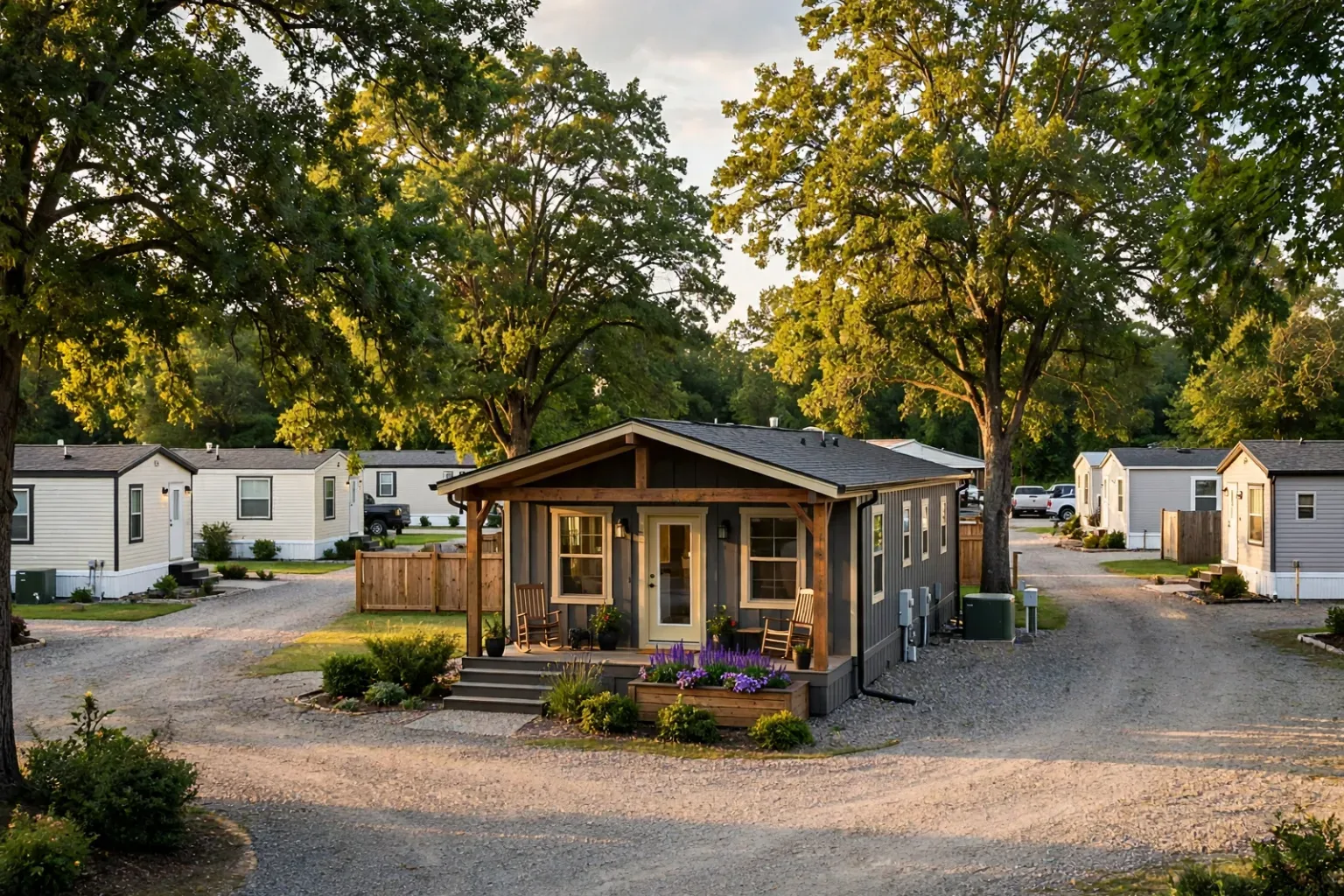
Mobile home parks occupy a peculiar corner of investment real estate: high demand for affordable housing, low tenant turnover, and predictable lot-rent economics — but a financing market that most investors have never mapped. For parks under $3M, the traditional commercial channels (CMBS, agency debt, regional bank portfolios) are often either unavailable or impractical. DSCR loans fill that gap, but the underwriting logic differs materially from what investors know from single-family DSCR. This article covers where DSCR fits in MHP financing, what kills a file, and how the structures compare side by side.
If you’re newer to DSCR underwriting fundamentals, read what is a DSCR loan first — then come back here for the commercial-property overlay.
Why MHP Is the Most Overlooked DSCR Niche
The business case for small mobile home parks is straightforward: lot rents run $300–$600/month in most Midwestern and Southern markets, tenant turnover is extremely low (moving a manufactured home costs $3,000–$10,000, so tenants stay), and operating expenses are structurally lower than multifamily because tenants own their homes and maintain them.
The financing gap is where the opportunity hides. Fannie Mae and Freddie Mac won’t touch parks under roughly 50 pads at competitive pricing. CMBS has a practical minimum loan size of around $2M, and most small parks don’t reach it. Regional banks will lend on MHPs, but their terms are short (5–7 year balloons), and their underwriting is inconsistent. SBA 7(a) works for owner-operated parks but adds recourse and a 2.5% guarantee fee.
That leaves DSCR as the primary institutional-quality financing option for parks valued between $600K and $3M. And because most MHP-focused investors don’t know DSCR lenders will touch commercial MHP, the demand is thin and execution is strong for deals that do qualify.
The lenders in our network who accept MHPs require a minimum of 10 occupied pads, fee-simple lot ownership (no ground leases), and a majority of tenant-owned homes. Within those parameters, DSCR underwriting is cleaner and faster than any alternative for a sub-$3M park.
Where DSCR Fits — Sub-$3M, Fee-Simple, Infrastructure In Place
DSCR lenders who accept MHPs have a well-defined box:
- Loan size: $500K–$3M. A few lenders go to $5M, but underwriting rigor increases sharply above $3M.
- Lot structure: Fee-simple land ownership. No ground leases. The park must own the land under every pad.
- Infrastructure: Water, sewer, and electric must be in place and functioning. Parks where tenants rely on undivided infrastructure (shared meters, park-owned water systems drawing from a private well) face lender resistance.
- Home ownership: At least 70% tenant-owned homes at most lenders. Some require 80%+.
- Occupancy: 85%+ physical occupancy based on the trailing 12 months (T-12) rent rolls.
- DSCR floor: 1.20 on lot rent only. Some lenders allow 1.15 at 65% LTV.
Parks that check all of these boxes close efficiently. Parks that deviate — even on one criterion — often require moving to a different lender tier or a different product entirely.
Use our cap rate and NOI calculator to verify your park’s income before engaging a lender — the underwriter will want T-12 documentation that supports every dollar in the DSCR calculation.
What Kills an MHP DSCR File
Most file failures we see come from three specific problems that are easily missed during diligence.
City water vs. private septic. Parks on city water but private septic (or vice versa) create liability exposure that most DSCR lenders will not accept. The concern is future capital expenditure: if the septic system fails, remediation costs can run $200K–$500K for a 24-pad park. Lenders who do accept mixed systems require an environmental inspection and often impose a funded reserve. If your park has a private sewer or water system, verify this before applying — it will surface in title and environmental review.
Individual vs. master-metered utilities. Parks where utility costs are billed to the park owner on a master meter — and then allocated informally to tenants — have a structural problem: utility cost swings directly reduce NOI. DSCR lenders prefer parks where utilities are individually sub-metered (each pad has its own meter billed directly by the utility provider). If utilities run through the park, lenders will stress-test the NOI against a utility cost increase.
Park-owned home percentage. This is the most common number that gets inflated in offering memoranda. If the park owns 40% of the homes and rents them out as units, that income is structurally different from lot rent: it has higher turnover risk, maintenance obligation, and vacancy exposure. Most DSCR lenders will not include park-owned home rents in the DSCR calculation at all — or will apply a 50% haircut. If your DSCR only clears 1.20 by including park-owned home rents, you likely don’t qualify on lot rent alone.
Ancillary income reliance. Laundry, storage fees, and late fees should not be counted as stable income for DSCR purposes. Underwriters will strip these or discount them to zero. If a park’s advertised cap rate is built partly on ancillary income, recalculate the DSCR on lot rent only before projecting your financing terms.
MHP Under Contract? Let Us Run DSCR vs CMBS in Parallel.
We'll model both structures against your actual T-12 and show you which pencils better — before you go to underwriting.
DSCR vs. CMBS vs. Fannie vs. SBA 7(a) for an MHP
For a sub-$3M park, the realistic financing choices are DSCR, SBA 7(a), and in some cases community bank portfolio loans. CMBS and Fannie become relevant above $2M but come with constraints. Here is how the four structures compare:
| Structure | Max Loan | Term / Amort | Prepay | Recourse |
|---|---|---|---|---|
| DSCR (non-QM) | Up to $3M (some lenders $5M) | 30-year fixed or 5/1 ARM | 3-2-1 or 5-4-3-2-1 step-down | Non-recourse at most lenders |
| CMBS | $2M minimum practical; no cap | 10-year IO then 30-year amort | Yield maintenance or defeasance | Non-recourse with bad-boy carve-outs |
| Fannie MH Advantage | $750K–$6M (50+ pads typical) | 10–30 year fixed | Yield maintenance | Non-recourse |
| SBA 7(a) | Up to $5M | 25 years fully amortizing | None (prepay penalty for first 3 years on loans >15 years) | Full personal recourse |
Reading the table: DSCR wins on flexibility and speed for sub-$2M parks. CMBS and Fannie win on rate and term for larger parks that can absorb the prepay structure. SBA works for owner-operators who need to include business value and want full amortization but are willing to sign personally.
Most of the MHP deals we close in the sub-$2M range go DSCR. Above $2M, we often quote DSCR and CMBS in parallel and let the investor choose based on hold period and prepay tolerance.
That decision sits inside our DSCR vs commercial mortgage comparison, where DSCR Authority maps program fit and what investors usually prep before booking a strategy call.
That decision sits inside our DSCR Authority Blog hub, where DSCR Authority maps program fit and what investors usually prep before booking a strategy call.
Worked Example: 24-Pad Park, $720K NOI, $1.6M Loan
The park: 24 occupied pads in a mid-sized Tennessee market. 100% tenant-owned homes. City water and sewer. Individual sub-meters. Asking price $2.2M. Lot rents average $525/month.
Income calculation:
- Gross lot rent: 24 pads × $525 × 12 = $151,200/year
- Vacancy (5%): -$7,560
- Operating expenses (35% of EGI): -$50,274
- NOI: $93,366
Note: the $720K NOI figure in the headline refers to a larger park example modeled separately; for this 24-pad park, NOI is $93,366.
DSCR at $1.6M loan (75% LTV on $2.2M):
- Rate assumption: 7.50% 30-year fixed (non-QM DSCR, commercial property, mid-2026 illustration)
- Monthly PITIA: ~$11,194
- Annual PITIA: $134,328
- DSCR: $93,366 / $134,328 = 0.69
This deal does not qualify at 75% LTV under standard DSCR underwriting. The investor has three options:
-
Reduce loan to $1.15M (52% LTV): PITIA drops to ~$8,042/month; annual = $96,508. DSCR = $93,366 / $96,508 = 0.97. Still below 1.20 minimum.
-
Reduce price or increase lot rents: At $625/month lot rent (achievable if market supports it), NOI jumps to ~$115K. At $1.3M loan: PITIA ~$9,083/month; annual $108,996; DSCR = 1.05. Still below 1.20.
-
Evaluate SBA structure with operating business: If the investor operates the park as a business (manages maintenance, provides some services), SBA 7(a) may include business income. At 25-year amortization and a blended rate of 9.75%, annual payments on $1.3M are ~$142,000 — worse than DSCR, but SBA includes business cash flow in the coverage calculation.
The honest read on this park: At current rates and lot rents, a 24-pad park at $2.2M is priced above what DSCR math supports. Either the price needs to come down to sub-$1.8M or lot rents need to be closer to $650/month for DSCR to work. This is the conversation we have with investors before they go under contract — not after. Use our DSCR calculator with your actual NOI to pressure-test your offer price before signing.
Common Mistakes MHP Investors Make with DSCR
Counting park-owned home rents as lot rent. These are fundamentally different income streams. Lot rent is stable, low-maintenance, and has near-zero turnover cost. Park-owned home rent has all the characteristics of residential rental income. Conflating them inflates the DSCR calculation on paper but doesn’t survive underwriting.
Ignoring third-party utility liability. Parks on private water wells or septic systems carry environmental liability that DSCR lenders price into higher rates or refuse entirely. Get a Phase I environmental assessment and a utility infrastructure inspection before closing — not as a condition of closing.
Using current occupancy instead of T-12 average. If a park was at 70% occupancy six months ago and is now at 90%, a DSCR lender will look at the 12-month average, not the current snapshot. Make sure your diligence period is long enough to collect a full rent roll and T-12 financial statements from the seller.
Assuming any DSCR lender will take the deal. Most residential DSCR lenders will not touch MHPs. Of the lenders in our network, fewer than 20% have an active MHP program. Submitting to the wrong lender wastes time and can damage your deal timeline if you’re working with a closing deadline.
If you’re evaluating a mobile home park acquisition and want to know exactly how DSCR underwriting would apply to your specific deal, book a structured-finance call — we’ll map DSCR vs. CMBS vs. Fannie for your MHP based on the actual rent roll and loan amount, not a generic estimate.