
2026 North Carolina DSCR market brief: non-judicial foreclosure, job-growth metros, Charlotte/Raleigh/Greensboro/Durham underwriting, and current lender appetite.
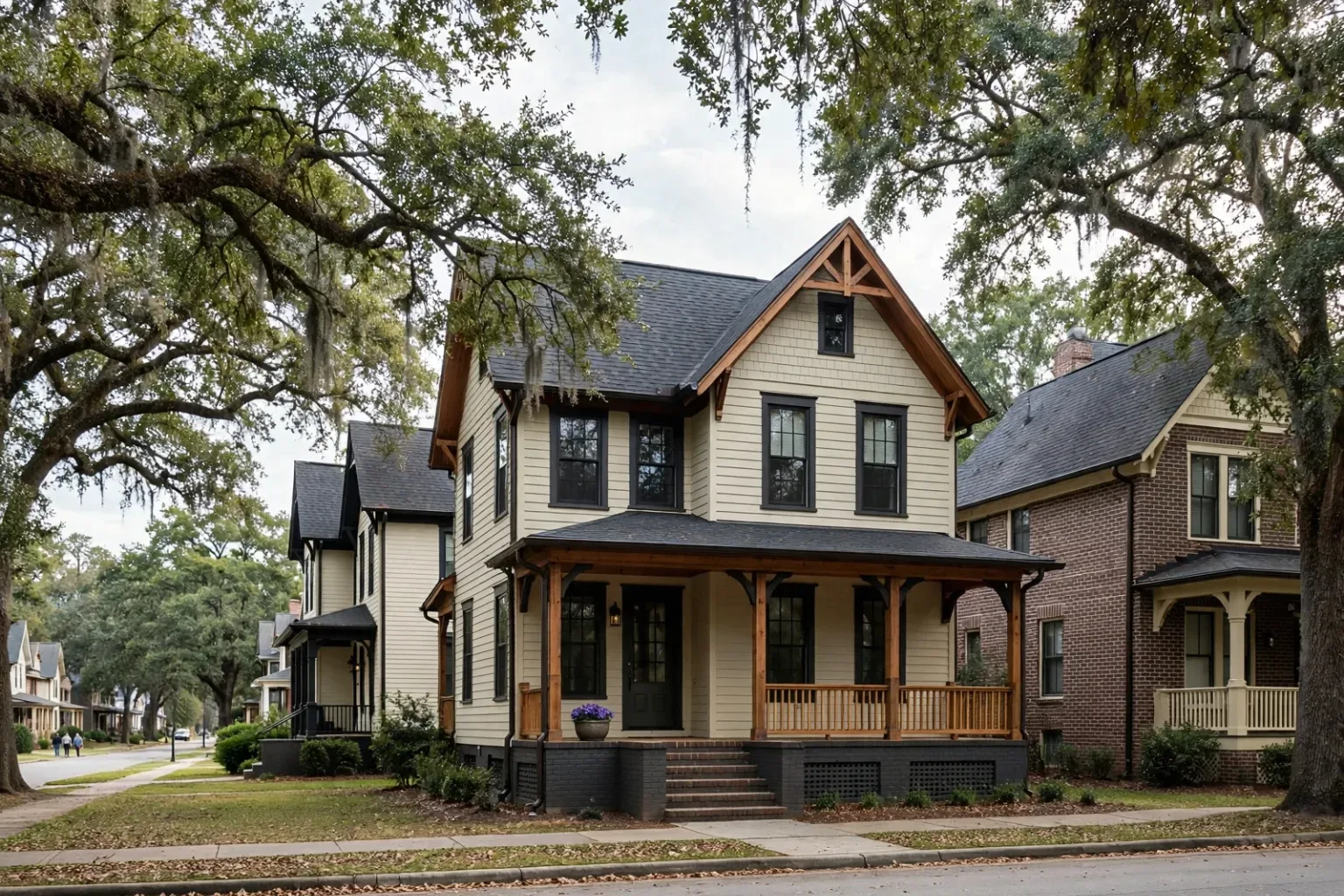
North Carolina draws DSCR investors from two distinct angles. Charlotte and Raleigh function primarily as appreciation plays — home prices have risen sharply over 2020–2025, DSCR ratios are tighter, and investors accept lower current yields in exchange for expected long-term value gains. Greensboro and Durham work more as cash-flow markets where the math clears more readily on a monthly basis. Understanding which market you’re in — and which lenders are built for it — determines whether your deal gets done at competitive terms or at a premium. This guide covers what you need to know about DSCR loans in each of North Carolina’s four major investor markets.
North Carolina market overview
North Carolina’s population has grown faster than the national average for the past decade. The Research Triangle (Raleigh-Durham-Chapel Hill) and Charlotte have attracted major employer relocations and expansions, creating sustained rental demand that DSCR lenders view favorably. DSCR loan volume in North Carolina ranks consistently in the top 10 states nationally.
The state’s investor markets span a wide range: from Charlotte’s $400,000+ SFR stock to Greensboro’s $150,000–$250,000 cash-flow properties to the distinctive Asheville STR market in the western mountains. Typical DSCR loan sizes range from $150,000 to $1.5M, with the bulk of volume concentrated between $200,000 and $650,000.
North Carolina’s landlord-tenant law is balanced, with reasonable eviction procedures, no rent control, and a quasi-judicial foreclosure process that is faster than pure judicial states. These characteristics support healthy lender appetite across all four major markets.
Charlotte
Charlotte is the financial capital of the Carolinas and the second-largest banking center in the US behind New York. The employment base — Bank of America, Wells Fargo, Truist, Honeywell, and a growing tech sector — drives demand for workforce housing in the $1,600–$2,800/month rent band. This is the sweet spot for DSCR investment on SFR and duplex properties in the suburbs.
DSCR math in Charlotte is tighter than secondary NC markets. Median SFR prices in the Charlotte metro (Mecklenburg, Union, Cabarrus, Gaston, Iredell Counties) averaged approximately $390,000 in mid-2025. At 75% LTV and 7.0% rate, monthly P&I on a $292,500 loan is $1,946. Add taxes ($325–$400/month at NC’s ~0.78% effective rate) and insurance ($150–$200/month), and PITIA runs $2,421–$2,546. A property clearing $2,800/month in rent produces a DSCR of approximately 1.10–1.15 — workable, but tight, and leaving limited buffer for vacancy.
Investors who buy in Charlotte generally accept this math as part of an appreciation thesis. The investors who struggle are those who underwrite Charlotte as a cash-flow market and are surprised when deals barely clear 1.0.
Submarkets producing better cash flow within the Charlotte metro: Gaston County (Gastonia, Belmont), Cabarrus County (Kannapolis, Concord), and parts of Rowan County. Prices are $50,000–$100,000 lower than Mecklenburg core while rents remain competitive, improving DSCR by 0.10–0.20.
The Charlotte market also has active 2–4 unit stock; the 2–4 unit DSCR guide covers relevant lender overlays for small multifamily that apply here as in other major metros.
Raleigh
The Raleigh-Durham-Chapel Hill Research Triangle is the most economically dynamic submarket in North Carolina. Research Triangle Park hosts hundreds of life sciences, technology, and government employers. Apple’s $1B campus expansion in the Triangle (announced 2021, ongoing buildout) and hundreds of smaller tech relocations have accelerated in-migration, creating a rental market where vacancy is structurally low.
DSCR in Raleigh proper faces similar math to Charlotte — median prices in Wake County have appreciated significantly, and cap rates on turnkey SFR properties in central Raleigh and desirable suburbs (Cary, Apex, Holly Springs) run 4.5%–6%. These numbers produce DSCRs below 1.0 at 75% LTV in many cases, pushing investors toward either lower LTV (65–70%), no-ratio programs, or suburban markets where the math is more favorable.
The Raleigh cash-flow corridor extends east and south: Johnston County (Smithfield, Selma), Harnett County (Dunn, Lillington), and Lee County (Sanford) offer price points $100,000–$200,000 below Wake County while capturing proximity-to-Raleigh rental demand. These markets are underserved by local lenders but work well with national DSCR programs that don’t apply metropolitan-only underwriting.
Durham, often grouped with Raleigh, is addressed separately below as it has a distinct investor profile.
Greensboro
Greensboro is the prototypical NC cash-flow market. Median SFR prices in Guilford County run $220,000–$280,000 for investor-quality 3BR properties. Market rents in established neighborhoods typically fall in the $1,300–$1,700/month range. That combination produces DSCRs in the 1.20–1.40 range at 75% LTV with 7% rate assumptions — well clear of standard lender thresholds.
The Greensboro economy is diversified: Honda Aircraft Company, FedEx Ground, Volvo Financial Services, and UNC Greensboro anchor the employment base. No single employer dominates, which creates income stability that DSCR lenders view positively compared to single-employer markets.
Lender appetite in Greensboro is strong. The city is large enough to avoid secondary-market overlays at most national DSCR lenders, and the property values are high enough that loan amounts clear the minimum thresholds (most lenders start at $75,000–$100,000; Greensboro deals rarely approach that floor).
The High Point submarket, within Guilford County, offers similar economics with slightly lower price points and a manufacturing/furniture industry employment base. High Point properties sometimes trigger secondary-market flags at lenders less familiar with the Triad — vetting lender appetite specifically for Guilford County is worth doing before committing.
Durham
Durham sits at the junction of research, healthcare, and university employment. Duke University and Duke University Health System are the city’s largest employers, followed by a substantial biotech and life sciences cluster. This employment base creates demand for higher-end rentals from faculty, researchers, and professionals — $1,800–$2,600/month for 3BR properties in desirable Durham neighborhoods.
Durham’s investor market differs from neighboring Chapel Hill (effectively priced out for cash-flow DSCR investment) and splits between appreciation-focused Intown Durham deals and cash-flow-accessible southern Durham and Durham County rural pockets.
Properties in the $200,000–$350,000 range in southern Durham (near RDU Airport, south of I-40) produce reasonable DSCR results. The mix of long-term tenants (university-affiliated), steady in-migration, and competitive rents makes this a sustainable long-term hold market.
Asheville and STR regulation: a critical flag
Asheville deserves specific attention because it is one of the most frequently misunderstood markets for DSCR STR loans.
Asheville passed sweeping short-term rental regulations effective 2023. The core restriction: non-owner-occupied STRs are effectively prohibited in residential zoning districts. The city requires a Homestay permit, but the Homestay classification is limited to owner-occupied properties. Investor-owned properties — the typical DSCR borrower profile — cannot legally operate as STRs in most residential zones in Asheville under the current ordinance.
The consequence for DSCR investors is significant: underwriting Asheville properties on STR income is not viable for non-owner-occupied investment deals in restricted zones. A property that generates $4,500/month as an Airbnb becomes a $1,800/month long-term rental if the investor is non-owner-occupied — a DSCR swing that can turn a passing deal into a failing one.
Investors interested in Asheville should review the STR restricted cities DSCR guide and confirm current permit eligibility with the City of Asheville directly before underwriting. Mountain resort communities outside Asheville’s city limits (Buncombe County unincorporated areas, Waynesville, Brevard) have different — often less restrictive — rules, and some permit STR operation with appropriate county permits.
NC Deal Routing: Cash-Flow or Appreciation Market?
We match Charlotte, Raleigh, Greensboro, and Durham deals to the right DSCR lenders — no STR pitfalls.
North Carolina landlord-tenant law
Foreclosure: North Carolina uses a quasi-judicial (non-judicial) foreclosure process administered through the clerk of superior court. The trustee must file a Notice of Hearing, which is served on the borrower at least 10 days before the hearing. The clerk conducts a hearing to verify the default and note, and if the foreclosure is authorized, a 10-day upset bid period follows. Total minimum timeline from filing to completed sale: approximately 60–90 days for uncontested cases. Contested cases or bankruptcy filings can extend this to 4–6 months. This is faster than full judicial states but somewhat slower than Georgia.
That decision sits inside our DSCR Loans by State hub, where DSCR Authority maps program fit and what investors usually prep before booking a strategy call.
That decision sits inside our DSCR Loans by State hub, where DSCR Authority maps program fit and what investors usually prep before booking a strategy call.
That decision sits inside our DSCR Loans by State hub, where DSCR Authority maps program fit and what investors usually prep before booking a strategy call.
Eviction: Under North Carolina law (G.S. Chapter 42), a landlord must provide written notice of termination before filing for summary ejectment. Notice period is typically 7 days for week-to-week tenancies and 30 days for month-to-month. After the notice period, the landlord files a complaint in small claims or district court. A hearing is typically scheduled within 7–10 days of filing. If judgment is entered for the landlord, the tenant has 10 days to appeal; absent appeal, a writ of possession can be executed. Total timeline from notice to possession: approximately 45–60 days in a standard uncontested case.
Security deposit: NC limits security deposits to 1.5 months’ rent for month-to-month tenancies and 2 months’ rent for fixed-term leases (G.S. § 42-51). Deposit must be held in a trust account and returned (or an itemized list provided) within 30 days of lease termination.
Rent control: Prohibited statewide under G.S. 42-14.1. Local governments have no authority to impose rent stabilization in North Carolina.
Insurance dynamics in North Carolina
Western NC (Asheville, Boone, Brevard, mountain counties): Standard fire and hazard insurance without hurricane loading. However, western NC experienced significant flooding and infrastructure damage from Hurricane Helene in September 2024, which has prompted some insurers to add flood exclusions or increase flood-zone mapping scrutiny in mountain watersheds. Investors in western NC should budget for flood coverage review even on properties not previously in mapped flood zones. Average HO premiums for investor properties in western NC: $1,200–$2,200/year.
Piedmont/Triad (Charlotte, Greensboro, Winston-Salem, Raleigh-Durham): The primary risk driver is hail and wind. The NC Piedmont has seen 20–35% homeowner’s insurance rate increases since 2023, driven by catastrophic hail event frequency. Budget $1,400–$2,500/year for investor SFR properties. Charlotte’s proximity to the coast is not material, but the metro-wide rate increases from hail losses have affected statewide pricing.
Coastal NC (Wilmington, New Bern, Outer Banks, Crystal Coast): Hurricane exposure is the dominant insurance factor. Coastal NC properties require windstorm coverage that can run $3,000–$8,000/year, plus mandatory flood insurance for FEMA flood zone properties (which covers much of the coast). The NC Insurance Underwriting Association (Beach Plan) provides last-resort wind coverage for coastal properties. Lenders require evidence of windstorm coverage for all coastal NC collateral.
North Carolina PPP considerations
North Carolina has no statutory prohibition on investment property prepayment penalties. DSCR loans in NC follow standard national PPP structures. The specific consideration for NC investors: both Charlotte and Raleigh have seen accelerating appreciation, and investors entering in 2024–2026 at higher prices face different refinance scenarios than investors who entered earlier.
If your investment thesis includes refinancing out of the DSCR loan within 3 years (to pull equity or achieve a lower rate after rate normalization), modeling PPP cost against the rate premium is essential. Use the DSCR calculator to run this comparison with your specific loan amount and hold period.
Lender appetite snapshot — North Carolina
| Lender stance | Min loan | Max LTV | Indicative rate range | Notes |
|---|---|---|---|---|
| National DSCR specialists (full coverage) | $100,000 | 80% | 6.50%–7.25% | Active in all four metros; Charlotte/Raleigh strong volume |
| National DSCR specialists (standard) | $75,000 | 75% | 6.75%–7.50% | Full NC coverage; secondary markets without overlay |
| Portfolio lenders (regional) | $150,000 | 75% | 7.00%–8.00% | Carolina-focused; relationship-based terms |
| STR-specialist lenders | $150,000 | 70% | 7.25%–8.00% | Exclude Asheville city limits for non-owner STR; active outside city |
| No-ratio programs | $150,000 | 70% | 7.50%–8.25% | 720+ FICO, 12 months reserves; Charlotte tight-DSCR deals |
Rate ranges are illustrative, sourced from our lender network (August 2026). Individual pricing will vary.
Worked example: Greensboro cash-flow SFR
Property: 3BR/2BA SFR in Guilford County, NC
Purchase price: $245,000
Loan amount (75% LTV): $183,750
Rate: 7.00% / 30-year fixed, 5-4-3-2-1 PPP
Monthly PITIA breakdown:
- Principal & interest (7.00%, $183,750): $1,222
- Property taxes (0.78% effective rate × $245,000 / 12): $159
- Homeowner’s insurance: $160
- Total PITIA: $1,541
Market rent: $1,900/month (3BR in established Guilford County market)
DSCR: $1,900 / $1,541 = 1.23
A 1.23 DSCR clears standard lender minimums with margin for vacancy. Down payment at 25% is $61,250. With 6 months PITIA reserves ($9,246) and estimated closing costs of $6,000–$8,000, total capital required at closing is approximately $76,500–$79,000.
Contrast this with a Charlotte deal at the same 75% LTV: a $390,000 purchase produces a DSCR around 1.10–1.15 — passable, but less resilient to rate movements, vacancy, or insurance cost increases. This is why sophisticated NC investors often run parallel analyses of Charlotte-area markets and Greensboro-area markets before committing capital.
Common mistakes North Carolina investors make
Underwriting Asheville on STR income without permit verification. This is the single most expensive mistake NC DSCR investors make. A deal that pencils on $4,000/month STR revenue may not be lendable if the property is in a restricted zone — and the investor has committed earnest money before discovering this.
Treating Charlotte as a cash-flow market. Charlotte is an appreciation market. Investors who underwrite Charlotte deals with DSCR-first metrics — expecting 1.25+ DSCRs at 75% LTV — often don’t find deals. The investors who succeed understand they’re accepting tighter current yield for expected appreciation.
Missing the suburban cash-flow corridor. Investors focused on Wake County in Raleigh and Mecklenburg County in Charlotte frequently overlook the adjacent counties (Johnston, Lee, Gaston, Cabarrus) where the same job market demand drives rents but prices are meaningfully lower. National DSCR lenders cover these counties without secondary-market overlays.
Ignoring post-Helene flood zone updates in western NC. The 2024 Helene flooding caused FEMA to re-evaluate flood mapping in several western NC watersheds. Properties that were outside flood zones pre-Helene may now face mandatory flood insurance requirements, which affects PITIA and therefore DSCR.
Not verifying that the lender covers the specific NC county. Some DSCR lenders have metro-specific appetites and avoid Tier 3 counties. Verifying county-level lender coverage before ordering the appraisal protects earnest money and avoids costly delays.
Closing
North Carolina’s combination of strong job growth, landlord-friendly law, and diverse submarkets — from the tight but appreciating Charlotte and Raleigh markets to the accessible cash-flow economics of Greensboro and Durham — makes it a durable DSCR lending market. The STR complexity in Asheville adds a layer of due diligence that is manageable with the right preparation.
NC investor? Get pre-qualified now. Get matched and we’ll route your deal to the right lender for your specific NC market, whether you’re cash-flow focused in Greensboro or appreciation-focused in Charlotte.