
2026 Indiana DSCR market brief: Indianapolis sub-$200K cash-flow, Fort Wayne fundamentals, landlord-friendly law, judicial foreclosure, and lender appetite.
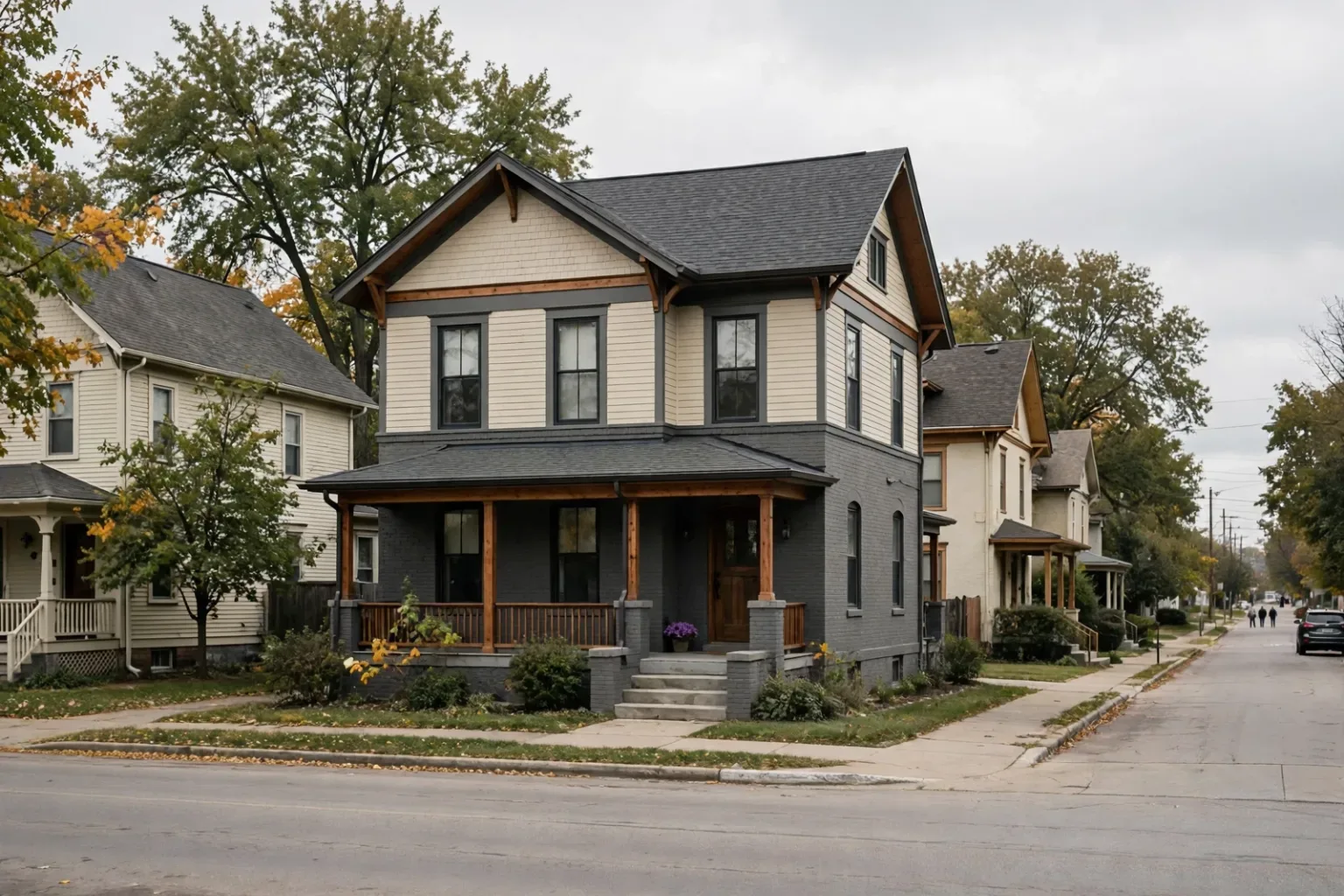
Indianapolis is, by deal volume, one of the most active DSCR markets our team works in — and it doesn’t get the press coverage it deserves. The combination of accessible acquisition prices, strong rent-to-PITIA ratios, a genuinely landlord-friendly legal environment, and low property taxes makes DSCR loan Indiana underwriting produce some of the most consistent approval profiles in our network. This guide covers Indianapolis’s submarkets in detail, adds Fort Wayne and South Bend, and addresses the state-level legal and insurance nuances that determine which lenders will work Indiana deals.
Indiana Investment Market Overview
Indiana’s population has grown modestly — approximately 200,000 net new residents between 2020 and 2024 (U.S. Census Bureau) — with growth concentrated in the Indianapolis Metro Statistical Area (Marion County and surrounding Hamilton, Hendricks, Johnson, and Boone counties). Indiana’s economy is anchored by manufacturing, healthcare (Eli Lilly, Indiana University Health), and logistics, all of which generate stable working-class and middle-class rental demand.
The defining characteristic of Indiana DSCR lending is the rent-to-PITIA ratio. Indiana’s modest property taxes (effective rates averaging 0.8–1.1% of assessed value statewide), affordable acquisition prices, and market rents that have kept pace with price appreciation mean that DSCR ratios frequently come in at 1.10–1.30 on standard 75% LTV structures — a level that clears most mainstream lenders without complicated structuring.
Our Indiana DSCR deal flow ranges from roughly $90,000 (Fort Wayne SFR) to $500,000 (Indianapolis multifamily or suburban SFR), with the median around $165,000. Unlike Ohio, where a significant portion of inventory falls below $100,000, Indiana’s investor market is more concentrated in the $100,000–$200,000 range — still accessible, but above the minimum loan cutoffs of most national DSCR programs.
Indiana state income tax is a flat 3.15% on adjusted gross income as of 2026. Local county taxes add 0.35%–2.9% depending on county. Rental income is subject to this combined rate, which is modest but higher than no-income-tax states. On a $15,000 annual net rental profit, the state + county tax burden runs $525–$900 — not a deal-breaker but relevant to after-tax return modeling for out-of-state investors.
Top Indiana Cities: Cash Flow and Growth
Indianapolis
Indianapolis is our primary Indiana market and one of the highest-volume individual markets in our entire DSCR network. The metro’s investment thesis is straightforward: large inventory of SFR and small multifamily at accessible prices, strong rental demand from a diversified employment base, and predictable fundamentals that have not experienced the boom-bust volatility of high-growth Sunbelt markets.
Investor submarket breakdown:
- Lawrence, Warren Township, Beech Grove: East-side Indianapolis outer ring. Acquisition prices $100,000–$155,000, rents $1,050–$1,350/month. Strong working-class rental demand. Section 8 concentration in some areas.
- Southport, Perry Township: South Indianapolis. Prices $120,000–$175,000, rents $1,100–$1,450. Good tenant quality, suburban character.
- Pike Township, northwest Indianapolis: Prices $130,000–$190,000, rents $1,200–$1,550. More diverse tenant mix.
- Near Eastside/Bates-Hendricks (emerging): Urban renovation opportunity. Prices $80,000–$150,000 (pre-renovation) with strong upside. More sophisticated value-add play requiring experienced management.
- Fishers, Carmel, Noblesville (Hamilton County): Northern suburbs. Prices $250,000–$400,000, rents $1,800–$2,400. Better tenant quality, lower management intensity, tighter DSCR coverage (often 1.0–1.10 range).
DSCR profile: Strong across most Indianapolis submarkets. The east-side and south-side outer ring produces the best DSCR ratios. Hamilton County suburbs produce more moderate ratios but with lower management burden.
Investor strategy: Cash-flow primary in Marion County outer ring. Appreciation plus cash-flow in Hamilton County suburbs. Small multifamily (duplex, triplex) is a high-return strategy in Indianapolis given the density of available inventory.
Fort Wayne
Fort Wayne is Indiana’s second-largest city and a consistently underrated cash-flow market. The city’s manufacturing base (General Motors transmission plant, various tier-1 auto suppliers) and healthcare employment (Parkview Health, Parkview Regional Medical Center) create stable blue-collar and middle-income rental demand.
DSCR profile: Acquisition prices for investor-grade SFRs in Fort Wayne run $90,000–$160,000. Rents in established investor neighborhoods (Southeast Fort Wayne, Waynedale, Georgetown area) are $900–$1,250/month. DSCR at 75% LTV typically falls in the 1.15–1.40 range — strong coverage with modest management requirements.
Investor strategy: Cash-flow primary. Fort Wayne doesn’t have the same appreciation narrative as Indianapolis, but it produces reliable, quiet DSCR performance. Investors who want consistent $150–$300/month net cash flow per door without constant management attention find Fort Wayne productive.
Minimum loan watch: Fort Wayne acquisition prices sometimes fall below $100,000, triggering minimum loan constraints at some national DSCR programs. Confirm minimum loan size before committing to a deal in the sub-$100,000 price range.
South Bend
South Bend’s investment market is shaped by two distinct demand drivers: University of Notre Dame (which creates strong rental demand in neighborhoods within walking distance) and a working-class industrial base (the Elkhart County RV manufacturing corridor is nearby).
DSCR profile: Notre Dame-adjacent neighborhoods (near campus, Howard Park, Indiana Avenue corridor) support rents of $1,200–$1,600 on acquisition prices of $120,000–$200,000. DSCR ratios are generally in the 1.10–1.25 range on standard 75% LTV.
Student housing note: Properties clearly marketed or positioned as student housing (multiple unrelated occupants, lease structures tied to academic calendar) can trigger overlay restrictions at some DSCR lenders. Confirm with your lender whether the property’s intended tenant profile triggers any student housing overlays. Our DSCR student housing guide (coming) covers this in detail.
Investor strategy: Cash-flow in the Notre Dame corridor. Longer-term hold works given the institutional anchor; turnovers tend to be predictable (academic year calendar).
Muncie/Anderson/Kokomo (secondary markets): These smaller Indiana cities have extremely low acquisition prices ($50,000–$90,000) with rents of $700–$950/month. DSCR ratios on paper are excellent, but minimum loan size constraints at national lenders eliminate most deals. These markets are primarily served by local community banks and portfolio lenders rather than national DSCR programs.
Indiana Landlord-Tenant Law
Indiana’s landlord-tenant framework is considered one of the more landlord-friendly in the Midwest.
Eviction timeline: For nonpayment of rent, Indiana requires a 10-day notice to pay or vacate (Indiana Code §32-31-1-6). After the notice period, the landlord can file an eviction lawsuit in small claims or superior court. Hearings are typically scheduled within 10–14 days. An uncontested case results in a judgment within 2–3 weeks of the hearing; physical eviction via sheriff’s writ follows within days. Total timeline in an uncontested case: 5–7 weeks from initial notice to physical possession — faster than Ohio and much faster than Florida’s judicial process.
Security deposit limits: Indiana does not cap security deposit amounts (Indiana Code §32-31-3-9). Landlords can charge any amount. The landlord must return deposits within 45 days of lease termination with an itemized accounting of deductions.
Rent control: Indiana has no statewide rent control. State law (Indiana Code §36-1-20) explicitly prohibits local governments from enacting rent control ordinances. No Indiana city has rent control, and state law prevents any from being enacted.
Landlord entry requirements: Indiana requires landlords to provide reasonable notice (typically 24 hours is the standard applied by courts, though not specifically set in statute) before entering a rental unit for repairs or inspections. This is consistent with most landlord-friendly states.
Tenant remedies: Indiana tenants have limited self-help remedies compared to states with stronger tenant protection laws. Retaliatory eviction claims are recognized but have a relatively high burden of proof. This is a modest risk factor but not a systematic barrier for landlords.
Judicial foreclosure: Indiana requires court-supervised foreclosure. Marion County (Indianapolis) typically processes uncontested residential investment property foreclosures in 6–9 months from filing to sheriff’s sale. Allen County (Fort Wayne) moves similarly. Contested cases or bankruptcy filings can extend significantly. This timeline is longer than non-judicial states (Texas, Tennessee) but generally faster than Ohio’s congested Cuyahoga County courts.
Indiana STR Regulation
Indiana does not have a strong STR tourism market at the state level — the state doesn’t have Florida’s beaches or Tennessee’s Smoky Mountains. STR activity is concentrated in a few specific contexts:
Indianapolis: STR registration required. Marion County requires permits for short-term rental operations. No hard permit cap as of 2026, but compliance enforcement has increased since 2024. The STR market is primarily driven by convention visitors, race fans (Indianapolis Motor Speedway hosts IndyCar and NASCAR events), and college sports visitors.
Indiana Dunes (Porter County, Lake Michigan shore): A genuine seasonal STR market driven by proximity to Lake Michigan beaches (Indiana Dunes National Park). Properties in Portage, Michigan City, and Ogden Dunes rent for $2,500–$4,000/month during peak season. This is a summer-seasonal market with meaningful off-season softness. DSCR lenders with STR programs that work here typically apply seasonal haircuts.
That decision sits inside our DSCR Authority Blog hub, where DSCR Authority maps program fit and what investors usually prep before booking a strategy call.
That decision sits inside our DSCR Loans by State hub, where DSCR Authority maps program fit and what investors usually prep before booking a strategy call.
That decision sits inside our DSCR Loans by State hub, where DSCR Authority maps program fit and what investors usually prep before booking a strategy call.
Notre Dame area (South Bend/Mishawaka): Limited STR activity around game weekends. Not a reliable full-year STR income basis for DSCR underwriting.
For most Indiana DSCR investors, STR is not the primary income thesis — long-term and mid-term rental is the dominant strategy.
Indiana Insurance Dynamics
Indiana’s property insurance market is stable and reasonably priced. No major hurricane exposure, no wildfire risk, and manageable weather events make Indiana one of the lower-cost states for landlord insurance.
Key considerations:
- Annual premiums: Typical SFR landlord policy in Indianapolis runs $900–$1,600/year. Fort Wayne and South Bend are similar. These are comparable to Ohio and meaningfully lower than Florida or coastal Texas.
- Tornado risk: Indiana sits within the tornado-prone corridor of the Midwest. West-central and southwest Indiana (Terre Haute, Kokomo areas) have higher frequency than Indianapolis or Fort Wayne. Wind coverage is included in standard landlord policies — no separate windstorm endorsement required as in Florida.
- Flood zones: A few Indianapolis neighborhoods near the White River and Fall Creek have NFIP requirements. Most investor submarkets are outside Zone AE/A. Fort Wayne has some flood risk along the Maumee River system.
Low insurance costs are a quiet contributor to Indiana’s favorable DSCR ratios. Where Florida insurance can add $400–$600/month to PITIA, Indiana’s adds $75–$135/month — a difference of $270–$460/month that directly improves DSCR coverage on otherwise identical deals.
Indy Investor? We Close Indiana DSCR Loans Every Week
Our lender network covers Indianapolis sub-$200K SFR, small multifamily, and Fort Wayne cash-flow deals with 24-hour quote turnaround.
Indiana Prepayment Penalty Rules
Indiana has no specific state law restricting prepayment penalties on investment property DSCR loans. DSCR loans are non-QM products, and PPP terms are governed by the loan agreement.
Standard Indiana DSCR deals are offered with 3-year or 5-year step-down prepayment penalties (5-4-3-2-1%). For Indianapolis investors with a defined 5+ year hold strategy, taking a 5-year PPP in exchange for a lower rate (typically 0.35–0.50% lower) usually makes sense. For investors using a BRRRR strategy who plan to refinance within 2–3 years, a shorter or no-PPP structure reduces exit friction.
Indiana’s judicial foreclosure process (6–9 months in Marion County) is slower than non-judicial states but doesn’t appear to create systematic rate overlays at most DSCR lenders the way Ohio’s Cuyahoga County backlogs can. Indiana is generally priced at or near non-judicial-state rates in our network.
Blanket loan structures: Indianapolis is one of the most active states in our network for blanket/portfolio DSCR loans — investors acquiring 5–15 properties under a single loan. Blanket loan PPP structures have nuances (often property-release premiums rather than per-loan PPPs). Investors building Indianapolis portfolios should model blanket loan structures before assuming single-asset DSCR is the right vehicle. Our portfolio vs. blanket loan guide (coming) covers this decision in detail.
Lender Appetite Snapshot
Indiana, and Indianapolis specifically, is a well-regarded core market for national DSCR lenders. Lender appetite is broad, and the rent-to-price fundamentals mean deals are frequently clean from an underwriting standpoint.
| Lender Stance | Min Loan | Max LTV | Rate Range | Notes |
|---|---|---|---|---|
| Aggressive (IN-friendly, small loans accepted) | $75,000 | 80% | ~6.25–6.85% | 0.75 DSCR min, Section 8 accepted, Indianapolis approved |
| Mainstream (standard DSCR) | $100,000 | 75–80% | ~6.50–7.10% | 1.0 DSCR min, 660 FICO, 6 months reserves |
| Conservative (judicial foreclosure overlay) | $150,000 | 70–75% | ~6.75–7.35% | 720 FICO, avoids sub-$100K deals |
| Multifamily specialist (2–4 units) | $125,000 | 75–80% | ~6.60–7.20% | DSCR calculated on gross rent roll, favorable for duplex/triplex |
| No-ratio programs | $125,000 | 70–75% | ~7.25–7.85% | 720 FICO minimum, 12 months reserves |
Rate ranges are illustrative (mortgage-info.com, August 2026). Indiana’s judicial foreclosure timeline can produce slight rate premiums at some lenders versus Texas or Tennessee — verify by lender. The 2–4 unit multifamily segment often has more favorable program terms in Indiana because of the strong rent roll relative to purchase price on Indianapolis duplexes and triplexes.
Worked Example: Indianapolis SFR, South-Side Marion County
Scenario: 3-bedroom SFR in Perry Township (Indianapolis), Marion County. Purchase price $155,000. Market-rate tenant.
| Item | Monthly | Annual |
|---|---|---|
| Market rent (3BR, Perry Township 2026) | $1,350 | $16,200 |
| Loan: 75% LTV ($116,250 at 6.75%, 30yr) | $754 | $9,048 |
| Property tax (Marion County ~1.0% of assessed) | $129 | $1,550 |
| Insurance (landlord policy, Indiana) | $108 | $1,300 |
| Total PITIA | $991 | $11,898 |
| DSCR = $1,350 / $991 | = 1.36 | — |
At 1.36, this deal clears every mainstream DSCR lender’s minimum requirement and most conservative programs (1.25 min) as well. The combination of low property taxes and accessible acquisition price is the key driver.
If property is a duplex: A comparable duplex in Perry Township at $210,000 might generate $1,200/unit = $2,400 gross rent.
- Loan at 75% LTV ($157,500 at 6.75%) = $1,021/month
- Property tax at 1.0% = $175/month
- Insurance = $145/month
- Total PITIA = $1,341/month
- DSCR = $2,400 / $1,341 = 1.79
The duplex math illustrates why small multifamily DSCR loans are an active strategy for Indianapolis investors — per-unit rent efficiency dramatically improves coverage ratios compared to SFR at the same price point.
Common Mistakes Indiana Investors Make
Treating all Indianapolis submarkets as equivalent. The DSCR performance difference between Perry Township and Bates-Hendricks (near eastside urban core) is significant — not just in yield but in management intensity, tenant quality, and exit liquidity. Investors from out of state should verify submarket characteristics before contracting, not after.
Not modeling blanket loan alternatives for portfolio acquisitions. Investors acquiring their 3rd, 4th, or 5th Indianapolis property under individual DSCR loans are often leaving blanket loan efficiency on the table. Blanket structures can reduce per-deal transaction costs and simplify management, but they have different PPP and release-price structures. Run both scenarios before committing to a vehicle.
Overlooking Fort Wayne’s minimum loan constraints. Fort Wayne properties in the $90,000–$120,000 range are excellent cash-flow assets, but investors applying to DSCR programs with $150,000 minimums will be declined before underwriting. The lender selection issue is real and specific to deal size.
Underestimating Indiana’s judicial foreclosure timeline. Indiana is not as slow as Cuyahoga County, Ohio, but 6–9 months from filing to sheriff’s sale is meaningfully longer than the 30–60 days available in Texas or Tennessee. Budget for this risk in your operating model — specifically, maintain 3–4 months of gross rent equivalent in reserves per property beyond what the lender requires.
Not verifying Section 8 acceptance by geographic submarket. Some DSCR lenders accept Section 8 income nationally but restrict acceptance in specific MSAs or counties. A few lenders have Indianapolis-approved Section 8 programs but not Fort Wayne or South Bend equivalents. Confirm geographic scope before modeling.
Using acquisition price as assessed value for tax modeling. Indiana’s property tax assessment process involves periodic reassessment cycles. The assessed value used for tax calculation is not necessarily the same as purchase price in all cases. Request the current annual tax bill from the county assessor’s records (available through the Indiana Gateway portal for most counties) rather than estimating from purchase price.
Closing: Indiana DSCR Loans
Indiana, led by Indianapolis, is one of the most consistent DSCR markets our team works in — high volume, clean underwriting fundamentals, and a legal environment that doesn’t generate the same friction as Ohio’s foreclosure courts or Florida’s insurance market. The investors who get the most out of Indiana DSCR are those who understand submarket differences within Indianapolis, model the duplex/triplex opportunity alongside SFR, and work with lenders who know the market well enough to close quickly.
If you have an Indianapolis, Fort Wayne, or broader Indiana deal ready to evaluate, get a quote from our network. We close Indiana DSCR loans weekly and can provide a rate and program comparison within 24 hours of receiving your deal details.