

2026 Alabama DSCR market brief: non-judicial foreclosure, low property taxes, Birmingham cash-flow, Huntsville growth, and Mobile coastal underwriting.
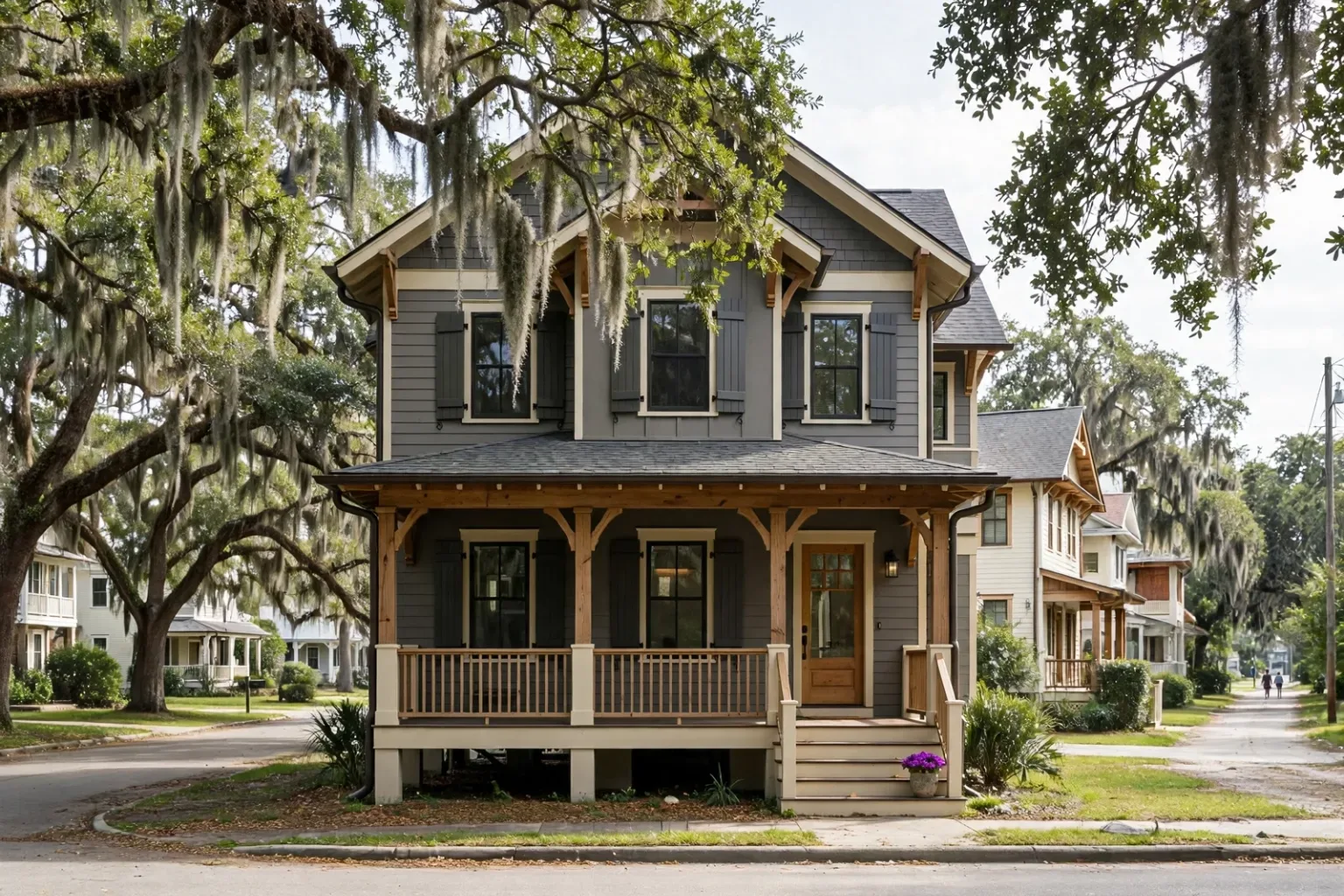
Alabama is an underappreciated DSCR state. Property taxes among the lowest in the country, one of the fastest non-judicial foreclosure timelines, no rent control, and three distinct investment markets — Birmingham’s cash-flow fundamentals, Huntsville’s defense and technology growth trajectory, and Mobile’s coastal economy — give investors meaningful optionality. The state’s lower absolute price points mean loan amounts can approach DSCR lender minimums in secondary submarkets, which is the primary underwriting friction to understand. This guide covers DSCR loan dynamics across all three major Alabama investor markets.
Alabama market overview
Alabama’s residential real estate market is defined by affordability relative to national benchmarks. Median home prices statewide remain well below $250,000, with investor-grade SFR stock in the $100,000–$250,000 range depending on the market. This affordability translates to accessible entry points, but it also means loan amounts in tertiary submarkets can approach the $75,000–$100,000 floor that many DSCR lenders maintain.
Typical DSCR loan sizes in Alabama range from $85,000 to $600,000. The Birmingham and Huntsville metros cluster in the $120,000–$350,000 range for SFR; coastal and luxury properties in Mobile and Baldwin County push higher. Secondary markets in Alabama (Tuscaloosa, Montgomery, Dothan) follow similar economics to Birmingham but with narrower lender coverage.
Alabama’s population trends have improved meaningfully in recent years. Huntsville specifically has grown faster than almost any Southeastern city its size, driven by the federal defense and aerospace workforce. Birmingham’s in-migration is more modest but positive, supported by UAB (University of Alabama at Birmingham) as a healthcare anchor and a growing financial services presence.
Lender appetite for Alabama is generally solid for the major three metros. Statewide appetite thins outside Birmingham-Huntsville-Mobile, and investors in Montgomery or Tuscaloosa should verify lender coverage specifically rather than assuming metro-level programs apply.
Birmingham
Birmingham is Alabama’s primary DSCR cash-flow market. The combination of low purchase prices, reasonable rents, and exceptionally low property taxes creates DSCR math that is favorable even in the current rate environment.
A representative investment scenario: a 3BR SFR in the Greater Birmingham area (Jefferson County, Shelby County, Blount County) purchased for $160,000 at 75% LTV. The loan is $120,000; at 7.0%, P&I is $799/month. Property taxes at 0.41% of assessed value produce approximately $55/month (Alabama assesses at a fraction of market value — typically 10% for residential, with the millage rate applied to assessed value, resulting in effective rates among the lowest nationally). Insurance runs $150–$200/month. Total PITIA: approximately $1,004–$1,054. Market rent for that property: $1,300–$1,500/month. DSCR: 1.23–1.49.
This math is why Birmingham draws yield-focused investors. Cash-on-cash returns in the 10%–14% range are achievable on conservatively underwritten deals — numbers that are difficult to replicate in coastal appreciation markets without significant leverage.
Section 8 density in Birmingham is higher than most metros of comparable size. A significant portion of investor-grade rental stock operates with Housing Choice Voucher tenants, which provides payment reliability but requires lender acceptance. Most DSCR lenders permit Section 8 tenancy; review the Section 8 HAP DSCR guide for the specific programs that accept versus prohibit voucher tenants.
Small multifamily in Birmingham — duplexes and quadplexes — represents another strong DSCR opportunity. Purchase prices on Birmingham duplexes run $100,000–$200,000; combined rents of $2,000–$2,800/month produce DSCR ratios well above 1.25 at 70% LTV even with 7.0% rate assumptions. See the 2–4 unit DSCR guide for lender-by-lender overlay details on small multifamily.
The Birmingham loan-amount consideration: A deal at $160,000 purchase price and 75% LTV produces a $120,000 loan. That clears the $100,000 minimum at most national DSCR lenders. However, investors purchasing below $140,000 (common in tertiary Birmingham submarkets) may need lenders who specifically offer programs starting at $75,000. We maintain relationships with lenders who underwrite at these levels for Alabama.
Huntsville
Huntsville is the growth story of Alabama. The Huntsville MSA has expanded significantly over 2020–2026, driven by growth in the federal defense and aerospace workforce at Redstone Arsenal and the surrounding defense contractor ecosystem. Northrop Grumman, Boeing, Lockheed Martin, Dynetics, and dozens of smaller contractors employ tens of thousands of professionals in the Huntsville market.
This employment base has two DSCR-relevant consequences: strong, stable rental demand from a professional workforce that rents rather than immediately purchases, and rising home prices that have modestly compressed cap rates compared to Birmingham.
Huntsville median SFR prices reached approximately $300,000–$350,000 in mid-2025 for investor-quality properties in the primary submarkets (Madison County, Limestone County). Market rents for 3BR properties run $1,600–$2,200/month depending on quality and location. A deal at $300,000 purchase, 75% LTV, 7.0% rate produces PITIA of approximately $1,745/month (P&I $1,495 + taxes $102 at 0.41% effective rate + insurance $150). At $1,900/month rent, DSCR is 1.09 — passing but tight for many lenders who require 1.20.
The Huntsville investor’s typical approach: either lower LTV (65–70%) to improve DSCR, target newer construction that commands higher rents ($2,000–$2,400 for new 3BR in Madison/Limestone County), or buy in appreciating suburban corridors (Toney, Meridianville, Athens) where prices are still in the $200,000–$260,000 range with rents at $1,600–$1,800.
Huntsville’s growth trajectory justifies an appreciation overlay on top of current cash-flow math. The defense workforce is a sticky employment base — contractors hired for 5-year programs generally don’t move year to year — and Redstone Arsenal continues to receive federal investment, providing longer-term demand visibility.
Mobile
Mobile is Alabama’s port city and the economic center of southwest Alabama and adjacent Mississippi counties. The Port of Mobile (State Docks) is the 12th-largest US port by tonnage (American Association of Port Authorities, 2024), and the logistics, distribution, and manufacturing workforce it anchors creates year-round rental demand.
The Mobile investment thesis differs from Birmingham and Huntsville. Price points in Mobile proper are accessible — investor-grade SFR runs $120,000–$200,000 in established neighborhoods — and market rents of $1,100–$1,600/month produce DSCR ratios in the 1.20–1.40 range on standard underwriting. Mobile operates closer to Birmingham’s cash-flow profile than Huntsville’s growth profile.
The insurance complexity is the Mobile-specific friction for DSCR investors. Mobile County and adjacent Baldwin County (Gulf Shores, Orange Beach, Fairhope) are coastal markets with meaningful hurricane exposure. The 2004 and 2005 hurricane seasons, Ivan and Katrina, remain reference points for the Alabama coastal insurance market. Investors in the Mobile MSA should budget materially more for insurance than Birmingham counterparts.
Baldwin County STR market (Gulf Shores, Orange Beach, Fort Morgan Peninsula) is one of Alabama’s most active STR markets. Gulf Shores and Orange Beach attract Gulf Coast beach tourism with strong summer occupancy. Investors underwriting Baldwin County beach properties on STR income should run scenarios through the STR DSCR analyzer and verify current municipality STR permit requirements — both Gulf Shores and Orange Beach have permitting requirements for short-term rentals.
Model Your Alabama DSCR Numbers
Birmingham cash-flow, Huntsville growth, Mobile coastal — we'll run the numbers and match you to the right lender.
Alabama landlord-tenant law
Non-judicial foreclosure: Alabama is a non-judicial foreclosure state. The process requires publication of a notice of foreclosure sale in a newspaper of general circulation for four consecutive weeks before the sale date. The sale is conducted by the trustee or mortgagee. Total timeline from publication start to completed foreclosure: typically 60–90 days for uncontested cases. Alabama courts generally do not get involved unless a borrower challenges the process, making this one of the faster foreclosure states nationally (National Mortgage Servicing Association data, 2025).
Eviction: Alabama evictions follow a relatively efficient process. For nonpayment of rent, landlords must provide a 7-day notice to pay or quit. If the tenant fails to cure, the landlord files an unlawful detainer action in district or circuit court. A hearing is typically scheduled within 7–14 days of filing. If judgment is entered for the landlord, the tenant may have 7 days to appeal; otherwise a writ of possession is issued. Total timeline from notice to possession: approximately 30–45 days for standard non-contested evictions (Alabama Legal Help, 2025).
Security deposit: Alabama code limits security deposits to 1 month’s rent for unfurnished units. The landlord must return the deposit (or provide itemized deductions) within 35 days of lease termination. (Ala. Code § 35-9A-201 et seq.)
Rent control: None. Alabama has no statewide rent control statute and no city imposes rent stabilization.
Insurance dynamics in Alabama
North Alabama (Huntsville, Decatur, Florence, Tuscaloosa): Standard homeowner’s insurance without significant windstorm premium loading. Primary risk drivers are tornado and hail — Alabama is in the core of Tornado Alley’s eastern branch, and catastrophic tornado events (April 2011 super outbreak, 2019 Lee County tornado) have influenced insurer pricing. Budget $1,200–$2,000/year for investor SFR in northern Alabama.
Birmingham metro: Similar risk profile to north Alabama. Tornado risk is the primary driver, with average investor SFR premiums of $1,200–$1,800/year. The Birmingham market has not experienced the same coastal-driven insurance increases as southeast markets.
Mobile and Baldwin County (coastal): Windstorm coverage is required and material. Hurricane season (June–November) creates significant insurer exposure, and the number of carriers willing to write coastal Alabama has declined post-2005. Investors in Mobile County and Baldwin County should budget $3,000–$7,000/year for combined HO + windstorm coverage, potentially significantly more for older construction or high-value beach properties. The Alabama Insurance Underwriting Association (Wind Pool) serves as a last-resort windstorm insurer for properties that cannot obtain private coverage. Lenders universally require proof of windstorm coverage for Mobile/Baldwin County collateral — failure to account for this in DSCR underwriting is a frequent and costly error.
Flood insurance is separately required for FEMA Special Flood Hazard Area properties. Much of coastal Baldwin County and Mobile Bay-adjacent properties carry flood zone designation.
Alabama-specific PPP considerations
Alabama has no statutory restriction on investment property prepayment penalties. DSCR loans in Alabama follow standard national PPP structures. The specific consideration for Alabama investors: given the cash-flow orientation of most Alabama markets, investors who anticipate refinancing — either to pull equity from appreciation or to reduce rate as market rates normalize — should model their PPP cost against the rate premium for a no-PPP or shorter step-down option.
Use the DSCR calculator to compare the effective cost of 5-year versus 3-year versus no PPP for your specific loan amount and projected hold period.
Lender appetite snapshot — Alabama
| Lender stance | Min loan | Max LTV | Indicative rate range | Notes |
|---|---|---|---|---|
| National DSCR specialists (full coverage) | $100,000 | 80% | 6.75%–7.50% | Active in Birmingham, Huntsville, Mobile |
| National DSCR specialists (secondary) | $75,000 | 75% | 7.00%–7.75% | Cover Jefferson, Shelby, Madison Counties; tertiary limited |
| Portfolio lenders (Alabama-focused) | $100,000 | 75% | 7.25%–8.25% | Relationship-based; more flexible on unusual properties |
| STR-specialist lenders | $150,000 | 70% | 7.25%–8.00% | Active in Baldwin County beach market; require local STR permit |
| No-ratio programs | $150,000 | 70% | 7.75%–8.50% | 720+ FICO, 12 months reserves |
Rate ranges are illustrative, sourced from our lender network (September 2026). Individual pricing will vary.
Worked example: Birmingham SFR cash-flow deal
Property: 3BR/2BA SFR in Shelby County, Alabama (Birmingham suburb)
Purchase price: $175,000
Loan amount (75% LTV): $131,250
Rate: 7.00% / 30-year fixed, 5-4-3-2-1 PPP
Monthly PITIA breakdown:
- Principal & interest (7.00%, $131,250): $873
- Property taxes (0.41% effective rate × $175,000 / 12): $60
- Homeowner’s insurance: $150
- Total PITIA: $1,083
Market rent: $1,450/month (3BR in Shelby County suburb)
DSCR: $1,450 / $1,083 = 1.34
A 1.34 DSCR is comfortably above the 1.20 threshold that most DSCR lenders target, with significant vacancy buffer. Down payment at 25% is $43,750. With 6 months PITIA reserves ($6,498) and estimated closing costs of $5,000–$6,500, total capital required at closing runs approximately $55,000–$57,000.
This economics profile — strong DSCR, modest capital requirements, affordable acquisition — is what drives investor interest in Birmingham. Investors from coastal markets often find Alabama yields materially better than their home state on equivalent capital deployment, which is why out-of-state investors represent a meaningful share of Alabama DSCR volume.
If the investor opts for a no-ratio program at 70% LTV ($122,500 loan), P&I drops to $815, PITIA falls to $1,025, and DSCR improves further — but the investor needs 12 months reserves ($12,300) and a higher FICO floor (720+) to qualify. The tradeoff makes sense primarily for investors who are concerned about DSCR qualification rather than yield optimization, since the standard program already produces a comfortable ratio.
Common mistakes Alabama investors make
Not accounting for windstorm insurance in Mobile/Baldwin County. Investors who underwrite coastal Alabama deals with Birmingham-level insurance assumptions ($150–$200/month) routinely miscalculate PITIA. A $5,000/year coastal wind policy adds $417/month to PITIA — enough to move a 1.30 DSCR to below 1.0 on a smaller loan.
Assuming all DSCR lenders will go below $100K. Birmingham has a segment of the market where investor-quality properties trade below $140,000. At 75% LTV, those deals produce loans of $105,000 or less. Several large DSCR lenders have hard minimums at $100,000 or $125,000 and will not go below. Confirming lender minimum loan amounts before engaging is essential in this market.
Treating Huntsville as a cash-flow market equivalent to Birmingham. Huntsville’s price appreciation means cap rates are lower and DSCR at 75% LTV is tighter than Birmingham. Investors applying Birmingham-style cash-flow underwriting to Huntsville deals often find they need to lower LTV or target higher-rent properties to achieve qualifying DSCR.
Missing the HOA in newer construction. Newer subdivisions in Shelby County, Madison County, and Baldwin County increasingly have HOA fees of $50–$200/month. These fees are part of PITIA for DSCR calculation purposes and reduce the ratio. Verify HOA fees during due diligence before underwriting.
Ignoring Section 8 lender restrictions. Investors targeting Birmingham’s Section 8 market should confirm that their selected DSCR lender permits voucher tenancy before ordering an appraisal. Most lenders do, but a small number have programs that prohibit it, and discovering this restriction late in the process wastes time and may cost earnest money.
Closing
Alabama’s DSCR market rewards investors who understand the state’s geographic diversity. Birmingham delivers dependable cash-flow math. Huntsville offers a growth overlay at tighter current yield. Mobile provides coastal optionality with the insurance complexity that entails. The state’s exceptionally low property taxes, fast non-judicial foreclosure, and no rent control create a landlord-friendly framework that DSCR lenders price favorably.
Birmingham investor? We’ll model your numbers. Get matched and our team will run your deal through the current lender network to find the program that fits your market, loan size, and DSCR within 24 hours.