

2026 Texas DSCR market brief: Series LLC vesting, high property-tax PITIA, Houston/Dallas/San Antonio underwriting, and how lenders price TX deals.
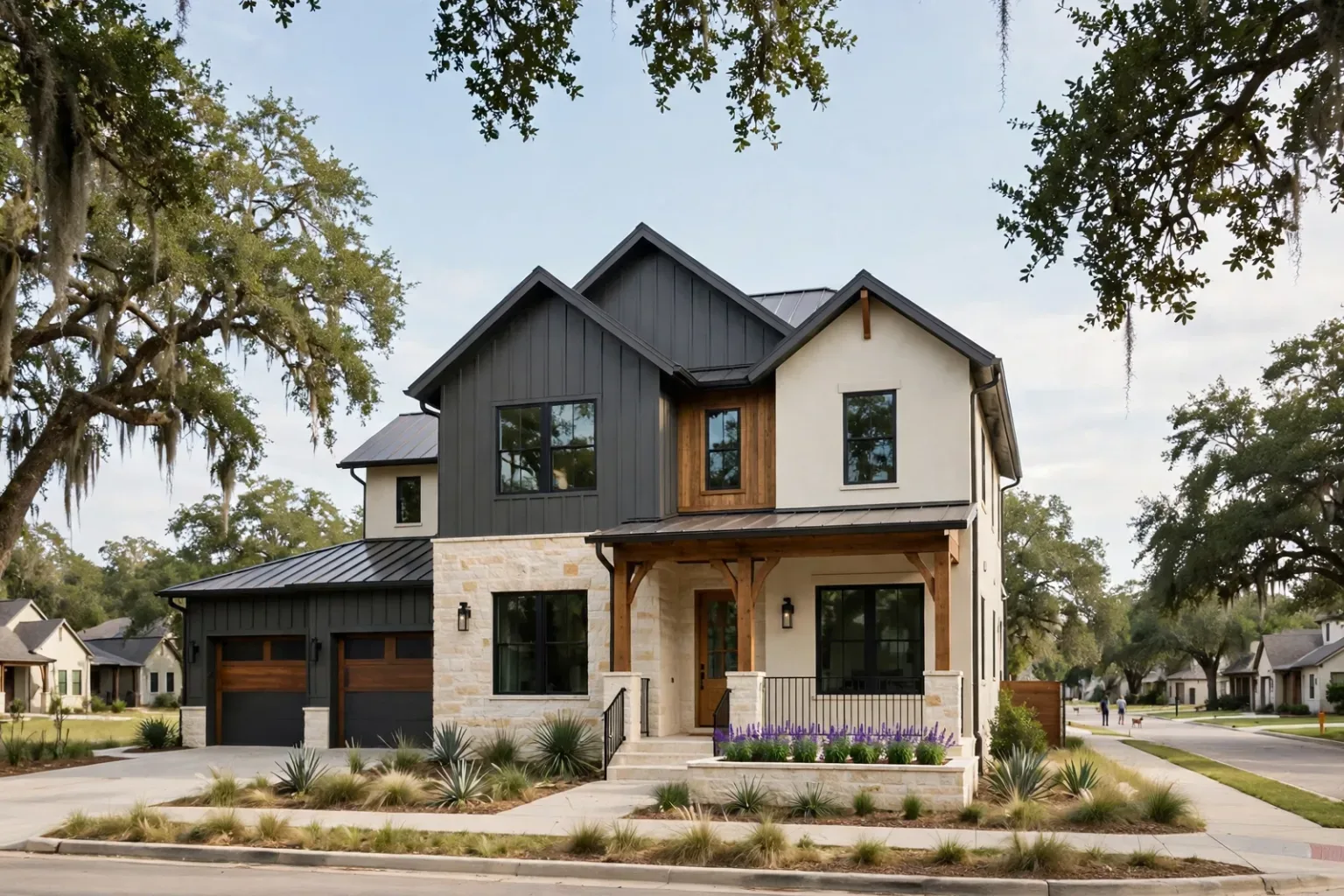
Texas is the second-largest state by population, the top state for in-migration from 2020–2024, and one of the most active DSCR loan markets we work in. Whether you’re buying a single-family rental in Houston, a small multifamily in San Antonio, or a short-term rental near Austin, a DSCR loan Texas lenders will actually approve looks different here than in most other states — primarily because of property taxes. This guide covers the state’s top markets, landlord-tenant law, STR regulation, insurance dynamics, and what our lender network is currently pricing on Texas deals.
Texas Investment Market Overview
Texas attracted roughly 800,000 net new residents between 2020 and 2024 (U.S. Census Bureau estimates), driven by economic migration from California, Illinois, and the Northeast. That population growth has sustained rental demand across every major metro while simultaneously pushing home prices up, which compressed cap rates in the 2021–2023 period.
By 2025, the market had rebalanced. Austin multifamily and condo markets saw price corrections of 10–18% from 2022 peaks (per CoStar data). Houston and San Antonio remained more stable because their price appreciation was more measured. The result in 2026: Texas offers a range of DSCR deal profiles depending on city — from cash-flow-first plays in Houston’s outer rings to appreciation-forward strategies in the DFW suburbs.
Our Texas DSCR deal flow runs from roughly $130,000 to $1.2 million per loan, with the median around $280,000. Loan sizes that are too small (under $100,000) or too large (above $2 million) see fewer program options. Within the middle band, Texas has excellent lender participation.
No state income tax is an important backstory. Texas landlords don’t pay state income tax on rental income. That math improves after-tax cash-on-cash returns and makes Texas attractive to out-of-state investors evaluating net yield comparisons across markets.
Top Texas Cities: Cash Flow vs. Appreciation vs. STR
Houston
Houston is our highest-volume Texas market. The metro’s sprawling geography and affordable land have kept construction active enough that prices remain accessible. Median SFR rents in Houston proper run $1,700–$2,200 per month depending on submarket (HAR Houston Association of Realtors, Q1 2026). Acquisition prices for investor-grade SFRs range from $160,000 in Harris County’s eastern submarkets to $350,000+ in Katy and Sugar Land.
DSCR profile: Outer-ring Houston neighborhoods (Humble, Baytown, Pasadena) offer the best coverage ratios — often 1.10–1.25 on a 70% LTV purchase when modeled at current rates. Inner-loop properties in Montrose or The Heights require careful underwriting given price appreciation without proportional rent growth.
Investor strategy: Cash-flow focused. STR is viable near the Medical Center and downtown, but Houston’s STR ordinance requires registration and limits short-term use in certain zones.
Dallas–Fort Worth
Dallas and Fort Worth form a single economic mega-region but have distinct investor profiles. Dallas proper has strong employment demand and rents ($1,900–$2,600/month median SFR), but acquisition prices in desirable zip codes push cap rates below 5%. Fort Worth’s outer submarkets — Crowley, Burleson, Cleburne — offer better cash-flow math with rents of $1,500–$1,900 against prices of $200,000–$280,000.
DSCR profile: DFW is appreciation-forward in the urban core and cash-flow viable in suburban submarkets. Investors coming from low-yield markets like the coasts often find DFW’s fundamentals attractive on a relative basis even if absolute DSCR coverage is tight.
Investor strategy: Mix. BRRRR and value-add plays are active in South Dallas and eastern Fort Worth, where prices haven’t fully appreciated with the broader market.
San Antonio
San Antonio is our most frequently cited Texas city for favorable rent-to-price ratios. The metro’s military and government employment base provides stable rental demand without the speculative price volatility of Austin. Median SFR rents are $1,400–$1,800 (San Antonio Board of Realtors, 2026), and investor-grade properties in the $150,000–$250,000 range are still available within 30 minutes of the city center.
DSCR profile: Strong. San Antonio frequently achieves 1.15+ DSCR on a standard 75% LTV purchase at current rates. The combination of lower acquisition prices and stable rents is the reason this market appears in our model portfolios.
Investor strategy: Cash-flow primary. STR near the River Walk and downtown is viable but subject to City of San Antonio’s short-term rental ordinance.
Austin
Austin is a correction story. The market that saw 40%+ price appreciation in 2021–2022 has given back 10–18% in some segments (primarily condos and new construction). For DSCR investors, the correction creates opportunity — properties that couldn’t cash-flow in 2022 are now buyable with positive coverage at 75% LTV in submarkets like Round Rock, Cedar Park, and Georgetown.
DSCR profile: Improving. STR-focused buyers can still find favorable AirDNA projections in central Austin neighborhoods, though the City of Austin’s Type 2 STR permit restrictions (limiting non-owner-occupied STR in residential zones) reduce the addressable STR inventory.
Investor strategy: Opportunistic appreciation play, with STR income supplementing long-term hold strategy.
Fort Worth
Fort Worth deserves its own section because of its distinct investment character. The city has seen significant industrial and logistics job growth (BNSF Railway headquarters, Amazon distribution, etc.) that supports blue-collar rental demand. SFRs in the $150,000–$220,000 range in East Fort Worth and Haltom City frequently rent for $1,400–$1,700 per month.
Investor strategy: Cash-flow. Similar to San Antonio but with stronger job diversification and more available inventory in the under-$200,000 band.
Texas Landlord-Tenant Law
Texas is a landlord-friendly state by most measures. Key provisions affecting DSCR investment underwriting:
Eviction timeline: Texas provides one of the shortest eviction timelines in the country. A landlord can file an eviction (forcible detainer) after providing a 3-day written notice to vacate. The Justice of the Peace court can issue a judgment in as few as 10–14 days after filing, and a writ of possession can be issued within 5 days of judgment if not appealed. Total time from notice to physical vacancy: 30–60 days under normal circumstances (Texas Property Code §24).
Security deposit limits: Texas does not cap the amount of a security deposit (Texas Property Code §92.102). Landlords can charge any amount they and the tenant agree to. The law requires return within 30 days of lease termination with an itemized accounting.
Rent control: Texas has no statewide rent control, and state law prohibits municipalities from enacting rent control ordinances (Texas Local Government Code §214.902). No Texas city has rent control.
Self-help eviction prohibition: Texas law prohibits landlords from using self-help remedies (lockouts, utility shutoffs) to remove tenants; formal eviction is required.
For DSCR lenders, Texas’s non-judicial foreclosure process and landlord-friendly environment are explicit risk-reduction factors that support lender appetite for Texas deals.
Short-Term Rental Regulation in Texas
STR regulation in Texas happens at the city level, not the state level. Key city positions as of early 2026:
- Austin: Requires STR permits. Type 1 (owner-occupied) permits are relatively accessible. Type 2 (non-owner-occupied) permits in single-family residential zones are capped and waitlisted — effectively a de facto restriction in many neighborhoods.
- San Antonio: Requires registration with the city. Rules focus on nuisance abatement (noise, occupancy limits) rather than outright prohibition. Investor-owned STR is permitted in most areas.
- Houston: No citywide STR ordinance as of early 2026. Individual HOAs may restrict. This is a key market for STR DSCR because the lack of municipal restriction opens the inventory.
- Fort Worth: Requires registration. No zoning prohibition on STR in most residential zones.
- Dallas: Requires registration. Dallas has explored additional restrictions but had not enacted hard caps as of early 2026.
That decision sits inside our DSCR Loan Guides hub, where DSCR Authority maps program fit and what investors usually prep before booking a strategy call.
That decision sits inside our DSCR Loans by State hub, where DSCR Authority maps program fit and what investors usually prep before booking a strategy call.
That decision sits inside our DSCR Loans by State hub, where DSCR Authority maps program fit and what investors usually prep before booking a strategy call.
That decision sits inside our DSCR Loans by City hub, where DSCR Authority maps program fit and what investors usually prep before booking a strategy call.
That decision sits inside our DSCR Loans by City hub, where DSCR Authority maps program fit and what investors usually prep before booking a strategy call.
That decision sits inside our DSCR Loans by City hub, where DSCR Authority maps program fit and what investors usually prep before booking a strategy call.
That decision sits inside our DSCR Loans by State hub, where DSCR Authority maps program fit and what investors usually prep before booking a strategy call.
That decision sits inside our DSCR Loans by State hub, where DSCR Authority maps program fit and what investors usually prep before booking a strategy call.
STR investors should verify current ordinance status before contracting — this regulatory environment shifts.
Texas Insurance Dynamics
Texas has two distinct insurance challenges: windstorm/hail in inland and Gulf Coast markets, and flood in Houston’s flood-prone corridors.
Hail: Texas consistently ranks among the top states for hail damage claims (Insurance Information Institute). Roof condition and age (typically 15 years maximum for insurable coverage) are material underwriting factors. Lenders will require wind/hail coverage as part of the property insurance policy — some properties in hail-prone zip codes face premium surcharges.
Hurricane/Gulf Coast wind: Properties within 25 miles of the Gulf Coast typically require a separate windstorm policy through the Texas Windstorm Insurance Association (TWIA), the state insurer of last resort. TWIA rates can add $3,000–$8,000+ annually for coastal properties, significantly impacting cash flow. Galveston, Corpus Christi, and coastal Victoria County are the most affected.
Flood: Harris County (Houston) has experienced repeated major flood events (Harvey 2017, multiple tax-day floods). Flood insurance via the National Flood Insurance Program (NFIP) is required for properties in FEMA Special Flood Hazard Areas (Zone A or AE). Premiums vary but $1,200–$4,000 annually is typical for Zone AE properties in Houston’s inner ring. Post-Risk Rating 2.0, NFIP pricing reflects property-specific risk more accurately.
Lenders underwriting Texas deals should always model the total insurance cost before confirming DSCR coverage, particularly in Houston and Gulf Coast markets.
Texas Prepayment Penalty Rules
Texas has no specific state law restricting prepayment penalties on investment property loans. The DSCR loan is a non-QM product, and prepayment penalty terms are negotiated within the loan agreement. Texas homestead law (which does create some restrictions on certain residential mortgage terms) does not apply to investment properties.
Most Texas DSCR deals are offered with 3-year or 5-year step-down prepayment penalties. A 5-1 step-down (5%-4%-3%-2%-1%) is the most common structure. The rate differential between a 5-year PPP and no PPP is typically 0.35%–0.50% in current market conditions. For investors with a defined hold period of 3+ years, taking the PPP in exchange for a lower rate is usually the better math.
Series LLC investors should note that a transfer of ownership between series can trigger the due-on-sale clause, which is structurally similar to a prepayment penalty event. Get written lender confirmation before restructuring entity ownership after closing.
Lender Appetite Snapshot
Texas is a core market for DSCR lending. The following table reflects general program availability in our network as of Q2 2026; individual lender programs change quarterly.
| Lender Stance | Min Loan | Max LTV | Rate Range | Notes |
|---|---|---|---|---|
| Aggressive (Texas-friendly, Series LLC accepted) | $100,000 | 80% | ~6.25–6.75% | Accepts 0.75 DSCR, Series LLC, non-judicial state pricing reflected |
| Mainstream (standard DSCR programs) | $150,000 | 75–80% | ~6.50–7.00% | 1.0 DSCR minimum, 660 FICO, 6 months reserves |
| Conservative (tight overlays on Texas) | $200,000 | 70–75% | ~6.75–7.25% | Excludes coastal/flood zone, 720 FICO minimum |
| STR-specialist | $125,000 | 75% | ~6.75–7.50% | AirDNA underwriting, 700 FICO, 12 months reserves |
| No-ratio programs | $150,000 | 70–75% | ~7.25–7.75% | 720–740 FICO, 12 months reserves, no income/DSCR floor |
Note: Rate ranges are illustrative based on typical 30-year DSCR pricing (mortgage-info.com, June 2026). Actual rates depend on FICO, LTV, loan size, property type, and prepayment structure.
Worked Example: Houston SFR Cash-Flow Deal
Scenario: Single-family rental in Humble, TX (Harris County). 3/2, 1,400 sq ft, built 1998. Purchase price $215,000.
| Item | Monthly | Annual |
|---|---|---|
| Market rent (HAR comparable) | $1,750 | $21,000 |
| Loan: 75% LTV ($161,250 at 6.625%, 30yr) | $1,032 | $12,384 |
| Property tax (2.4% of assessed = $5,160/yr) | $430 | $5,160 |
| Insurance (wind/hail + liability) | $185 | $2,220 |
| Total PITIA | $1,647 | $19,764 |
| DSCR = $1,750 / $1,647 | = 1.06 | — |
At 1.06, this deal qualifies at most mainstream DSCR lenders (minimum 1.0). An investor with 720+ FICO would qualify even with lenders requiring 1.0 at 75% LTV.
If property taxes are underestimated at the original 2.0% rate:
- Taxes at 2.0% = $4,300/yr = $358/month
- PITIA would be $1,575/month
- DSCR = $1,750 / $1,575 = 1.11
The 0.4% difference in tax rate assumption changes the DSCR from 1.06 to 1.11. Always verify the current year’s tax bill from the county appraisal district before modeling. Harris County Appraisal District (HCAD) publishes assessments annually; values can change materially year to year.
Common Mistakes Texas Investors Make
Underestimating property taxes. The most common mistake we see on Texas DSCR submissions is modeling property taxes at 1.5–1.8% of purchase price when the actual county rate is 2.2–2.6% of assessed value. Use the actual tax bill, not an estimate.
Not accounting for TWIA or flood insurance. Gulf Coast investors routinely underestimate total insurance cost when initial quotes don’t include windstorm and flood as separate policies. The deal that pencils on homeowners insurance alone can fail DSCR when windstorm adds $5,000/year.
Assuming all lenders accept Series LLC. Texas investors love the Series LLC structure for liability segregation. But not all DSCR lenders have Series LLC experience. Taking title in a Series LLC at closing with a lender who later discovers they don’t support it creates a workout situation. Confirm entity acceptance before application.
Ignoring Austin’s STR permit cap. Investors modeling Austin STR income based on AirDNA projections without verifying permit availability are taking on regulatory risk. A property that can’t legally operate STR in its zoning district has a fundamentally different income profile than projections suggest.
Treating “non-judicial foreclosure” as always fast. While Texas non-judicial foreclosure is structurally fast, contested foreclosures, bankruptcy filings by tenants, and defective notice procedures can all extend timelines. The structural advantage is real, but don’t assume you’ll never need a lawyer.
Get a DSCR Quote on Your Texas Rental in 24 Hours
We work with 40+ DSCR lenders and know which ones price Texas deals — and accept Series LLCs — right now.
Closing: Texas DSCR Loans
Texas is a deep, landlord-friendly, Series LLC-native market where DSCR lending is active and competitive. The key variables to manage: property tax accuracy in your DSCR model, insurance stacking in coastal and Houston flood-zone markets, and entity structure compatibility with your lender before you go under contract.
If you’re ready to move on a Texas deal, get matched with a lender and receive a DSCR quote within 24 hours. We’ll identify which lenders in our network are pricing Texas most competitively right now — including which ones accept your entity structure.