State guide · VT
DSCR Loans in Vermont: 2026 Investor's Guide
2026 guide to DSCR loans in Vermont — high property taxes, judicial foreclosure, Burlington market, and which lenders fund the Green Mountain State.
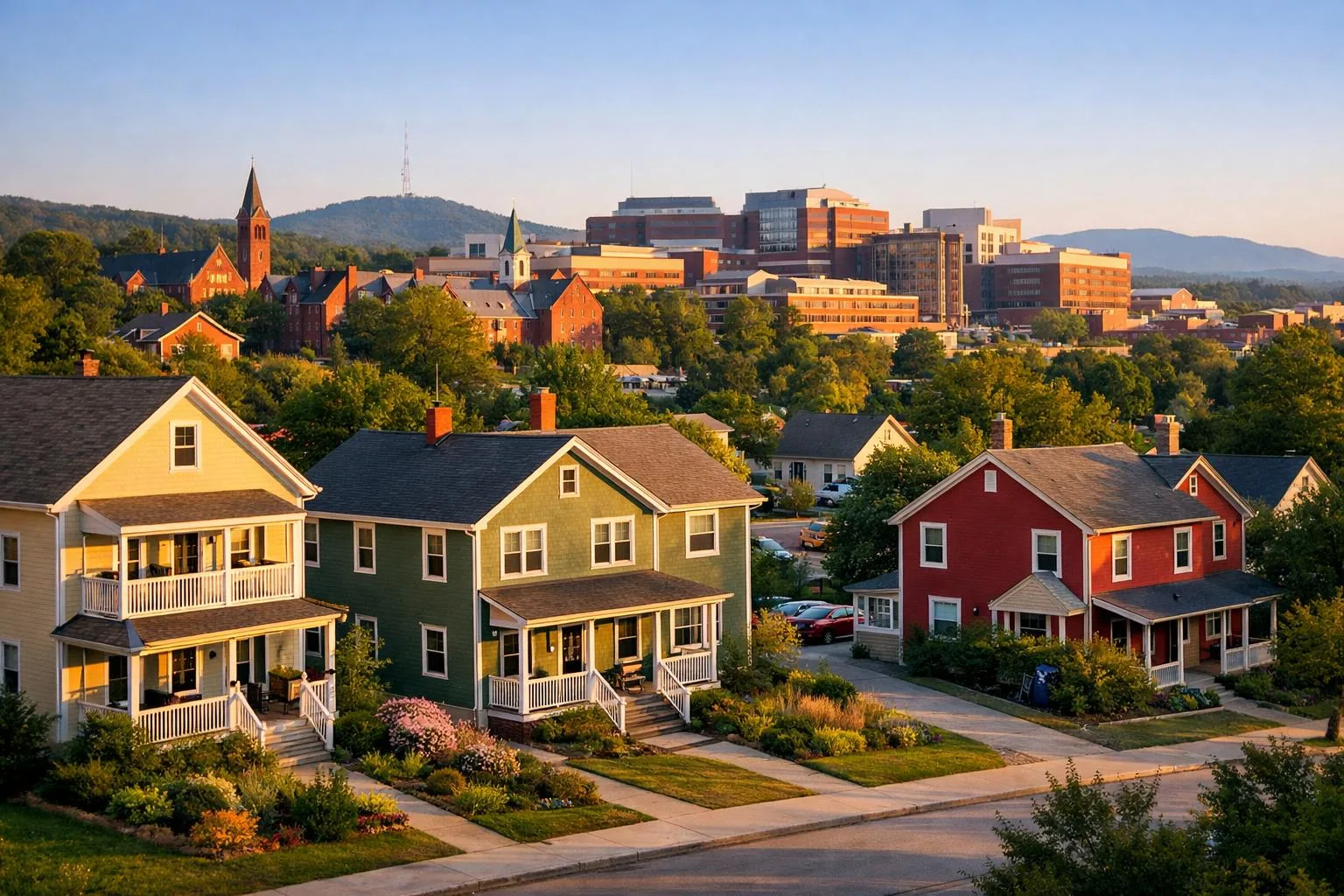
Vermont is the smallest DSCR state in the Northeast. Population of just 650,000, one genuinely investor-grade metro (Burlington), and a high-property-tax, slow-judicial-foreclosure environment that compresses margins. For investors with existing Vermont operations or specific thesis (Stowe STR, Burlington student-adjacent rental), Vermont is workable. For first-time DSCR investors, neighboring New Hampshire or upstate New York typically offers better math.
This guide walks through DSCR lending in Vermont: the Burlington metro, the property-tax structure, and the Green Mountain-specific details that matter.
Why Investors Choose Vermont
Vermont’s total population is tiny but the state has genuine economic drivers in specific corridors. Burlington (Chittenden County) is the dominant metro — University of Vermont (14,000 students), UVM Medical Center (the state’s largest employer), General Dynamics, Global Foundries’ semiconductor plant, and a growing tech/software cluster. Burlington has attracted sustained young-professional in-migration since 2015.
Montpelier is the state capital (smallest state capital by population in the US). Rutland, Brattleboro, and St. Albans are secondary markets with specific local economies. Stowe is the premier ski-and-tourism market.
Rental demand in Burlington is sticky because ownership supply is genuinely constrained — the city has tight building regulations, Lake Champlain limits expansion, and new construction has been slow. Rent growth in 2020-2024 was meaningful but has moderated.
DSCR Loan Rules in Vermont
Most national DSCR lenders fund Vermont. Some smaller DSCR shops exclude Vermont due to the small market. Expect 2-4 quotes. There are no state-specific DSCR restrictions.
Typical terms: min DSCR 0.85-1.20, max LTV 70-75%, min FICO 680-700, 6-9 months reserves. Slightly tighter than national average because of the slow judicial foreclosure process.
Taxes & Carrying Costs
Property tax is the Vermont story. Effective rate approximately 1.90% — among the top five in the country. Vermont funds K-12 education through a statewide education property tax plus local school-district millage, which produces high total bills. Investor-owned “non-residential” property is taxed at a higher rate than owner-occupied “homestead” residential. Even Vermont’s lowest-millage towns produce effective rates above 1.5% for investor property.
A $325K Burlington-metro rental typically carries $6,000-$8,500 in annual property tax. Model accurately.
State income tax: graduated 3.35% to 8.75%. Out-of-state investors file VT non-resident returns. Vermont LLCs: $125 formation, $35 annual report.
Insurance runs $1,200-$1,800 per $300K for most of Vermont. Lake Champlain and mountain property can carry higher premiums.
Foreclosure & Eviction Landscape
Vermont permits strict foreclosure and foreclosure by sale — both judicial. Strict foreclosure transfers title to the lender without auction; foreclosure by sale produces an auction. Both are court-supervised. Typical timelines 12-18 months from filing to completion. Among the slower processes in the Northeast.
Eviction in Vermont runs 45-90 days. Non-payment starts with a 14-day notice to pay or quit. Landlords file ejectment in superior court. Vermont has moderate tenant protections; contested cases can extend materially.
Landlord-Tenant Law
No statewide rent control. 9 V.S.A. Section 4453 preempts local rent caps (a 2022 Burlington advisory vote did not produce legally binding rent control). Burlington has just-cause eviction requirements on some tenancies and relocation-assistance obligations; verify current city ordinance.
Security deposits not statutorily capped. Landlords have 14 days (Vermont is among the shortest) to return deposits with itemized deductions. Vermont requires 48-hour notice before non-emergency entry.
Top Vermont Markets
Burlington / South Burlington / Essex (Chittenden County) — The anchor. UVM + UVM Medical Center + Global Foundries. DSCR properties price $425K-$700K with rents $2,300-$3,200. Cap rates 5-6.5%. Competition for quality inventory is real.
Montpelier — State capital. Small market. DSCR properties $275K-$400K.
Rutland — South central Vermont. Lower basis. DSCR properties $175K-$275K with rents $1,200-$1,600.
Stowe (Lamoille County) — Ski resort. STR-focused. Specialty underwriting. High basis. DSCR properties price $650K-$1.5M+ with winter-season STR revenue driving pro-forma returns. Ski-season rental math only works when the property has confirmed permit status and realistic occupancy assumptions — many Stowe DSCR deals fail when investors assume 180+ nights of rental when realistic occupancy is 100-130 nights. Use AirDNA-equivalent data for the specific street and building type.
Brattleboro and Bennington — Southern Vermont secondary markets. Massachusetts-commuter demand for Brattleboro. DSCR properties $225K-$350K with rents $1,400-$1,850.
Special Considerations
Vermont’s slow judicial foreclosure (12-18 months) is the single largest lender-side concern with the state. It drives the higher DSCR rate pricing and the smaller lender pool. For investors who have confidence in their underwriting and tenant quality, this is academic — the lender’s foreclosure timeline rarely matters if the investor doesn’t default. For lenders, it materially affects loss severity assumptions and therefore pricing.
Education property tax is the dominant cost. Vermont’s statewide education funding model (Act 60 / Act 68 lineage) produces effective tax rates that rank among the four highest in the country on investor-owned “non-residential” property. Model the full tax bill — don’t rely on a percentage estimate. The Vermont Tax Department publishes equalized rates by town annually; use the current number for the specific town.
Burlington just-cause and relocation-assistance ordinances (though not formal rent control) do change operating math. Verify current Burlington city tenant-rights ordinance requirements before underwriting; Burlington has been incrementally adding tenant protections since 2019.
Short-term rental regulations in Stowe, Burlington, and increasingly across Vermont are tightening. Verify the specific municipality’s current STR rules before underwriting STR revenue in any Vermont deal — the regulatory trajectory is toward more restriction, not less.
Entity Formation Notes
Vermont LLCs cost $125 formation, $35 annually. Standard structures apply. Many Vermont investors use Wyoming or Delaware parent holding LLCs owning VT LLCs. See the entity structure guide.
Getting Started
Use the DSCR calculator with accurate Vermont property tax modeling, check current rates, then get matched.
Related guides: New Hampshire, Maine, New York.
Keep exploring
Hand-picked next steps — whether you want to go deeper on this topic, compare alternatives, or run the numbers.
Editor's picks
Hand-chosen follow-ups for this topic.
- Guide
What Is a DSCR Loan? The Complete 2026 Guide for Real Estate Investors
A DSCR loan qualifies a rental property on rental income ÷ PITIA — not personal income or tax returns. Full 2026 guide to ratios,…
- Guide
DSCR Loan LLC Guide: Entity Structure, Vesting & Personal Guarantees
DSCR loan LLC guide: single-member, multi-member, S-Corp, trusts, personal guarantees, state selection, and lender requirements —…
- Guide
DSCR Loan Risks: What Investors Need to Know Before Signing in 2026
DSCR loan risks: ARM rate resets, prepayment traps, insurance spikes, refinance risk, personal guarantees. Honest risk analysis…
- Property type
DSCR Loan for Airbnb & Short-Term Rentals: 2026 Complete Guide
DSCR loan for Airbnb and short-term rentals in 2026: AirDNA underwriting, 20% income haircut, STR lender shortlist, and every…
- Property type
DSCR Loan for 2-4 Unit Properties: Duplex, Triplex & Quadplex Guide
DSCR loans for 2-4 unit properties in 2026: 75-80% LTV, 0.85-1.0 DSCR minimums, and the duplex, triplex, and fourplex lender…
Compare other states
DSCR rules, rates, and tax posture in similar markets.
- State guide
DSCR Loans in Alabama
Complete 2026 guide to DSCR loans in Alabama — rates, non-judicial foreclosure rules, Birmingham and Huntsville markets, and how…
- State guide
DSCR Loans in Alaska
2026 guide to DSCR loans in Alaska — small lender pool, no state income tax, Anchorage and Fairbanks markets, and typical…
- State guide
DSCR Loans in Arkansas
2026 guide to DSCR loans in Arkansas — low property taxes, non-judicial foreclosure, Little Rock and Northwest Arkansas markets,…
- State guide
DSCR Loans in California
Complete 2026 guide to DSCR loans in California — AB1482 rent control, Prop 13 reassessment, $800 LLC tax, LA/SF/San Diego…
DSCR loan products for your next deal
The financing structures investors use most in this market.
- Loan type
DSCR Purchase Loan: Complete 2026 Guide for Investors
Everything real estate investors need to know about using a DSCR purchase loan — LTV limits, rent schedule requirements, closing…
- Loan type
DSCR Cash-Out Refinance: 2026 Playbook for Investors
DSCR cash-out refinance 2026: LTV limits, seasoning rules, tax impact, delayed financing, and when the math actually pencils —…
- Loan type
DSCR Rate-and-Term Refinance: Can You Refinance a DSCR Loan? (2026)
Yes — you can refinance a DSCR loan with rate-and-term or cash-out. Seasoning (often 3–6 months), LTV, DSCR floors, PPP costs,…
Property types investors finance here
Run the numbers
Free interactive tools to stress-test your deal.
- Interactive tool
DSCR Ratio Calculator
Calculate your DSCR in seconds and see pass/fail by lender tier.
- Live rates
Today's DSCR Loan Rates
Live DSCR rate ranges by credit tier, LTV, and product type.
- Resource
Best DSCR Lenders of 2026
Head-to-head shortlist of the leading DSCR lenders with program details.
- Interactive tool
Short-Term Rental DSCR Analyzer
Run Airbnb income through lender STR haircuts with LTR fallback.
Is There a DSCR Lender in This Market?
Coverage, foreclosure timelines, and local overlays decide whether the deal funds. Get matched now.
Shop every major DSCR lender in 60 seconds
Tell us about your deal once. We'll send you the top 3 lender offers within the hour.
Soft match — no credit pull, no spam. Your info stays with licensed brokers only.