State guide · SD
DSCR Loans in South Dakota: 2026 Investor's Guide
2026 guide to DSCR loans in South Dakota — no state income tax, Sioux Falls and Rapid City markets, trust-friendly entity law, and 1.17% effective property tax.
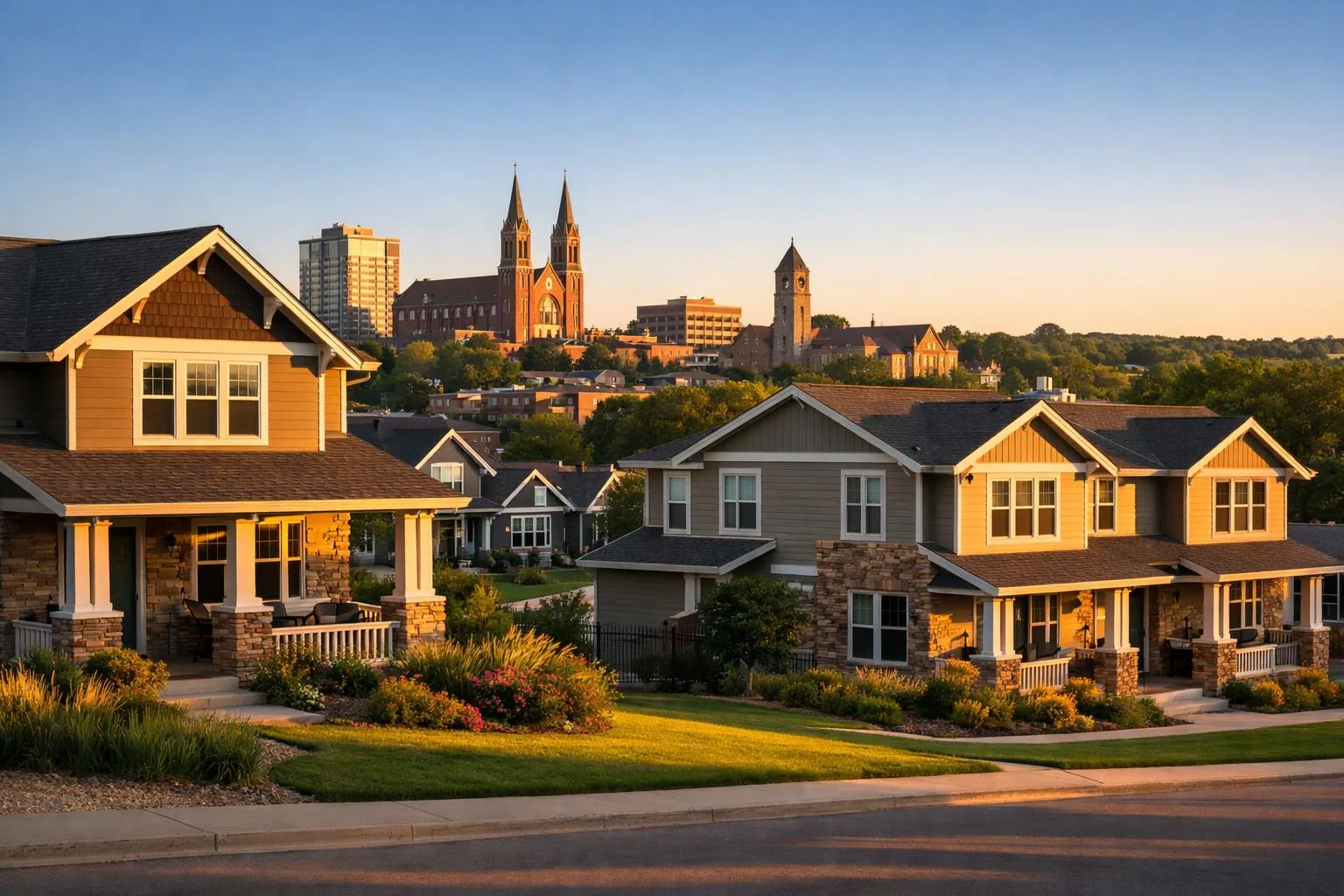
South Dakota is a small but quietly interesting DSCR state. No state income tax, landlord-friendly legal framework, stable metros in Sioux Falls and Rapid City, and growing appeal as a formation jurisdiction for LLCs and trusts. The catch is a smaller lender pool and mid-tier property taxes. For investors building diversified Mountain-Plains portfolios — or for high-income investors considering SD for a holding-company structure — South Dakota is worth a serious look.
This guide walks through DSCR lending in South Dakota: the two metros, the tax setup, and why SD has become a formation contender.
Why Investors Choose South Dakota
South Dakota’s population is small (920,000) but has grown steadily at 0.5-1.0% annually through the 2020s — among the stronger Midwest growth rates. Sioux Falls specifically has been a notable growth story.
Sioux Falls (Minnehaha County) is the dominant metro (metro population ~290,000). Financial services has been the defining story — in 1981, South Dakota eliminated usury caps, and Citibank (now Citigroup) relocated its credit-card operations to Sioux Falls. Wells Fargo followed. Today Sioux Falls has one of the largest concentrations of banking and financial-services employment per capita in the US. Add Sanford Health (one of the largest integrated health systems in the region), Avera Health, and manufacturing, and Sioux Falls has a diversified, high-income employer base.
Rapid City (Pennington County) is Western South Dakota’s economic center. Ellsworth Air Force Base, tourism (Mount Rushmore, Black Hills), healthcare (Monument Health), and defense contractors anchor the economy. Population has grown steadily.
Aberdeen, Brookings, Watertown are smaller agricultural/industrial markets. Brookings hosts South Dakota State University.
DSCR Loan Rules in South Dakota
Most major national DSCR lenders fund South Dakota. Some smaller lenders exclude the state due to the small market or judicial foreclosure timeline. There are no state-specific DSCR restrictions.
Typical terms: min DSCR 0.85-1.20, max LTV 70-75%, min FICO 680-700, 6-9 months reserves.
Taxes & Carrying Costs
No state income tax. This is SD’s biggest structural advantage. Rental income flows through to federal 1040 only. No state-level LLC franchise tax.
Property tax is in the middle tier. Effective rate approximately 1.21% statewide. South Dakota has a distinction between owner-occupied residential (lower rate) and non-owner-occupied residential (higher rate). Investor rentals pay the non-owner-occupied rate. Minnehaha County (Sioux Falls) total millage produces effective rates around 1.5-1.9% for non-owner-occupied residential. Pennington County (Rapid City) similar.
A $225K Sioux Falls rental typically carries $2,800-$3,800 annually.
SD has no state sales tax on services (but does have sales tax on goods). SD LLCs: $150 formation, $50 annual report.
Insurance in SD is moderate — $900-$1,400 per $300K for most of the state. Hail exposure significant; hail deductibles 1-2% of dwelling value standard.
Foreclosure & Eviction Landscape
South Dakota permits both judicial and non-judicial foreclosure. Judicial under SDCL 21-47 is the default for most residential mortgages. Non-judicial (foreclosure by advertisement) under SDCL 21-48 is available when the mortgage contains specific power-of-sale language. Typical timelines: 6-9 months judicial, 4-6 months non-judicial. South Dakota also has a 1-year post-sale redemption period for residential property (unless specifically waived or the mortgage is subject to shortened redemption).
Eviction in SD runs 21-45 days. Non-payment starts with a 3-day notice to pay or quit. Landlords file in magistrate court; cases move to hearing in 2-4 weeks. Physical removal follows judgment.
Landlord-Tenant Law
No rent control. SD Code preempts local rent caps. Security deposits capped at one month’s rent. Landlords have 14 days to return the deposit (or 45 days if returning partial). SD requires reasonable notice before non-emergency entry.
Top South Dakota Markets
Sioux Falls (Minnehaha County) — The dominant DSCR market. DSCR properties in central, east-side, and west-side neighborhoods price $200K-$325K with rents $1,400-$1,900. Cap rates 6-7.5%. Strong professional-rental demand from financial-services and healthcare workers.
Rapid City (Pennington County) — Second metro. Tourism and military economy. DSCR properties $175K-$275K with rents $1,300-$1,750.
Brookings (Brookings County) — SDSU. Student-housing + young-professional rental market.
Aberdeen, Watertown — Smaller secondary markets.
Special Considerations — South Dakota as a Formation State
South Dakota has developed over the past 20 years into a significant holding-company and trust formation jurisdiction. The appeal:
- No state income tax on LLC or trust income (for non-grantor trusts / LLCs with non-SD economic nexus)
- Strong asset-protection trust law — the Dynasty Trust and Domestic Asset Protection Trust (DAPT) statutes are among the oldest and most-tested in the US
- Privacy — SD’s trust-secrecy rules are notably strong (the state was cited in the “Pandora Papers” coverage for trust activity, though for real-estate DSCR purposes this is largely irrelevant)
- No state-level LLC franchise tax
For real-estate DSCR investors specifically, South Dakota is less commonly chosen than Wyoming, Delaware, or Nevada for pure LLC formation. The SD appeal concentrates more on trust structures for high-net-worth estate planning. A high-net-worth investor building a large portfolio might structure a SD-trust-owning-LLC architecture; a typical DSCR investor with 5-20 properties usually chooses Wyoming for simplicity and lower annual costs.
See the entity structure guide for a comparison of the major formation states.
Entity Formation Notes
SD LLCs cost $150 formation and $50 annual report. Standard single-purpose structures work. Many SD-based investors hold directly in SD LLCs; larger portfolios may layer a Wyoming parent holding company. For high-net-worth investors, a SD asset-protection trust owning operating LLCs is a specialized structure requiring estate-planning counsel.
Getting Started
Use the DSCR calculator, check current rates, then get matched with DSCR lenders funding South Dakota.
Related guides: North Dakota, Wyoming, Nebraska.
Keep exploring
Hand-picked next steps — whether you want to go deeper on this topic, compare alternatives, or run the numbers.
Editor's picks
Hand-chosen follow-ups for this topic.
- Guide
What Is a DSCR Loan? The Complete 2026 Guide for Real Estate Investors
A DSCR loan qualifies a rental property on rental income ÷ PITIA — not personal income or tax returns. Full 2026 guide to ratios,…
- Guide
DSCR Loan LLC Guide: Entity Structure, Vesting & Personal Guarantees
DSCR loan LLC guide: single-member, multi-member, S-Corp, trusts, personal guarantees, state selection, and lender requirements —…
- Guide
Holding Company LLC Real Estate Strategy: Structure, Tax & Lender Acceptance
Scaling investor's blueprint for a real-estate holding company LLC: Wyoming parent, property-state LLCs, tax elections, banking,…
- Property type
DSCR Loan for Single-Family Rental (SFR): 2026 Investor Guide
DSCR loan for single-family rentals in 2026: 80% LTV, 0.75+ DSCR, baseline pricing, and the exact SFR lender landscape to shop…
- Investor profile
DSCR Portfolio Builder Guide: Scaling a Rental Portfolio Past 10 Properties
Scale past Fannie's 10-property cap with DSCR: blended DSCR, blanket loans, Wyoming holdings, reserves, and capital recycling…
Compare other states
DSCR rules, rates, and tax posture in similar markets.
- State guide
DSCR Loans in Alabama
Complete 2026 guide to DSCR loans in Alabama — rates, non-judicial foreclosure rules, Birmingham and Huntsville markets, and how…
- State guide
DSCR Loans in Alaska
2026 guide to DSCR loans in Alaska — small lender pool, no state income tax, Anchorage and Fairbanks markets, and typical…
- State guide
DSCR Loans in Arkansas
2026 guide to DSCR loans in Arkansas — low property taxes, non-judicial foreclosure, Little Rock and Northwest Arkansas markets,…
- State guide
DSCR Loans in California
Complete 2026 guide to DSCR loans in California — AB1482 rent control, Prop 13 reassessment, $800 LLC tax, LA/SF/San Diego…
DSCR loan products for your next deal
The financing structures investors use most in this market.
- Loan type
DSCR Purchase Loan: Complete 2026 Guide for Investors
Everything real estate investors need to know about using a DSCR purchase loan — LTV limits, rent schedule requirements, closing…
- Loan type
DSCR Cash-Out Refinance: 2026 Playbook for Investors
DSCR cash-out refinance 2026: LTV limits, seasoning rules, tax impact, delayed financing, and when the math actually pencils —…
- Loan type
DSCR Rate-and-Term Refinance: Can You Refinance a DSCR Loan? (2026)
Yes — you can refinance a DSCR loan with rate-and-term or cash-out. Seasoning (often 3–6 months), LTV, DSCR floors, PPP costs,…
Property types investors finance here
- Property type
DSCR Loan for 2-4 Unit Properties: Duplex, Triplex & Quadplex Guide
DSCR loans for 2-4 unit properties in 2026: 75-80% LTV, 0.85-1.0 DSCR minimums, and the duplex, triplex, and fourplex lender…
- Property type
DSCR Loan for Airbnb & Short-Term Rentals: 2026 Complete Guide
DSCR loan for Airbnb and short-term rentals in 2026: AirDNA underwriting, 20% income haircut, STR lender shortlist, and every…
Run the numbers
Free interactive tools to stress-test your deal.
- Interactive tool
DSCR Ratio Calculator
Calculate your DSCR in seconds and see pass/fail by lender tier.
- Live rates
Today's DSCR Loan Rates
Live DSCR rate ranges by credit tier, LTV, and product type.
- Resource
Best DSCR Lenders of 2026
Head-to-head shortlist of the leading DSCR lenders with program details.
- Interactive tool
DSCR Qualification Estimator
Estimate your rate range, LTV cap, and approval odds before you apply.
Is There a DSCR Lender in This Market?
Coverage, foreclosure timelines, and local overlays decide whether the deal funds. Get matched now.
Shop every major DSCR lender in 60 seconds
Tell us about your deal once. We'll send you the top 3 lender offers within the hour.
Soft match — no credit pull, no spam. Your info stays with licensed brokers only.