State guide · NE
DSCR Loans in Nebraska: 2026 Investor's Guide
2026 guide to DSCR loans in Nebraska — Omaha and Lincoln markets, 1.54% property tax, trust-deed non-judicial foreclosure, and stable Midwest cash flow math.
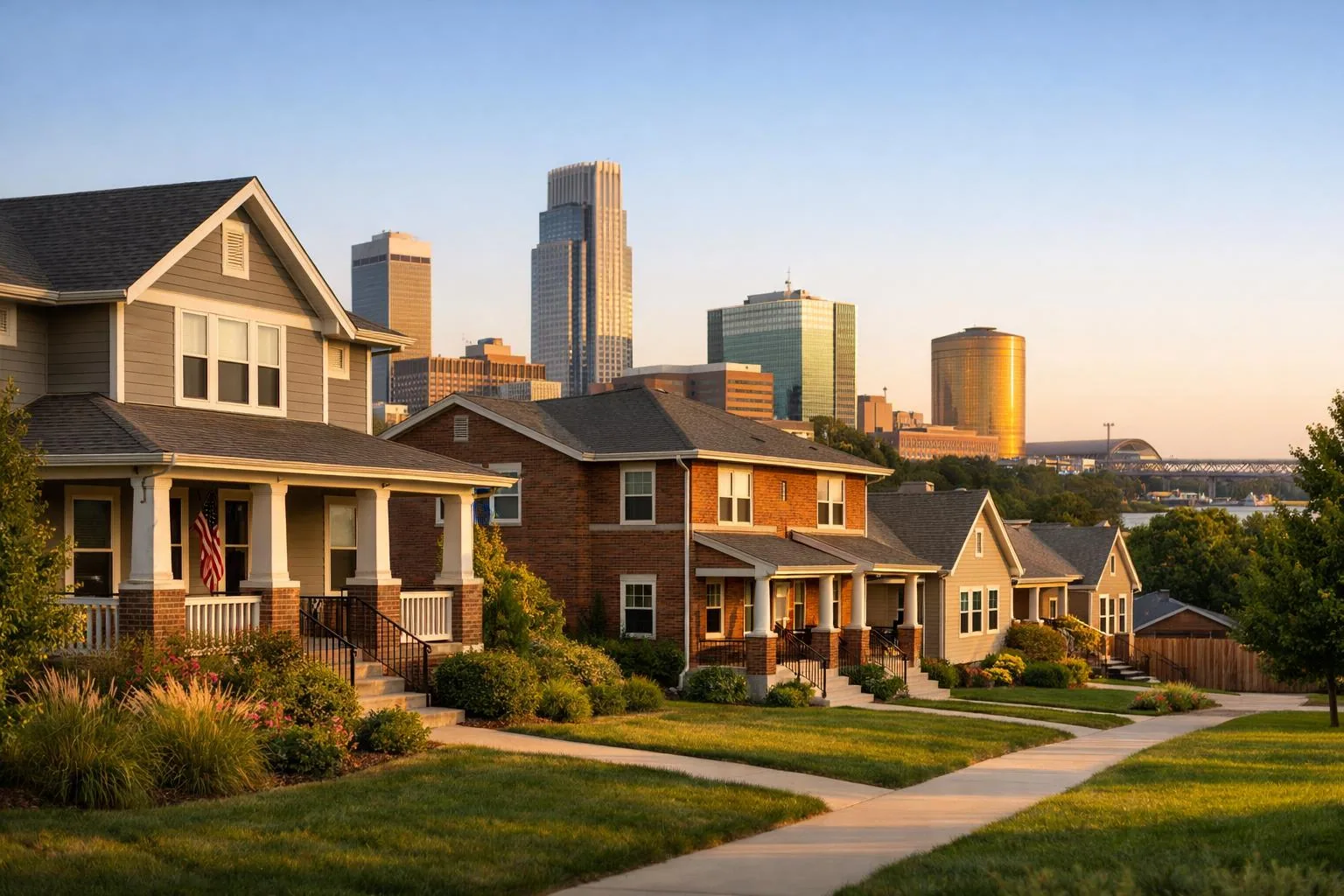
Nebraska is a quiet but reliable DSCR market. Omaha’s economy is genuinely diversified — Berkshire Hathaway’s headquarters, Union Pacific Railroad, Mutual of Omaha, Kiewit Corporation, Offutt Air Force Base, and the University of Nebraska Medical Center produce a stable white-collar employment base and sticky rental demand. Lincoln adds state-government and University of Nebraska demand. The main friction is property tax — Nebraska has one of the 10 highest effective rates in the country, and investor underwriting must account for it.
This guide walks through DSCR financing in Nebraska: who lends, what to expect on taxes, and which markets actually move.
Why Investors Choose Nebraska
Nebraska’s statewide population growth is modest (0.1-0.3% annually), but Omaha has grown more consistently than most Midwest metros. The Omaha-Council Bluffs metro has Warren Buffett’s Berkshire Hathaway HQ (which attracts corporate activity disproportionate to the metro’s size), Union Pacific Railroad HQ, Mutual of Omaha, Werner Enterprises trucking, Kiewit construction/engineering HQ, First National Bank of Omaha, Offutt Air Force Base (home of US Strategic Command), and the University of Nebraska Medical Center.
This employer set creates a high-income, stable, long-term-rental tenant base. Omaha median single-family is around $260K. Rent growth has been 3-5% annually through most of the 2020s.
Lincoln is Nebraska’s second metro with state government and the University of Nebraska (25,000 students) as the primary employers. Smaller and more cyclical than Omaha.
DSCR Loan Rules in Nebraska
Every major national DSCR lender funds Nebraska. There are no state-specific DSCR restrictions. Nebraska’s Residential Mortgage Licensing Act governs consumer lending; bona-fide business-purpose loans to investor LLCs for 1-4 unit property are exempt.
Typical terms: min DSCR 0.85-1.20 (tighter than some states because the property-tax drag narrows the PITIA margin), max LTV 75%-80%, min FICO 660-680, 6 months reserves. July 2026 NE DSCR rates typically run 6.25%-7.875% on 30-year fixed, aligned with the national 6.25%-7.875% band given the 10-year Treasury at 4.65%.
Taxes & Carrying Costs
Property tax is the Nebraska story. Effective rate approximately 1.54% statewide — among the 10 highest. Douglas County (Omaha) and Lancaster County (Lincoln) run even higher. Nebraska property tax is structurally high because the state funds a smaller share of K-12 education than most states, leaving local districts to fund operations through property tax. Reform efforts (LB 242, LB 873, various sessions) have produced incremental relief but no structural shift as of 2026.
A $250K Omaha rental commonly carries a bill of $3,500-$4,500 annually. Model this accurately — it’s a meaningful DSCR variable.
State income tax: graduated 2.46% to 4.55% in 2026 after reductions (down from a 5.20% top rate in 2025 and 6.64% pre-reform). LB 754 phases the top rate to 3.99% in 2027. Out-of-state investors file NE non-resident returns. Nebraska LLCs: $105 online formation plus a biennial $10 report. Very low maintenance cost.
Insurance in Nebraska is moderate but tornado/hail exposure is significant. Expect $1,100-$1,700 per $300K, with hail deductibles of 1-2% of dwelling value. Hail damage is the #1 insurance claim type in Nebraska; roofs are the single most-frequently-replaced component. Factor roof age into your acquisition math.
Foreclosure & Eviction Landscape
Nebraska permits both judicial and non-judicial foreclosure. Non-judicial (trust-deed) foreclosure under Neb. Rev. Stat. §76-1001 et seq. is faster — 90-120 days from notice to sale. Judicial foreclosure runs 6-10 months. Most modern investor mortgages use trust deeds permitting non-judicial; older mortgages may require judicial.
Eviction in Nebraska runs 21-45 days. Non-payment starts with a 3-day notice to pay or quit (updated from a 7-day notice in earlier statute). Landlords file forcible-entry-and-detainer actions. Nebraska’s Uniform Residential Landlord and Tenant Act governs lease terms.
Landlord-Tenant Law
No rent control. Security deposits are capped at one month’s rent (two months for pet deposits). Landlords have 14 days to return the deposit with itemized deductions. Nebraska requires reasonable notice (typically construed as 24 hours) before non-emergency entry. No statewide rental registration.
Top Nebraska Markets
Omaha (Douglas County + Sarpy County) — The dominant DSCR market. DSCR properties in Midtown, Dundee, Benson, and West Omaha price $200K-$350K with rents $1,400-$2,000. Sarpy County suburbs (Bellevue, Papillion, La Vista) offer newer stock and stronger schools. DSCR properties $275K-$425K with rents $1,800-$2,400.
Lincoln (Lancaster County) — State capital, University of Nebraska. Student-housing specialty plus white-collar government/university rental base. DSCR properties $175K-$275K with rents $1,300-$1,750.
Bellevue (Sarpy County) — Omaha suburb, Offutt Air Force Base. Military renter base is the largest in Nebraska. DSCR properties $225K-$350K with rents $1,600-$2,100.
Grand Island and Kearney — Central Nebraska mid-size markets. Much lower basis, higher cap rates, less appreciation. Grand Island has JBS meatpacking and manufacturing. Kearney has UNK (University of Nebraska Kearney) and regional healthcare. DSCR properties in both typically price $125K-$180K with rents $900-$1,300. Cap rates 8-10%, but vacancy risk is higher than Omaha — durability of demand is a real consideration.
Special Considerations
Property tax is the variable that separates a good Nebraska deal from a bad one. Model the specific mill rate in the specific taxing district. Omaha Public Schools and Douglas County mill rates can produce bills 20-30% higher than a Sarpy County (Papillion, Bellevue) property of identical market value. Verify school-district levies during due diligence.
Hail roof damage is the #1 insurance claim in Nebraska. During acquisition, pull roof age and prior claim history. A 15-year-old roof that has not been replaced since the last significant hail event is a likely lender-required replacement and should be priced into the offer.
Nebraska’s post-sale redemption on mortgages is shorter than Kansas but worth understanding — 9 months for a trust-deed foreclosure, 12 months for judicial. This affects bank-owned/foreclosure acquisition timing.
Omaha’s Offutt AFB provides a genuinely stable military-renter base in Sarpy County, particularly Bellevue and Papillion. Military-focused property management firms know the BAH (Basic Allowance for Housing) rates and can optimize pricing for PCS-cycle turnover windows.
Entity Formation Notes
Nebraska LLCs cost $105 online formation plus $10 biennial report — low maintenance. Most Nebraska investors form directly in NE. For multi-state portfolios, Wyoming or Delaware parent LLC is useful. See the entity structure guide.
Getting Started
Use the DSCR calculator with accurate property tax modeling, check current rates, then get matched with DSCR lenders funding Nebraska.
Related guides: Iowa, Kansas, Missouri.
Keep exploring
Hand-picked next steps — whether you want to go deeper on this topic, compare alternatives, or run the numbers.
Editor's picks
Hand-chosen follow-ups for this topic.
- Guide
What Is a DSCR Loan? The Complete 2026 Guide for Real Estate Investors
A DSCR loan qualifies a rental property on rental income ÷ PITIA — not personal income or tax returns. Full 2026 guide to ratios,…
- Guide
DSCR Loan LLC Guide: Entity Structure, Vesting & Personal Guarantees
DSCR loan LLC guide: single-member, multi-member, S-Corp, trusts, personal guarantees, state selection, and lender requirements —…
- Guide
DSCR Loan Reserve Requirements: How Much Cash Do You Need After Closing?
Complete guide to DSCR loan reserve requirements. Baseline 2 months PITIA, scaling for loan size, what counts as reserves, and…
- Property type
DSCR Loan for Single-Family Rental (SFR): 2026 Investor Guide
DSCR loan for single-family rentals in 2026: 80% LTV, 0.75+ DSCR, baseline pricing, and the exact SFR lender landscape to shop…
- Investor profile
DSCR Portfolio Builder Guide: Scaling a Rental Portfolio Past 10 Properties
Scale past Fannie's 10-property cap with DSCR: blended DSCR, blanket loans, Wyoming holdings, reserves, and capital recycling…
Compare other states
DSCR rules, rates, and tax posture in similar markets.
- State guide
DSCR Loans in Alabama
Complete 2026 guide to DSCR loans in Alabama — rates, non-judicial foreclosure rules, Birmingham and Huntsville markets, and how…
- State guide
DSCR Loans in Alaska
2026 guide to DSCR loans in Alaska — small lender pool, no state income tax, Anchorage and Fairbanks markets, and typical…
- State guide
DSCR Loans in Arkansas
2026 guide to DSCR loans in Arkansas — low property taxes, non-judicial foreclosure, Little Rock and Northwest Arkansas markets,…
- State guide
DSCR Loans in California
Complete 2026 guide to DSCR loans in California — AB1482 rent control, Prop 13 reassessment, $800 LLC tax, LA/SF/San Diego…
DSCR loan products for your next deal
The financing structures investors use most in this market.
- Loan type
DSCR Purchase Loan: Complete 2026 Guide for Investors
Everything real estate investors need to know about using a DSCR purchase loan — LTV limits, rent schedule requirements, closing…
- Loan type
DSCR Cash-Out Refinance: 2026 Playbook for Investors
DSCR cash-out refinance 2026: LTV limits, seasoning rules, tax impact, delayed financing, and when the math actually pencils —…
- Loan type
DSCR Rate-and-Term Refinance: Can You Refinance a DSCR Loan? (2026)
Yes — you can refinance a DSCR loan with rate-and-term or cash-out. Seasoning (often 3–6 months), LTV, DSCR floors, PPP costs,…
Property types investors finance here
- Property type
DSCR Loan for 2-4 Unit Properties: Duplex, Triplex & Quadplex Guide
DSCR loans for 2-4 unit properties in 2026: 75-80% LTV, 0.85-1.0 DSCR minimums, and the duplex, triplex, and fourplex lender…
- Property type
DSCR Loan for Airbnb & Short-Term Rentals: 2026 Complete Guide
DSCR loan for Airbnb and short-term rentals in 2026: AirDNA underwriting, 20% income haircut, STR lender shortlist, and every…
Run the numbers
Free interactive tools to stress-test your deal.
- Interactive tool
DSCR Ratio Calculator
Calculate your DSCR in seconds and see pass/fail by lender tier.
- Live rates
Today's DSCR Loan Rates
Live DSCR rate ranges by credit tier, LTV, and product type.
- Resource
Best DSCR Lenders of 2026
Head-to-head shortlist of the leading DSCR lenders with program details.
- Interactive tool
DSCR Qualification Estimator
Estimate your rate range, LTV cap, and approval odds before you apply.
Is There a DSCR Lender in This Market?
Coverage, foreclosure timelines, and local overlays decide whether the deal funds. Get matched now.
Shop every major DSCR lender in 60 seconds
Tell us about your deal once. We'll send you the top 3 lender offers within the hour.
Soft match — no credit pull, no spam. Your info stays with licensed brokers only.