State guide · KS
DSCR Loans in Kansas: 2026 Investor's Guide
2026 guide to DSCR loans in Kansas — Johnson County suburbs, Wichita, and Topeka markets, 6-9 month judicial foreclosure, and 1.33% effective property tax.
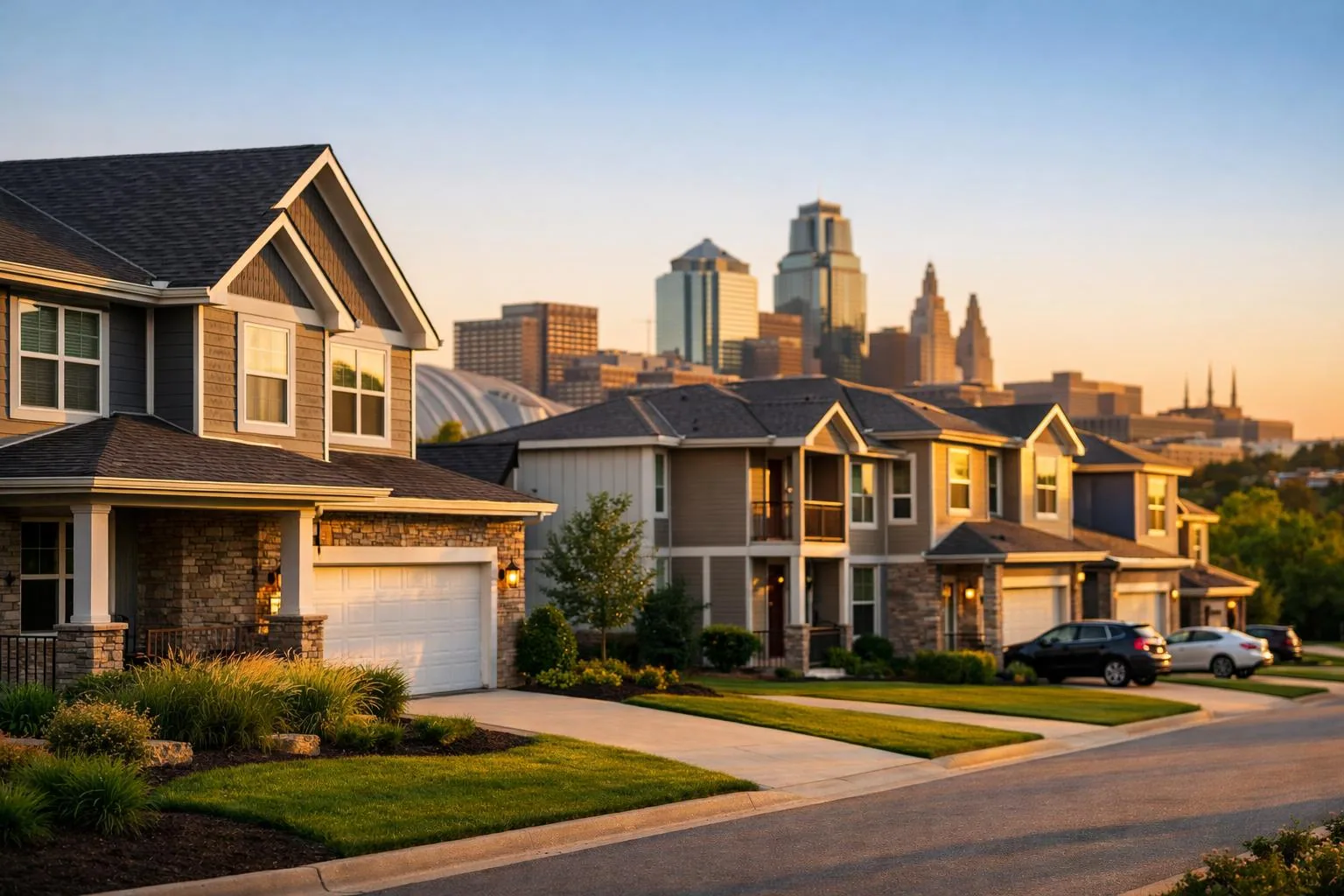
Kansas is a two-metro DSCR state. The Johnson County suburbs of Kansas City (Overland Park, Olathe, Lenexa, Shawnee) are genuinely strong long-term rental markets with a white-collar professional tenant base. Wichita has steady cash-flow math driven by the aviation industry. Topeka, Lawrence, and Manhattan fill out the secondary market. Kansas’s judicial foreclosure and mid-tier property taxes make it neither the fastest nor the cheapest Midwest state, but the underlying fundamentals are solid.
This guide covers DSCR financing in Kansas and the specific markets where investor volume concentrates.
Why Investors Choose Kansas
Kansas’s statewide population growth is modest (0.2-0.4% annually), but Johnson County has grown materially faster — it’s consistently among the fastest-growing Midwest counties. The Kansas City metro straddles the Missouri-Kansas line, and the Kansas side (Johnson and Wyandotte counties) has genuinely different demographics than the Missouri side (Jackson, Clay, Platte).
Johnson County is the economic engine: high household incomes, top-ranked school districts (Blue Valley, Olathe, Shawnee Mission), corporate HQ presence (Black & Veatch, YRC Worldwide, Cerner’s KC operations). Sprint/T-Mobile has its legacy Overland Park campus. Garmin is headquartered in Olathe.
Wichita is Kansas’s largest single city and the center of US general aviation — Textron (Cessna, Beechcraft, Hawker), Spirit AeroSystems, and Boeing-legacy plants all operate here. Cyclical but durable employer base. Topeka is the state capital. Lawrence hosts the University of Kansas. Manhattan hosts Kansas State.
DSCR Loan Rules in Kansas
Every national DSCR lender funds Kansas. There are no Kansas-specific DSCR restrictions, no PPP prohibitions, and no unusual licensing requirements for out-of-state lenders making business-purpose loans to investor LLCs.
Typical terms: min DSCR 0.75-1.25, max LTV 75%-80% on purchase, 70%-75% on cash-out refi, min FICO 660-680, 6 months reserves.
Taxes & Carrying Costs
Kansas’s effective property tax rate of 1.33% is in the middle tier. Residential assessment is at 11.5% of market value; millage rates then apply. Johnson County runs a combined mill rate around 115-140 mills in most cities; Wichita runs 130+ mills; rural counties can run 80-100. A $300K rental in Overland Park typically carries a bill of $3,800-$4,500.
Kansas operates a two-bracket personal income tax for 2026: 3.10% on taxable income up to $30,000 single / $60,000 MFJ, and 5.70% above those thresholds (collapsed from a three-bracket structure under 2024 reforms). Out-of-state investors file KS non-resident returns. Kansas LLC fees: $165 online formation, $50 annual report.
Insurance in Kansas is moderate. Tornado and hail exposure is meaningful — Kansas is classic Tornado Alley. Hail deductibles of 1-2% of dwelling value are standard. Expect $1,100-$1,700 per $300K of dwelling coverage. Wichita tends to run slightly higher than Johnson County.
Foreclosure & Eviction Landscape
Kansas is a judicial foreclosure state under K.S.A. 60-2401 and related statutes. Typical timeline runs 6-9 months from filing to sheriff’s sale. A distinctive Kansas feature is the post-sale redemption period — borrowers can redeem the property after sale for 3 to 12 months depending on the unpaid principal balance and equity. This redemption period is one of the longer in the country and affects how lenders price Kansas foreclosure risk.
Eviction in Kansas runs 21-45 days. Non-payment starts with a 3-day notice to pay or quit. Kansas’s Residential Landlord and Tenant Act governs lease terms. Summary-possession actions in district court typically produce judgments within 2-3 weeks of filing.
Landlord-Tenant Law
No rent control. K.S.A. 58-2557 and related preempt local rent caps. Security deposits are capped at one month’s rent (unfurnished) or one-and-a-half months (furnished). Landlords have 30 days to return with itemized deductions. Kansas requires reasonable notice (typically construed as 24 hours) before non-emergency entry. No statewide rental registration.
Top Kansas Markets
Overland Park / Olathe / Lenexa / Shawnee (Johnson County) — The DSCR core of Kansas. Blue Valley, Olathe, and Shawnee Mission school districts are among the best in the Midwest, which sustains long-term-rental demand from professional families. DSCR properties price $325K-$500K with rents $2,100-$2,800. Cap rates 5.5-7%. Appreciation has been steady.
Kansas City, Kansas (Wyandotte County) — Lower basis, higher cap rates, more tenant-quality variance than Johnson County. Village West / Legends entertainment district has driven some revitalization. DSCR properties price $150K-$225K with rents $1,200-$1,550.
Wichita — Sedgwick County. Aviation-industry anchor (Textron, Spirit, Boeing-legacy). Cost basis is low ($130K-$200K), rents $1,100-$1,500. Cyclical tied to general aviation but durable over full cycles. Cap rates 7-9%.
Topeka — State capital, government/healthcare employer base. Similar cost structure to Wichita. DSCR properties $120K-$180K with rents $1,000-$1,350.
Lawrence — University of Kansas (28,000 students). Student-housing market dominates; specialty underwriting applies.
Manhattan — Kansas State University (22,000 students) plus Fort Riley military base 10 miles away. Dual-driver rental economy.
Special Considerations
Post-sale redemption periods are a Kansas-specific detail — the 3-to-12-month window during which the borrower can redeem after foreclosure sale affects lender pricing and should be understood by DSCR investors acquiring via bank-owned sales. Property-tax mill rate variation between Johnson County and more rural counties can be 60%+, so underwrite using the specific city/county rate for the property. Tornado and hail exposure is real; budget for 1-2% hail deductibles and consider a roof-age assessment during diligence — a 20-year-old roof can be uninsurable or trigger lender-required replacement. Johnson County vs. Kansas City, Kansas is a meaningful distinction: Wyandotte County properties trade at much higher cap rates than Johnson County, but tenant-quality variance is materially higher.
Wichita’s aviation economy is cyclical. General-aviation demand drives Textron, Spirit, and Cessna employment, and a down cycle in business-jet orders tightens Wichita rental demand within 12 months. Diversify within Kansas rather than concentrating all purchases in a single cyclical market.
Entity Formation Notes
Kansas LLCs cost $165 to form and $50 annually. Kansas recognizes series LLCs since 2012. Many investors hold Kansas property in a single-purpose Kansas LLC with a Wyoming or Delaware parent holding company — a common structure for portfolios of 5+ doors, providing Wyoming’s charging-order protection and privacy at the holding level while keeping the operating LLC in-state for compliance. See the entity structure guide for a full decision framework on Kansas-specific LLC structure.
Getting Started
Use the DSCR calculator, check current rates, then get matched with DSCR lenders funding Kansas.
Related guides: Missouri, Oklahoma, Nebraska.
Keep exploring
Hand-picked next steps — whether you want to go deeper on this topic, compare alternatives, or run the numbers.
Editor's picks
Hand-chosen follow-ups for this topic.
- Guide
What Is a DSCR Loan? The Complete 2026 Guide for Real Estate Investors
A DSCR loan qualifies a rental property on rental income ÷ PITIA — not personal income or tax returns. Full 2026 guide to ratios,…
- Guide
DSCR Loan LLC Guide: Entity Structure, Vesting & Personal Guarantees
DSCR loan LLC guide: single-member, multi-member, S-Corp, trusts, personal guarantees, state selection, and lender requirements —…
- Guide
Series LLC DSCR Loan Guide: Which Lenders Accept, Cost Math & State Rules
Series LLC DSCR loan guide: states that allow them, lenders that accept, cost savings vs standalone LLCs, and when a holding…
- Property type
DSCR Loan for Single-Family Rental (SFR): 2026 Investor Guide
DSCR loan for single-family rentals in 2026: 80% LTV, 0.75+ DSCR, baseline pricing, and the exact SFR lender landscape to shop…
- Investor profile
DSCR Portfolio Builder Guide: Scaling a Rental Portfolio Past 10 Properties
Scale past Fannie's 10-property cap with DSCR: blended DSCR, blanket loans, Wyoming holdings, reserves, and capital recycling…
Compare other states
DSCR rules, rates, and tax posture in similar markets.
- State guide
DSCR Loans in Alabama
Complete 2026 guide to DSCR loans in Alabama — rates, non-judicial foreclosure rules, Birmingham and Huntsville markets, and how…
- State guide
DSCR Loans in Alaska
2026 guide to DSCR loans in Alaska — small lender pool, no state income tax, Anchorage and Fairbanks markets, and typical…
- State guide
DSCR Loans in Arkansas
2026 guide to DSCR loans in Arkansas — low property taxes, non-judicial foreclosure, Little Rock and Northwest Arkansas markets,…
- State guide
DSCR Loans in California
Complete 2026 guide to DSCR loans in California — AB1482 rent control, Prop 13 reassessment, $800 LLC tax, LA/SF/San Diego…
DSCR loan products for your next deal
The financing structures investors use most in this market.
- Loan type
DSCR Purchase Loan: Complete 2026 Guide for Investors
Everything real estate investors need to know about using a DSCR purchase loan — LTV limits, rent schedule requirements, closing…
- Loan type
DSCR Cash-Out Refinance: 2026 Playbook for Investors
DSCR cash-out refinance 2026: LTV limits, seasoning rules, tax impact, delayed financing, and when the math actually pencils —…
- Loan type
DSCR Rate-and-Term Refinance: Can You Refinance a DSCR Loan? (2026)
Yes — you can refinance a DSCR loan with rate-and-term or cash-out. Seasoning (often 3–6 months), LTV, DSCR floors, PPP costs,…
Property types investors finance here
- Property type
DSCR Loan for 2-4 Unit Properties: Duplex, Triplex & Quadplex Guide
DSCR loans for 2-4 unit properties in 2026: 75-80% LTV, 0.85-1.0 DSCR minimums, and the duplex, triplex, and fourplex lender…
- Property type
DSCR Loan for Airbnb & Short-Term Rentals: 2026 Complete Guide
DSCR loan for Airbnb and short-term rentals in 2026: AirDNA underwriting, 20% income haircut, STR lender shortlist, and every…
Run the numbers
Free interactive tools to stress-test your deal.
- Interactive tool
DSCR Ratio Calculator
Calculate your DSCR in seconds and see pass/fail by lender tier.
- Live rates
Today's DSCR Loan Rates
Live DSCR rate ranges by credit tier, LTV, and product type.
- Resource
Best DSCR Lenders of 2026
Head-to-head shortlist of the leading DSCR lenders with program details.
- Interactive tool
DSCR Qualification Estimator
Estimate your rate range, LTV cap, and approval odds before you apply.
Is There a DSCR Lender in This Market?
Coverage, foreclosure timelines, and local overlays decide whether the deal funds. Get matched now.
Shop every major DSCR lender in 60 seconds
Tell us about your deal once. We'll send you the top 3 lender offers within the hour.
Soft match — no credit pull, no spam. Your info stays with licensed brokers only.