State guide · ND
DSCR Loans in North Dakota: 2026 Investor's Guide
2026 guide to DSCR loans in North Dakota — Fargo and Bismarck markets, 6-9 month judicial foreclosure, Bakken energy demand, and 0.98% property tax.
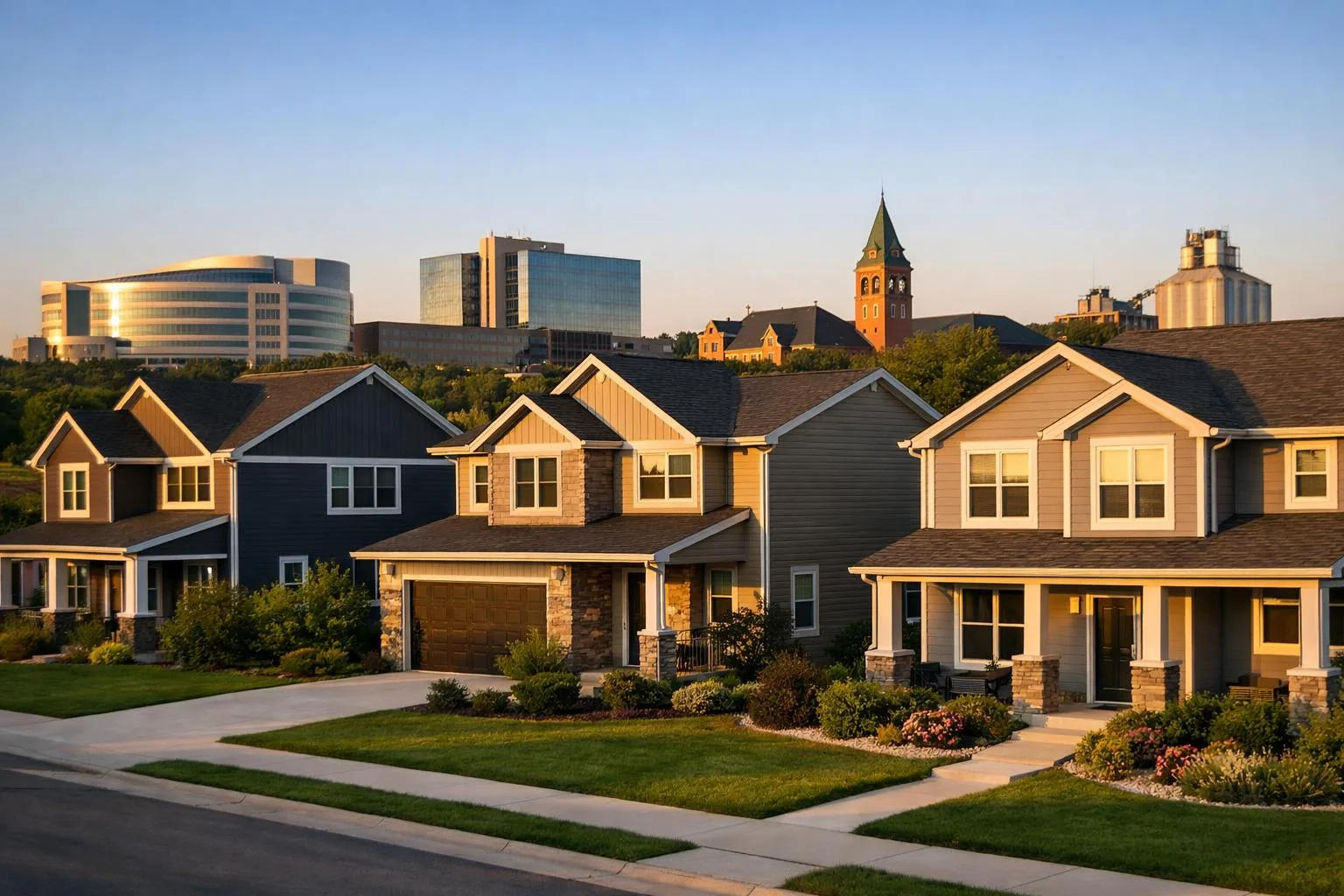
North Dakota is the smallest DSCR market in the Mountain-Plains region, but it’s not without appeal. Fargo has a diversified, growing economy (healthcare, NDSU, ag-tech) and Bismarck is a stable state-capital market. Property taxes are reasonable, landlord-tenant law is investor-friendly, and the state has very low income-tax rates. The main friction is judicial foreclosure (one of the slower processes in the region) and a small lender pool that limits rate-shopping leverage.
This guide covers DSCR lending in North Dakota: which markets move, the judicial foreclosure process, and the energy-economy correlation worth understanding.
Why Investors Choose North Dakota
North Dakota’s population is small (780,000) but grew more than 15% during the 2010s — largely driven by the Bakken oil boom. Post-2015, population growth has stabilized at 0.2-0.4% annually, concentrated in Fargo-Moorhead (which straddles the Minnesota border) and Bismarck.
Fargo is the dominant metro (metro population ~250,000). North Dakota State University (NDSU, 14,000 students), Sanford Health (major regional health system), Microsoft’s Fargo campus (one of MS’s largest campuses outside Redmond, legacy Great Plains Software acquisition), and a growing ag-tech cluster anchor the economy.
Bismarck is the state capital (metro population ~130,000). Government, healthcare (Sanford Health Bismarck, CHI St. Alexius), and a small ag-services base.
Grand Forks is University of North Dakota + Grand Forks Air Force Base.
Minot and the oil-patch cities (Williston, Dickinson, Watford City) are energy-correlated. Housing demand and rent swings with Bakken oil activity. Most DSCR investors avoid these cities because the volatility is too high; others specifically target them on dips.
DSCR Loan Rules in North Dakota
Most national DSCR lenders fund North Dakota. A few exclude ND due to the small market or the judicial foreclosure timeline. There are no state-specific DSCR restrictions on structure, pricing, or prepayment penalties.
Typical terms: min DSCR 0.85-1.20, max LTV 70-75% (slightly tighter than national average), min FICO 680-700, 6-9 months reserves. July 2026 ND DSCR rates typically run 6.375%-7.875% on 30-year fixed, reflecting the judicial-foreclosure premium (10-year Treasury at 4.65%; national band 6.25%-7.875%).
Taxes & Carrying Costs
Effective property tax rate approximately 0.98% — below the national average. North Dakota has a complex property-tax formula based on True and Full Value with taxable value at 9% for residential (Class 1). Mill rates vary by county and school district. A typical $225K Fargo rental carries a bill of $2,200-$2,800.
ND has one of the lowest income-tax structures in the country — a three-bracket schedule for 2026 of 0% / 1.95% / 2.50%, with the 0% bracket extending to roughly $48,475 single ($81,950 MFJ) and the 2.50% top rate only kicking in above $244,825 single. Some policy discussion of full elimination has occurred but not passed. Out-of-state investors file ND non-resident returns.
ND LLC fees: $135 formation, $50 annual report.
Insurance in ND is moderate — $900-$1,400 per $300K. Tornado/hail exposure is significant in the Red River Valley (Fargo region) — hail deductibles 1-2% are standard.
Foreclosure & Eviction Landscape
North Dakota is one of very few states that does not permit non-judicial foreclosure for residential mortgages. NDCC 32-19 requires judicial foreclosure for all residential loans. Timelines run 6-9 months from filing to sheriff’s sale, plus a 60-day post-sale redemption period for the borrower. Lenders price this into ND DSCR rates — expect a 0.125-0.25% pickup versus a comparable South Dakota or Minnesota file.
Eviction in ND runs 21-45 days. Non-payment starts with a 3-day notice. Landlords file in district court; cases move to hearing in 2-4 weeks. Physical removal follows judgment.
Landlord-Tenant Law
No rent control. Security deposits are capped at one month’s rent (two months if pets or if the tenant has a poor credit history documented). Landlords have 30 days to return with itemized deductions. ND requires reasonable notice (24 hours typical) before non-emergency entry.
Top North Dakota Markets
Fargo (Cass County) and West Fargo — The primary DSCR market in ND. DSCR properties price $200K-$300K with rents $1,400-$1,800. Microsoft Fargo campus and NDSU drive white-collar renter demand. West Fargo has newer construction and slightly higher basis.
Bismarck (Burleigh County) — State capital, healthcare. Stable. DSCR properties $175K-$275K with rents $1,300-$1,700.
Grand Forks (Grand Forks County) — UND + Grand Forks AFB. Student/military renter mix. DSCR properties $160K-$240K with rents $1,200-$1,550.
Minot (Ward County) — Minot AFB (ICBM missile-field base) + agricultural services. Some Bakken spillover.
Williston, Dickinson, Watford City — Oil-patch. Volatile. Not recommended for first-time DSCR investors.
Special Considerations
Judicial foreclosure is the largest operational headwind for DSCR lenders in North Dakota. The 6-9 month timeline plus 60-day post-sale redemption period means ND pricing typically includes a 0.125-0.25% premium versus comparable Minnesota or South Dakota files. Factor this into rate-shopping expectations.
Appraisal availability in smaller ND markets (Minot, Dickinson, Williston) can delay closings. Licensed appraisers are concentrated in Fargo and Bismarck; rural-county appraisals can take 3-5 weeks rather than the 7-10 days typical in Southeastern states.
Oil-patch volatility is real and worth explicitly avoiding if you’re a first-time ND DSCR investor. Williston and Watford City housing values swung 50%+ between the 2014 Bakken peak and the 2016 oil price crash. Current conditions are stable, but this is not a market to over-concentrate in. Fargo and Bismarck have diversified economies that are largely insulated from oil cycles.
Winter vacancy risk — ND has genuinely harsh winters. Vacant, unheated properties can suffer frozen-pipe failures and major claims. Budget for winterization protocols during vacancy, and verify insurance coverage on vacancy.
Entity Formation Notes
ND LLCs cost $135 formation, $50 annual. Standard structures apply. Many ND investors layer a Wyoming or Delaware parent holding LLC for privacy and charging-order protection at the holding level while keeping the ND operating LLC for in-state compliance. See the entity structure guide for the full framework.
Getting Started
Use the DSCR calculator, check current rates, then get matched with DSCR lenders funding North Dakota.
Related guides: South Dakota, Minnesota, Montana.
Keep exploring
Hand-picked next steps — whether you want to go deeper on this topic, compare alternatives, or run the numbers.
Editor's picks
Hand-chosen follow-ups for this topic.
- Guide
What Is a DSCR Loan? The Complete 2026 Guide for Real Estate Investors
A DSCR loan qualifies a rental property on rental income ÷ PITIA — not personal income or tax returns. Full 2026 guide to ratios,…
- Guide
DSCR Loan LLC Guide: Entity Structure, Vesting & Personal Guarantees
DSCR loan LLC guide: single-member, multi-member, S-Corp, trusts, personal guarantees, state selection, and lender requirements —…
- Guide
DSCR Loan Risks: What Investors Need to Know Before Signing in 2026
DSCR loan risks: ARM rate resets, prepayment traps, insurance spikes, refinance risk, personal guarantees. Honest risk analysis…
- Guide
DSCR Loan Reserve Requirements: How Much Cash Do You Need After Closing?
Complete guide to DSCR loan reserve requirements. Baseline 2 months PITIA, scaling for loan size, what counts as reserves, and…
- Property type
DSCR Loan for Single-Family Rental (SFR): 2026 Investor Guide
DSCR loan for single-family rentals in 2026: 80% LTV, 0.75+ DSCR, baseline pricing, and the exact SFR lender landscape to shop…
Compare other states
DSCR rules, rates, and tax posture in similar markets.
- State guide
DSCR Loans in Alabama
Complete 2026 guide to DSCR loans in Alabama — rates, non-judicial foreclosure rules, Birmingham and Huntsville markets, and how…
- State guide
DSCR Loans in Alaska
2026 guide to DSCR loans in Alaska — small lender pool, no state income tax, Anchorage and Fairbanks markets, and typical…
- State guide
DSCR Loans in Arkansas
2026 guide to DSCR loans in Arkansas — low property taxes, non-judicial foreclosure, Little Rock and Northwest Arkansas markets,…
- State guide
DSCR Loans in California
Complete 2026 guide to DSCR loans in California — AB1482 rent control, Prop 13 reassessment, $800 LLC tax, LA/SF/San Diego…
DSCR loan products for your next deal
The financing structures investors use most in this market.
- Loan type
DSCR Purchase Loan: Complete 2026 Guide for Investors
Everything real estate investors need to know about using a DSCR purchase loan — LTV limits, rent schedule requirements, closing…
- Loan type
DSCR Cash-Out Refinance: 2026 Playbook for Investors
DSCR cash-out refinance 2026: LTV limits, seasoning rules, tax impact, delayed financing, and when the math actually pencils —…
- Loan type
DSCR Rate-and-Term Refinance: Can You Refinance a DSCR Loan? (2026)
Yes — you can refinance a DSCR loan with rate-and-term or cash-out. Seasoning (often 3–6 months), LTV, DSCR floors, PPP costs,…
Property types investors finance here
- Property type
DSCR Loan for 2-4 Unit Properties: Duplex, Triplex & Quadplex Guide
DSCR loans for 2-4 unit properties in 2026: 75-80% LTV, 0.85-1.0 DSCR minimums, and the duplex, triplex, and fourplex lender…
- Property type
DSCR Loan for Airbnb & Short-Term Rentals: 2026 Complete Guide
DSCR loan for Airbnb and short-term rentals in 2026: AirDNA underwriting, 20% income haircut, STR lender shortlist, and every…
Run the numbers
Free interactive tools to stress-test your deal.
- Interactive tool
DSCR Ratio Calculator
Calculate your DSCR in seconds and see pass/fail by lender tier.
- Live rates
Today's DSCR Loan Rates
Live DSCR rate ranges by credit tier, LTV, and product type.
- Resource
Best DSCR Lenders of 2026
Head-to-head shortlist of the leading DSCR lenders with program details.
- Interactive tool
DSCR Qualification Estimator
Estimate your rate range, LTV cap, and approval odds before you apply.
Is There a DSCR Lender in This Market?
Coverage, foreclosure timelines, and local overlays decide whether the deal funds. Get matched now.
Shop every major DSCR lender in 60 seconds
Tell us about your deal once. We'll send you the top 3 lender offers within the hour.
Soft match — no credit pull, no spam. Your info stays with licensed brokers only.