State guide · WY
DSCR Loans in Wyoming: 2026 Investor's Guide
2026 guide to DSCR loans in Wyoming — the top LLC formation state, no income tax, Cheyenne/Jackson markets, non-judicial foreclosure, and pre-approval.
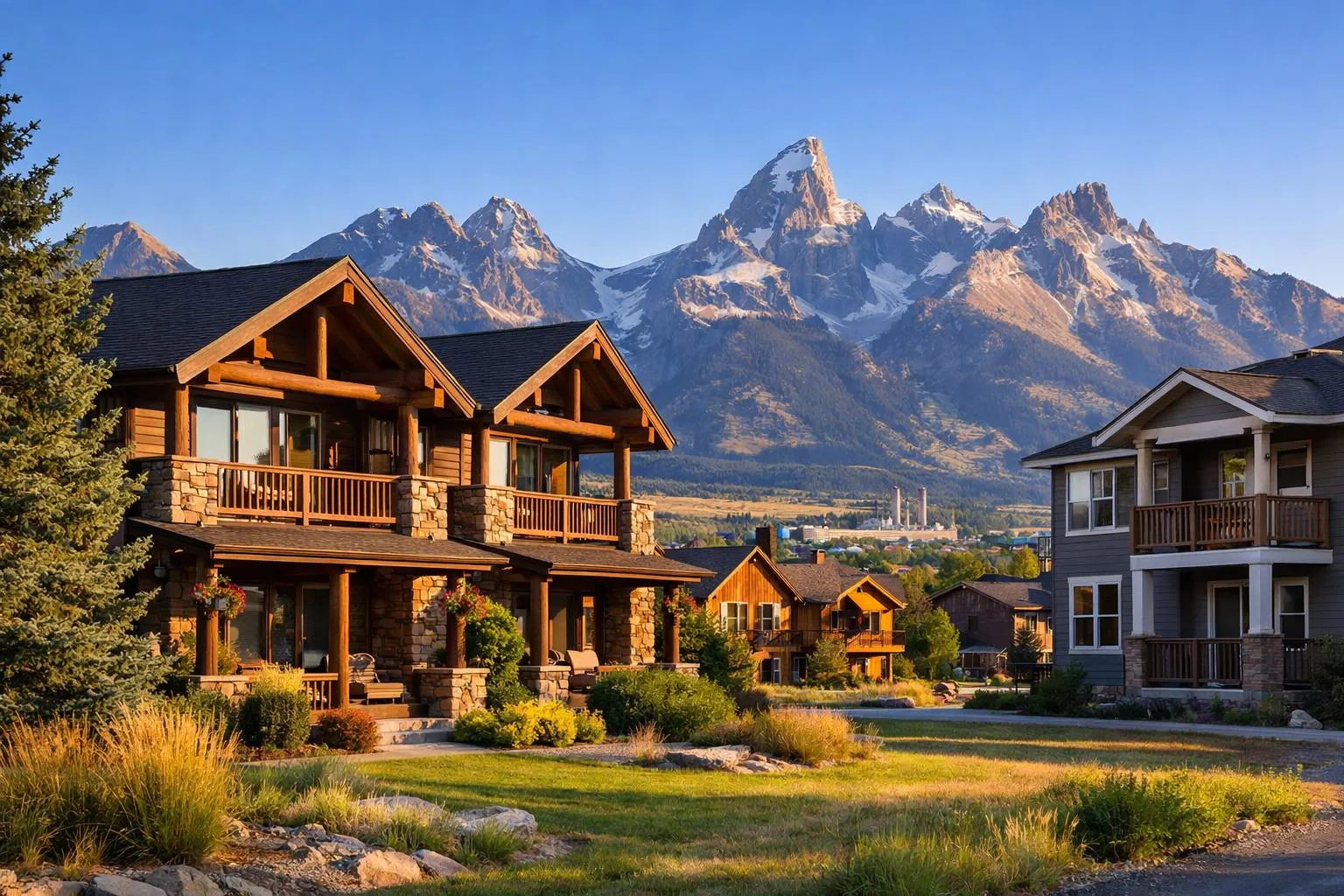
Wyoming is the LLC formation capital of the United States for real estate investors in 2026. Stronger charging-order protection than Delaware or Nevada, lower annual fees than any other formation state, genuine privacy (single-member LLCs don’t appear in public filings), no state income tax, and case law specifically developed for real-estate LLC structures. Most DSCR investors with portfolios of three or more properties hold a Wyoming parent holding LLC regardless of where their properties actually sit.
This guide covers both sides of Wyoming: the (smaller) in-state DSCR rental market in Cheyenne, Casper, and Laramie, and the (much more popular) use of Wyoming as a holding-company jurisdiction for investors operating in every other state.
Why Investors Choose Wyoming — Primarily as a Formation State
Wyoming’s rental-market story is simple — small state (580,000 residents), limited population growth, concentrated employment in energy (Powder River Basin coal, natural gas, wind power), government (state capital Cheyenne, University of Wyoming in Laramie), and tourism (Yellowstone, Grand Teton, Jackson). The primary DSCR activity in-state concentrates in Cheyenne and, secondarily, Laramie and Casper. Jackson is a specialized luxury-STR market.
The much bigger Wyoming story is LLC formation. Here’s why Wyoming dominates the holding-company market:
1. Strongest Charging-Order Protection in the US
When a creditor obtains a judgment against an LLC member personally (say, a car-accident lawsuit, a personal-guarantee default, divorce), they typically try to reach the member’s LLC interest. In most states, creditors can potentially force liquidation of the LLC or compel distributions. Wyoming’s charging-order statute (W.S. 17-29-503) limits creditor remedies to a “charging order” — meaning the creditor only receives distributions IF the LLC makes them, but cannot force distributions, cannot interfere with management, and cannot liquidate the LLC. This is the strongest statutory protection in the US for single-member and multi-member LLCs.
Nevada and Delaware offer similar protection but with more case-law variance. Wyoming’s is the cleanest.
2. Privacy (Anonymous LLC)
Wyoming does not require member names on the public Articles of Organization. The only name on public filings is the registered agent. Single-member LLCs can be structured so the owner is not publicly discoverable. Note: the federal Corporate Transparency Act (2024) now requires beneficial-owner reporting to FinCEN, so Wyoming does NOT provide anonymity at the federal level. It provides strong state-level filing privacy.
3. Lowest Annual Costs in the US
Wyoming LLC annual report fee is $60 (or the actual value of Wyoming-sourced assets, whichever is higher — for a holding company with no Wyoming assets, it’s $60). Registered agent typically $50-$200/year. Total annual cost $110-$260 — cheaper than Delaware ($300 franchise tax), Nevada ($350+ combined), or most other formation states.
4. No State Income Tax
Wyoming does not tax LLC income at the state level. For investors building a Wyoming holding company that owns out-of-state operating LLCs, Wyoming does not tax the holding company’s pass-through income. (Note: the states where properties sit will tax the operating LLCs on those states’ source income.)
5. Established Case Law
Wyoming was the first US state to adopt the LLC structure (1977, predating Delaware by 15+ years). Wyoming’s Business Corporation Act and LLC Act have been tested extensively and are considered well-developed specifically for real-estate holding structures.
6. Single-Member LLC Protection
Some states have weakened charging-order protection for single-member LLCs (on theory that the protection makes less sense when there are no other members to protect). Wyoming explicitly preserves charging-order protection for single-member LLCs, which matters for many DSCR investors who hold their portfolio in a solo structure.
The Common DSCR Investor Structure
Most DSCR investors with 3+ properties use a stacked structure:
Wyoming Holding LLC (the parent, formed in WY)
- Owns 100% of Operating LLC #1 (formed in State A where Property #1 sits)
- Owns 100% of Operating LLC #2 (formed in State B where Property #2 sits)
- Owns 100% of Operating LLC #3 (formed in State C where Property #3 sits)
Each operating LLC holds one property and handles state-specific compliance, rent collection, and operations. The Wyoming holding company provides the privacy and charging-order-protection layer. Annual cost: $60-$260 for Wyoming + registered agents + state-specific operating LLC annual fees.
For small portfolios (1-2 properties), this structure is overkill. For portfolios of 5+ properties, it’s the default.
See the entity structure guide for the full framework.
DSCR Loan Rules in Wyoming (In-State Real Estate)
Most major national DSCR lenders fund Wyoming. The in-state rental market is small, so expect 3-5 competing quotes. There are no state-specific DSCR restrictions.
Typical terms: min DSCR 0.85-1.20, max LTV 70-75%, min FICO 680-700, 6-9 months reserves.
Taxes & Carrying Costs (In-State)
No state income tax. No state corporate tax. Wyoming funds itself through mineral severance taxes (coal, natural gas, oil) and sales tax (4% state + local).
Property tax: effective rate 0.61% — among the 10 lowest. Residential assessment at 9.5% of market value; commercial/industrial at 11.5%. A $275K Cheyenne rental typically carries $1,700-$2,300 in annual property tax.
Wyoming LLCs: $100 filing fee (or $102 online), $60 annual report. Lowest ongoing cost in the US.
Insurance moderate — $900-$1,300 per $300K. Wind/hail exposure in eastern WY (Casper east) is real.
Foreclosure & Eviction Landscape
Wyoming is a non-judicial foreclosure state. Power-of-sale foreclosure under W.S. 34-4-101 et seq. requires notice, publication, and sale. Typical timeline: 90-120 days — one of the faster processes in the country. There is a post-sale redemption period (3 months typically).
Eviction in WY runs 14-30 days. Non-payment starts with a 3-day notice. Landlords file unlawful-detainer actions in circuit court. Wyoming is landlord-friendly.
Landlord-Tenant Law
No rent control. Security deposits not statutorily capped; market practice one month. Landlords have 30 days to return the deposit with itemized deductions. WY requires reasonable notice before non-emergency entry.
Top Wyoming Markets
Cheyenne (Laramie County) — State capital. F.E. Warren Air Force Base (ICBM missile-field base). DSCR properties $250K-$375K with rents $1,550-$2,000. Stable.
Laramie (Albany County) — University of Wyoming. Student/young-professional rentals. DSCR properties $200K-$325K with rents $1,400-$1,850.
Casper (Natrona County) — Central Wyoming. Energy economy. Cyclical.
Jackson (Teton County) — Luxury market. Specialized. Many DSCR lenders require specialty underwriting for Jackson properties. STR regulations are among the strictest in the Mountain West: Teton County prohibits short-term rentals (under 31 days) in most residential zones; the Town of Jackson permits STR in residential areas only under a Basic Use Permit capped at 3 rentals per year and 60 total nights, with fuller STR rights only inside the lodging overlay and Snow King Resort district. Verify the specific zoning district before underwriting any STR pro-forma.
Gillette, Sheridan — Energy and ranching economies.
Entity Formation Notes
For pure formation purposes (without in-state property), Wyoming registered agents charge $50-$200/year. The formation process can be completed online in 1-3 business days. Most DSCR investors use a registered agent service that also handles annual report filings.
For DSCR loans on properties outside Wyoming, the Wyoming holding LLC becomes the member of the state-specific operating LLC, and the DSCR loan is taken in the operating LLC’s name with the Wyoming LLC (and ultimately the beneficial owner) providing personal guarantees as required.
Getting Started
For in-state Wyoming DSCR lending, use the DSCR calculator, check current rates, then get matched.
For investors forming a Wyoming holding company for properties in other states, see the entity structure guide for a complete implementation walkthrough.
Related guides: Delaware, Nevada, South Dakota.
Keep exploring
Hand-picked next steps — whether you want to go deeper on this topic, compare alternatives, or run the numbers.
Editor's picks
Hand-chosen follow-ups for this topic.
- Guide
What Is a DSCR Loan? The Complete 2026 Guide for Real Estate Investors
A DSCR loan qualifies a rental property on rental income ÷ PITIA — not personal income or tax returns. Full 2026 guide to ratios,…
- Guide
DSCR Loan LLC Guide: Entity Structure, Vesting & Personal Guarantees
DSCR loan LLC guide: single-member, multi-member, S-Corp, trusts, personal guarantees, state selection, and lender requirements —…
- Guide
Holding Company LLC Real Estate Strategy: Structure, Tax & Lender Acceptance
Scaling investor's blueprint for a real-estate holding company LLC: Wyoming parent, property-state LLCs, tax elections, banking,…
- Guide
Series LLC DSCR Loan Guide: Which Lenders Accept, Cost Math & State Rules
Series LLC DSCR loan guide: states that allow them, lenders that accept, cost savings vs standalone LLCs, and when a holding…
- Investor profile
DSCR Portfolio Builder Guide: Scaling a Rental Portfolio Past 10 Properties
Scale past Fannie's 10-property cap with DSCR: blended DSCR, blanket loans, Wyoming holdings, reserves, and capital recycling…
Compare other states
DSCR rules, rates, and tax posture in similar markets.
- State guide
DSCR Loans in Alabama
Complete 2026 guide to DSCR loans in Alabama — rates, non-judicial foreclosure rules, Birmingham and Huntsville markets, and how…
- State guide
DSCR Loans in Alaska
2026 guide to DSCR loans in Alaska — small lender pool, no state income tax, Anchorage and Fairbanks markets, and typical…
- State guide
DSCR Loans in Arkansas
2026 guide to DSCR loans in Arkansas — low property taxes, non-judicial foreclosure, Little Rock and Northwest Arkansas markets,…
- State guide
DSCR Loans in California
Complete 2026 guide to DSCR loans in California — AB1482 rent control, Prop 13 reassessment, $800 LLC tax, LA/SF/San Diego…
DSCR loan products for your next deal
The financing structures investors use most in this market.
- Loan type
DSCR Purchase Loan: Complete 2026 Guide for Investors
Everything real estate investors need to know about using a DSCR purchase loan — LTV limits, rent schedule requirements, closing…
- Loan type
DSCR Cash-Out Refinance: 2026 Playbook for Investors
DSCR cash-out refinance 2026: LTV limits, seasoning rules, tax impact, delayed financing, and when the math actually pencils —…
- Loan type
DSCR Rate-and-Term Refinance: Can You Refinance a DSCR Loan? (2026)
Yes — you can refinance a DSCR loan with rate-and-term or cash-out. Seasoning (often 3–6 months), LTV, DSCR floors, PPP costs,…
Property types investors finance here
- Property type
DSCR Loan for Single-Family Rental (SFR): 2026 Investor Guide
DSCR loan for single-family rentals in 2026: 80% LTV, 0.75+ DSCR, baseline pricing, and the exact SFR lender landscape to shop…
- Property type
DSCR Loan for 2-4 Unit Properties: Duplex, Triplex & Quadplex Guide
DSCR loans for 2-4 unit properties in 2026: 75-80% LTV, 0.85-1.0 DSCR minimums, and the duplex, triplex, and fourplex lender…
- Property type
DSCR Loan for Airbnb & Short-Term Rentals: 2026 Complete Guide
DSCR loan for Airbnb and short-term rentals in 2026: AirDNA underwriting, 20% income haircut, STR lender shortlist, and every…
Run the numbers
Free interactive tools to stress-test your deal.
- Interactive tool
DSCR Ratio Calculator
Calculate your DSCR in seconds and see pass/fail by lender tier.
- Live rates
Today's DSCR Loan Rates
Live DSCR rate ranges by credit tier, LTV, and product type.
- Resource
Best DSCR Lenders of 2026
Head-to-head shortlist of the leading DSCR lenders with program details.
- Interactive tool
Portfolio DSCR Analyzer
Blend DSCR across your rental portfolio and preview blanket-loan structure.
Is There a DSCR Lender in This Market?
Coverage, foreclosure timelines, and local overlays decide whether the deal funds. Get matched now.
Shop every major DSCR lender in 60 seconds
Tell us about your deal once. We'll send you the top 3 lender offers within the hour.
Soft match — no credit pull, no spam. Your info stays with licensed brokers only.