State guide · DE
DSCR Loans in Delaware: 2026 Investor's Guide
2026 guide to DSCR loans in Delaware — LLC formation capital, Wilmington and Sussex Beach markets, 0.56% property tax, and a flat $300 LLC franchise fee.
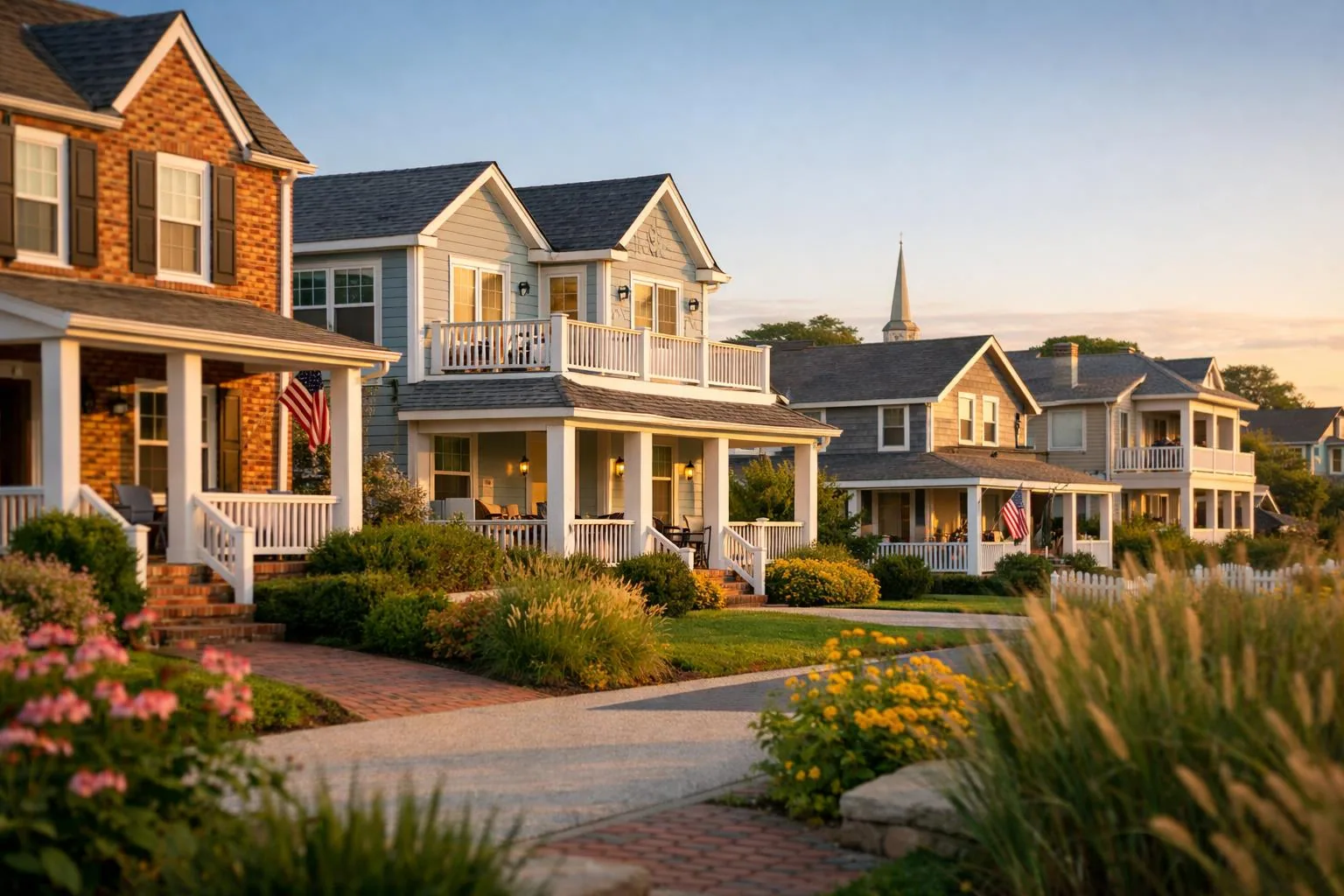
Delaware punches far above its weight in the DSCR world — not because of loan volume (the state has only 1 million residents and roughly 400,000 housing units) but because Delaware is the LLC formation capital of the United States. Approximately two-thirds of Fortune 500 companies are Delaware entities, and real estate investors routinely form Delaware holding companies that own out-of-state operating LLCs.
This guide covers both sides of Delaware: the (smaller) local DSCR market in Wilmington, Dover, Newark, and the Sussex County beaches, and the (very common) use of Delaware as a holding-company jurisdiction regardless of where the actual properties sit.
Why Investors Choose Delaware
As a formation state. Delaware’s General Corporation Law and Limited Liability Company Act are the most developed body of business law in the country. The Court of Chancery — Delaware’s specialized equity court with no juries and judges who are former corporate litigators — produces predictable, sophisticated rulings on LLC disputes, fiduciary duty, and member-manager deadlocks. Delaware recognized series LLCs in 1996, years before most states. Privacy is moderate (single-member owners are not required to be disclosed in the public filing, though a registered agent must be identified).
As a property market. Delaware has three counties and a straightforward economic setup: Wilmington is the banking capital (Chase, JP Morgan credit card operations, Capital One, WSFS), Dover is the state capital and home to Dover Air Force Base, and Sussex County is the beach-and-retirement corridor. Population growth is moderate but steady, driven by migration from New Jersey and Pennsylvania.
For investors who already operate in the Mid-Atlantic, Delaware offers low property taxes, no state sales tax, and a reasonable landlord-tenant framework.
DSCR Loan Rules in Delaware
All major national DSCR lenders fund Delaware. There are no state-specific DSCR restrictions, no prohibition on prepayment penalties, and no unusual licensing requirements for out-of-state lenders making business-purpose loans to investor LLCs.
Standard terms apply: min DSCR 0.75-1.25, max LTV 75%-80% on purchase, 70%-75% on cash-out refi, min FICO 660-680, 6 months PITIA reserves. 30-year fixed and ARMs available.
The only Delaware-specific wrinkle is the realty transfer tax — 4% of the purchase price, split between buyer and seller (2% each by default, though allocations are negotiable). Budget this at closing. It’s a meaningful cost compared to most states.
Taxes & Carrying Costs
Delaware has a graduated personal income tax topping at 6.6%. Out-of-state investors with Delaware property must file a non-resident return. Critical detail for LLC formation: Delaware does not tax Delaware LLCs that do not actually conduct business in Delaware. A Delaware LLC that owns property in Texas, for example, is not subject to Delaware income tax. The LLC pays Delaware’s flat $300 annual franchise tax and that’s it.
Delaware has no state sales tax — one of only five states without one.
Property tax is low. The effective statewide rate of 0.56% is among the ten lowest. New Castle County runs the highest at a combined state-county-school-district mill rate producing bills around 0.7% effective. Kent and Sussex counties run lower. Assessment in Delaware was frozen to 1974 (New Castle), 1987 (Kent), and 1974 (Sussex) values for decades until a 2020 Chancery Court ruling forced reassessment statewide — new values took effect for tax year 2024-2025 in New Castle, with Kent and Sussex following on staggered timelines. Pull the current reassessed bill, not legacy data, on any Delaware underwriting.
Insurance in inland Delaware is moderate ($1,000-$1,500 per $300K). Coastal Sussex County (Rehoboth, Bethany, Dewey, Fenwick) runs significantly higher due to wind/flood exposure — expect $2,500-$4,500 plus required flood insurance in FEMA zones.
Foreclosure & Eviction Landscape
Delaware is a mixed foreclosure state. The most common process is scire facias sur mortgage, a judicial but expedited procedure unique to Delaware and a handful of other jurisdictions. Total timeline from filing to sheriff’s sale runs 4-8 months. A traditional foreclosure action takes longer.
Eviction runs 30-60 days. Non-payment starts with a 5-day notice. Landlords file a summary-possession action in Justice of the Peace Court, which moves reasonably quickly. Sheriff’s execution typically occurs within a week of judgment.
Landlord-Tenant Law
No rent control in Delaware. Security deposits are capped at one month’s rent for leases one year or longer, and landlords have 20 days to return the deposit with itemized deductions. Delaware requires a Rental Purpose Permit in many municipalities (Wilmington, Newark) — confirm permitting before closing. Leases must comply with the Delaware Landlord Tenant Code.
Top Delaware Markets
Wilmington (New Castle County) — Delaware’s largest city. Banking (credit-card HQ cluster), healthcare (Christiana Care), and proximity to Philadelphia drive the renter base. DSCR properties in Trolley Square, Brandywine Village, and Greenville price $225K-$425K with rents of $1,600-$2,400. The city’s rental registration is active — plan for this during onboarding.
Newark — University of Delaware campus (22,000+ students) anchors the rental market. Student-oriented and young-professional rentals dominate. DSCR cap rates run 6-7.5%.
Dover — State capital, Dover Air Force Base. Stable military-and-government renter base. Lower basis than New Castle County; DSCR properties often price $175K-$275K with rents of $1,400-$1,800.
Sussex County beaches (Rehoboth, Bethany, Lewes, Fenwick) — Short-term rental economy. Peak summer weekly rents can support DSCR ratios above 1.30 on STR-underwriting, but many DSCR lenders apply a 30% revenue haircut or require long-term rental comps. This is the Delaware market where lender selection matters most — use a lender with STR-specific underwriting.
Special Considerations — The Delaware LLC Advantage
This is the section most investors care about. Here’s why Delaware is so frequently chosen for holding companies:
-
Court of Chancery. A 230-year-old equity court with specialized judges. Case law on LLC governance, fiduciary duty, and operating-agreement interpretation is the deepest in the US. Disputes resolve faster and more predictably than state-court equivalents elsewhere.
-
Operating Agreement primacy. Delaware gives maximum deference to the operating agreement. Members can waive fiduciary duties (with exceptions), create custom economic arrangements, and structure member-manager relationships in ways many other states constrain.
-
Series LLCs. Delaware pioneered the series LLC in 1996. Each series can hold separate assets with separate liability shields, all under one master LLC umbrella. Common for investors holding 10+ properties who want asset segregation without filing 10+ LLCs.
-
Privacy. Single-member owners don’t appear on the Certificate of Formation. Only the registered agent’s name is public. Note: Corporate Transparency Act beneficial-owner reporting to FinCEN was enjoined nationwide for domestic reporting companies in March 2025 (FinCEN interim final rule limiting CTA to foreign reporting companies), so the federal anonymity-piercing effect is presently narrowed — but the underlying statute is still on the books and the rule is being litigated. Delaware continues to provide state-level filing privacy regardless.
-
Franchise tax. Flat $300 per year for LLCs regardless of size. Predictable and cheap.
Caveat: if your property sits in another state, a Delaware holding LLC doesn’t avoid that state’s income tax, transfer tax, or foreign-qualification requirement. Delaware is a formation strategy, not a tax-avoidance strategy. See the entity structure guide for the full analysis.
Entity Formation Notes
Delaware LLC formation runs $90 filing plus a registered agent (typically $50-$300/year) and the $300 annual franchise tax. Total year-one cost is typically $450-$700.
Common structure for DSCR investors: Delaware holding LLC owns Delaware (or other-state) operating LLCs, each holding one property. The holding LLC lives in Delaware for governance; the operating LLC foreign-qualifies wherever the property is.
Getting Started
Use the DSCR calculator to model the deal, check current rates, then get matched with DSCR lenders funding Delaware.
Related guides: Wyoming, Nevada, Pennsylvania.
Keep exploring
Hand-picked next steps — whether you want to go deeper on this topic, compare alternatives, or run the numbers.
Editor's picks
Hand-chosen follow-ups for this topic.
- Guide
What Is a DSCR Loan? The Complete 2026 Guide for Real Estate Investors
A DSCR loan qualifies a rental property on rental income ÷ PITIA — not personal income or tax returns. Full 2026 guide to ratios,…
- Guide
DSCR Loan LLC Guide: Entity Structure, Vesting & Personal Guarantees
DSCR loan LLC guide: single-member, multi-member, S-Corp, trusts, personal guarantees, state selection, and lender requirements —…
- Guide
Series LLC DSCR Loan Guide: Which Lenders Accept, Cost Math & State Rules
Series LLC DSCR loan guide: states that allow them, lenders that accept, cost savings vs standalone LLCs, and when a holding…
- Guide
Holding Company LLC Real Estate Strategy: Structure, Tax & Lender Acceptance
Scaling investor's blueprint for a real-estate holding company LLC: Wyoming parent, property-state LLCs, tax elections, banking,…
- Property type
DSCR Loan for Airbnb & Short-Term Rentals: 2026 Complete Guide
DSCR loan for Airbnb and short-term rentals in 2026: AirDNA underwriting, 20% income haircut, STR lender shortlist, and every…
Compare other states
DSCR rules, rates, and tax posture in similar markets.
- State guide
DSCR Loans in Alabama
Complete 2026 guide to DSCR loans in Alabama — rates, non-judicial foreclosure rules, Birmingham and Huntsville markets, and how…
- State guide
DSCR Loans in Alaska
2026 guide to DSCR loans in Alaska — small lender pool, no state income tax, Anchorage and Fairbanks markets, and typical…
- State guide
DSCR Loans in Arkansas
2026 guide to DSCR loans in Arkansas — low property taxes, non-judicial foreclosure, Little Rock and Northwest Arkansas markets,…
- State guide
DSCR Loans in California
Complete 2026 guide to DSCR loans in California — AB1482 rent control, Prop 13 reassessment, $800 LLC tax, LA/SF/San Diego…
DSCR loan products for your next deal
The financing structures investors use most in this market.
- Loan type
DSCR Purchase Loan: Complete 2026 Guide for Investors
Everything real estate investors need to know about using a DSCR purchase loan — LTV limits, rent schedule requirements, closing…
- Loan type
DSCR Cash-Out Refinance: 2026 Playbook for Investors
DSCR cash-out refinance 2026: LTV limits, seasoning rules, tax impact, delayed financing, and when the math actually pencils —…
- Loan type
DSCR Rate-and-Term Refinance: Can You Refinance a DSCR Loan? (2026)
Yes — you can refinance a DSCR loan with rate-and-term or cash-out. Seasoning (often 3–6 months), LTV, DSCR floors, PPP costs,…
Property types investors finance here
- Property type
DSCR Loan for Single-Family Rental (SFR): 2026 Investor Guide
DSCR loan for single-family rentals in 2026: 80% LTV, 0.75+ DSCR, baseline pricing, and the exact SFR lender landscape to shop…
- Property type
DSCR Loan for 2-4 Unit Properties: Duplex, Triplex & Quadplex Guide
DSCR loans for 2-4 unit properties in 2026: 75-80% LTV, 0.85-1.0 DSCR minimums, and the duplex, triplex, and fourplex lender…
Run the numbers
Free interactive tools to stress-test your deal.
- Interactive tool
DSCR Ratio Calculator
Calculate your DSCR in seconds and see pass/fail by lender tier.
- Live rates
Today's DSCR Loan Rates
Live DSCR rate ranges by credit tier, LTV, and product type.
- Resource
Best DSCR Lenders of 2026
Head-to-head shortlist of the leading DSCR lenders with program details.
- Interactive tool
Portfolio DSCR Analyzer
Blend DSCR across your rental portfolio and preview blanket-loan structure.
Is There a DSCR Lender in This Market?
Coverage, foreclosure timelines, and local overlays decide whether the deal funds. Get matched now.
Shop every major DSCR lender in 60 seconds
Tell us about your deal once. We'll send you the top 3 lender offers within the hour.
Soft match — no credit pull, no spam. Your info stays with licensed brokers only.