State guide · WI
DSCR Loans in Wisconsin: 2026 Investor's Guide
2026 guide to DSCR loans in Wisconsin — Milwaukee and Madison markets, 10-month judicial foreclosure, 1.61% property tax, and landlord-friendly eviction law.
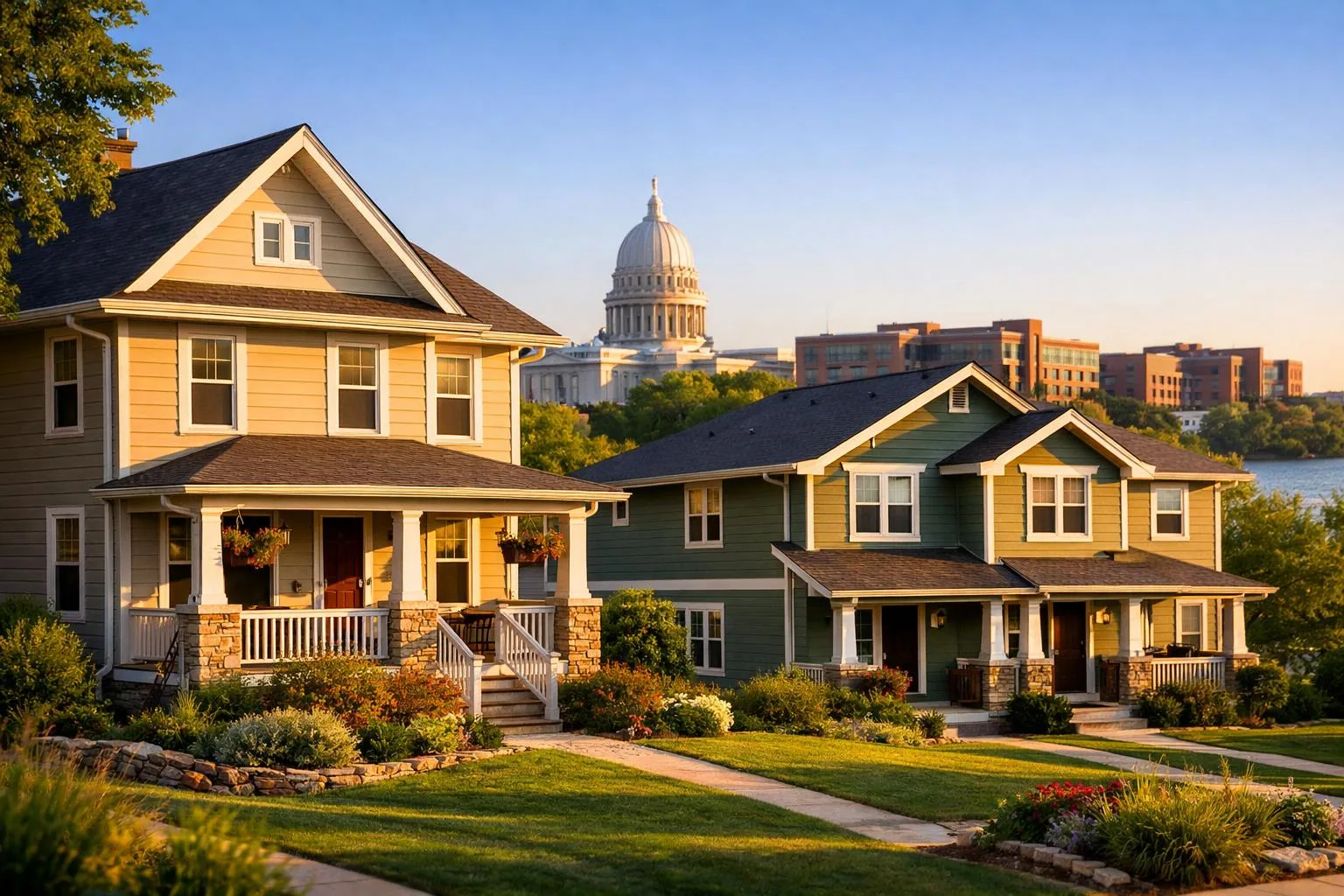
Wisconsin is a cash-flow DSCR state held back primarily by high property taxes. Milwaukee’s 2-4 unit housing stock (the classic “Polish flats” and duplexes built 1890-1940) offers genuinely strong cap rates — cap rates the coasts simply don’t produce. Madison is a stable university-and-government market with tighter DSCR math but stronger appreciation trajectory. Green Bay, Kenosha, and the Fox Valley add secondary markets. Every major national DSCR lender funds Wisconsin.
This guide walks through DSCR lending in Wisconsin: the two metros, the property-tax drag, and the small-multifamily opportunity that makes Milwaukee unique.
Why Investors Choose Wisconsin
Wisconsin’s population growth is modest (0.1-0.3% annually), with growth concentrated in Dane County (Madison) and the Fox Valley (Appleton, Green Bay area). Milwaukee has been essentially flat for decades but remains the state’s largest metro with 1.6 million residents.
Milwaukee metro (Milwaukee, Waukesha, Ozaukee, Washington counties) — Healthcare (Froedtert, Aurora, Children’s Hospital of Wisconsin), manufacturing (Harley-Davidson, Johnson Controls, Kohl’s HQ, Rockwell Automation), and financial services. The Milwaukee small-multifamily market is distinctive: vast inventory of 2-4 unit “Polish flats,” duplexes, and triplexes built during the early industrial era. These buildings trade at cap rates 7-10% in many neighborhoods and are well-suited to DSCR financing.
Madison (Dane County) — State capital + University of Wisconsin (47,000 students) + Epic Systems (one of the largest healthcare software companies in the US) + American Family Insurance HQ. Stable, diversified, consistently growing. Highest basis in Wisconsin.
Green Bay (Brown County) — Packers, Schneider National trucking, healthcare. Stable cash-flow market.
Kenosha, Racine — Chicago-adjacent southeast Wisconsin. Amazon’s massive Kenosha distribution center has driven some rental demand; spillover from Illinois commuter market.
DSCR Loan Rules in Wisconsin
Every major national DSCR lender funds Wisconsin. There are no state-specific DSCR restrictions. Wisconsin’s mortgage-lending statutes govern consumer lending; bona-fide business-purpose loans to investor LLCs for 1-4 unit property are exempt.
Typical terms: min DSCR 0.85-1.20 (tight because property taxes narrow PITIA margins), max LTV 75%-80%, min FICO 660-680, 6-9 months reserves.
Taxes & Carrying Costs
Property tax is the Wisconsin drag. Effective rate approximately 1.73% — among the top 10. Milwaukee’s effective rate runs 2.0-2.3%. Madison’s Dane County runs 1.8-2.1%. Fox Valley lower. School-district millage drives most of the total.
A $225K Milwaukee rental carries $3,600-$4,500 in annual property tax. A $325K Madison rental carries $4,800-$6,500. Model accurately.
State income tax: graduated 3.5% to 7.65% in 2026. Out-of-state investors file WI non-resident returns. Wisconsin LLCs: $130 formation, $25 annual report.
Insurance runs $1,000-$1,500 per $300K for most of Wisconsin. Great Lakes winter exposure is a minor consideration; frozen-pipe claims are the most common winter claim type.
Foreclosure & Eviction Landscape
Wisconsin is a judicial foreclosure state. WI Stat Chapter 846 governs. Uncontested timelines run 6-9 months from filing to sheriff’s sale; contested cases longer. Wisconsin also applies a post-sale redemption period — typically 6 months for non-abandoned residential property, 3 months for abandoned or waived residential, 12 months for farm property. The redemption period must run before the deed is delivered to the purchaser. Total effective lender timeline is 12-18 months typically.
Eviction in Wisconsin runs 21-45 days. Non-payment starts with a 5-day notice to pay or vacate (or 14-day for non-monthly tenancies). Landlords file small claims unlawful-detainer. Cases move to hearing in 2-3 weeks.
Landlord-Tenant Law
No rent control. Wisconsin Statutes 66.1015 preempts local rent stabilization. Security deposits not statutorily capped; market practice one month. Landlords have 21 days to return the deposit with itemized deductions. Wisconsin requires 12-hour notice before non-emergency entry (shorter than most states).
Milwaukee has rental-registration and lead-paint certification requirements similar to Chicago. Compliance costs: $100-$400 per unit per cycle.
Top Wisconsin Markets
Milwaukee — Primary DSCR market. 2-4 unit properties in Riverwest, Bay View, West Allis, Wauwatosa, Brewers Hill. DSCR properties $125K-$275K for single-family; $225K-$425K for 2-4 unit. Cap rates 7-10%. Lead-paint compliance and rental-registration are required.
Madison / Dane County — Higher basis, stronger appreciation. DSCR properties $325K-$525K with rents $1,800-$2,500. Tighter cap rates (5.5-7%).
Green Bay — Stable cash-flow. DSCR properties $175K-$275K with rents $1,300-$1,700.
Kenosha / Racine — Chicago-adjacent. Amazon distribution spillover. DSCR properties $175K-$275K with rents $1,300-$1,700.
Appleton / Fox Valley — Secondary market, stable. Manufacturing base (Kimberly-Clark legacy, significant paper and specialty manufacturing), healthcare (ThedaCare). DSCR properties $175K-$275K with rents $1,300-$1,700. Lower cost-of-living than Madison, stronger demand stability than Milwaukee’s outer neighborhoods.
Special Considerations
Post-sale redemption periods (typically 6 months for non-abandoned residential, 3 months abandoned or with waiver) extend lender effective timelines to 12-18 months total from initial filing. This is a key reason Wisconsin DSCR pricing runs slightly higher than non-judicial Midwest states — lenders price the longer loss-severity window into rate sheets.
Milwaukee lead-paint certification is strict and non-negotiable. The city requires lead-safe work practices for all renovation in pre-1978 housing, which is the vast majority of Milwaukee’s rental stock. Certified lead-safe contractors charge premium rates. Budget $500-$2,500 per unit in inspection, certification, and compliance costs annually across a Milwaukee portfolio.
Polish flats and duplex inventory in Milwaukee is the signature small-multifamily product — typically 2 or 3 units in a frame or brick building built 1890-1930, often with limited modernization. Mechanical systems (boilers, plumbing, knob-and-tube electrical) frequently need updates. A 2-4 unit Milwaukee DSCR deal that pencils at purchase often requires $15K-$40K in capital improvements during the first 12 months; model this.
Wisconsin’s property tax is structurally high and unlikely to decline. Legislative discussions of school-funding reform have recurred for decades without producing meaningful change. Don’t underwrite to a lower future mill rate.
Madison rental demand is exceptionally stable because Epic Systems, UW, and state government are all very large, long-tenure employer bases with minimal cyclical risk. Cap rates are tighter than Milwaukee but vacancy risk is materially lower.
Entity Formation Notes
Wisconsin LLCs cost $130 formation and $25 annually — low maintenance. Standard structures apply. Many investors use Wyoming or Delaware parent LLCs. See the entity structure guide.
Getting Started
Use the DSCR calculator with accurate Wisconsin property tax modeling, check current rates, then get matched.
Related guides: Illinois, Minnesota, Michigan.
Keep exploring
Hand-picked next steps — whether you want to go deeper on this topic, compare alternatives, or run the numbers.
Editor's picks
Hand-chosen follow-ups for this topic.
- Guide
What Is a DSCR Loan? The Complete 2026 Guide for Real Estate Investors
A DSCR loan qualifies a rental property on rental income ÷ PITIA — not personal income or tax returns. Full 2026 guide to ratios,…
- Guide
DSCR Loan LLC Guide: Entity Structure, Vesting & Personal Guarantees
DSCR loan LLC guide: single-member, multi-member, S-Corp, trusts, personal guarantees, state selection, and lender requirements —…
Compare other states
DSCR rules, rates, and tax posture in similar markets.
- State guide
DSCR Loans in Alabama
Complete 2026 guide to DSCR loans in Alabama — rates, non-judicial foreclosure rules, Birmingham and Huntsville markets, and how…
- State guide
DSCR Loans in Alaska
2026 guide to DSCR loans in Alaska — small lender pool, no state income tax, Anchorage and Fairbanks markets, and typical…
- State guide
DSCR Loans in Arkansas
2026 guide to DSCR loans in Arkansas — low property taxes, non-judicial foreclosure, Little Rock and Northwest Arkansas markets,…
- State guide
DSCR Loans in California
Complete 2026 guide to DSCR loans in California — AB1482 rent control, Prop 13 reassessment, $800 LLC tax, LA/SF/San Diego…
DSCR loan products for your next deal
The financing structures investors use most in this market.
- Loan type
DSCR Purchase Loan: Complete 2026 Guide for Investors
Everything real estate investors need to know about using a DSCR purchase loan — LTV limits, rent schedule requirements, closing…
- Loan type
DSCR Cash-Out Refinance: 2026 Playbook for Investors
DSCR cash-out refinance 2026: LTV limits, seasoning rules, tax impact, delayed financing, and when the math actually pencils —…
- Loan type
DSCR Rate-and-Term Refinance: Can You Refinance a DSCR Loan? (2026)
Yes — you can refinance a DSCR loan with rate-and-term or cash-out. Seasoning (often 3–6 months), LTV, DSCR floors, PPP costs,…
Property types investors finance here
- Property type
DSCR Loan for Single-Family Rental (SFR): 2026 Investor Guide
DSCR loan for single-family rentals in 2026: 80% LTV, 0.75+ DSCR, baseline pricing, and the exact SFR lender landscape to shop…
- Property type
DSCR Loan for 2-4 Unit Properties: Duplex, Triplex & Quadplex Guide
DSCR loans for 2-4 unit properties in 2026: 75-80% LTV, 0.85-1.0 DSCR minimums, and the duplex, triplex, and fourplex lender…
- Property type
DSCR Loan for Airbnb & Short-Term Rentals: 2026 Complete Guide
DSCR loan for Airbnb and short-term rentals in 2026: AirDNA underwriting, 20% income haircut, STR lender shortlist, and every…
Run the numbers
Free interactive tools to stress-test your deal.
- Interactive tool
DSCR Ratio Calculator
Calculate your DSCR in seconds and see pass/fail by lender tier.
- Live rates
Today's DSCR Loan Rates
Live DSCR rate ranges by credit tier, LTV, and product type.
- Resource
Best DSCR Lenders of 2026
Head-to-head shortlist of the leading DSCR lenders with program details.
- Interactive tool
DSCR Qualification Estimator
Estimate your rate range, LTV cap, and approval odds before you apply.
Is There a DSCR Lender in This Market?
Coverage, foreclosure timelines, and local overlays decide whether the deal funds. Get matched now.
Shop every major DSCR lender in 60 seconds
Tell us about your deal once. We'll send you the top 3 lender offers within the hour.
Soft match — no credit pull, no spam. Your info stays with licensed brokers only.