State guide · IL
DSCR Loans in Illinois: 2026 Investor's Guide
Complete 2026 guide to DSCR loans in Illinois — Chicago's landlord rules, high property taxes, Cook County protections, and how to get pre-approved.
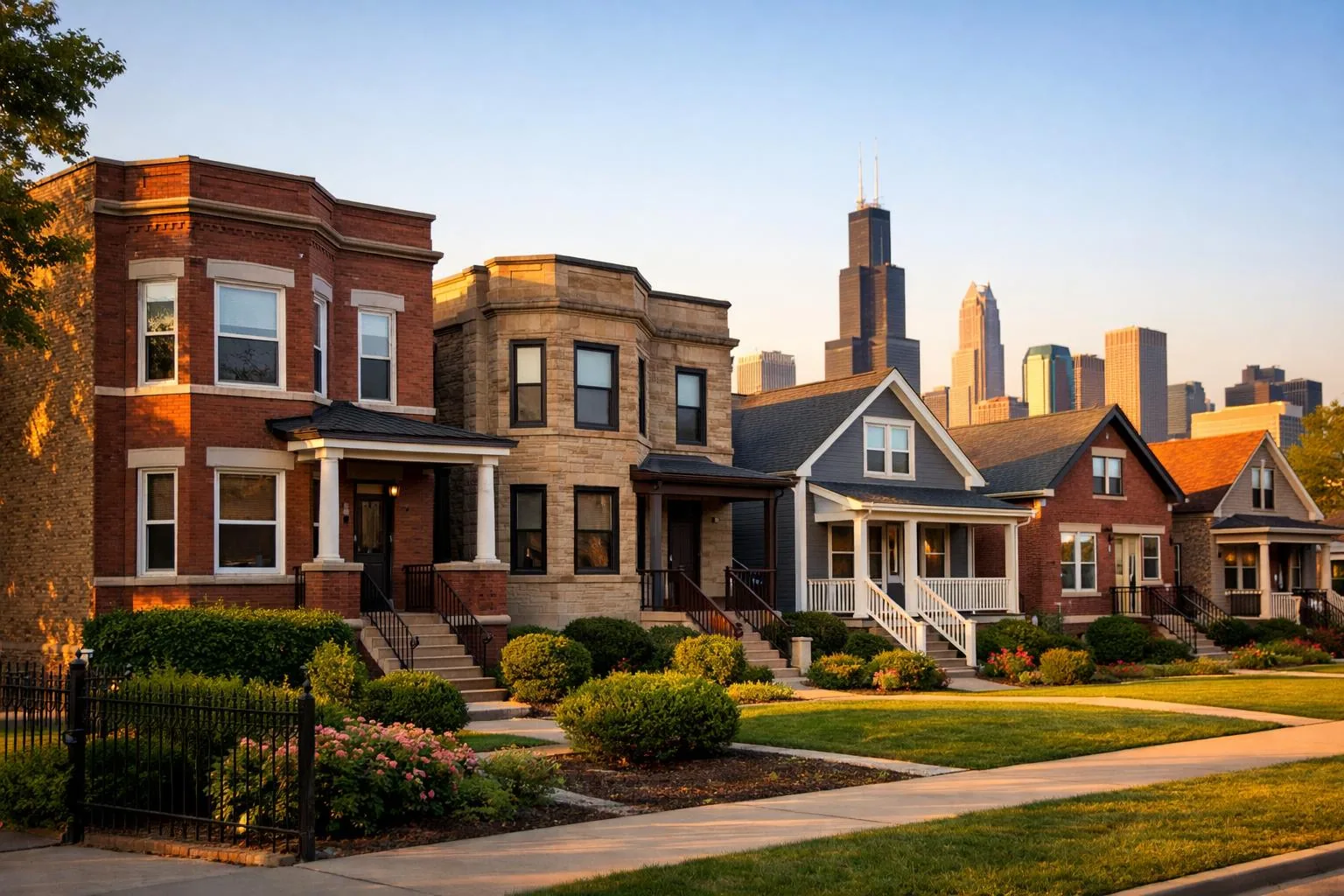
Illinois is a complicated DSCR state. The property-tax rate is the second-highest in the country and dominates underwriting. The judicial foreclosure process is slow. Cook County has unusually strong tenant protections. But Chicago’s small-multifamily market (the iconic 2-4 unit “three flats” and “two flats”) trades at cap rates 6.5-8.5% — genuinely cash-flow-positive even at 2026 interest rates — and that’s why Chicago remains a top-10 DSCR lending market despite all the frictions.
This guide covers DSCR financing in Illinois: what’s workable, what’s not, and how to underwrite the property-tax line item correctly.
Why Investors Choose Illinois
Illinois’s population has been declining slowly (roughly 0.1-0.3% per year net outmigration since 2014), which is genuinely the bear case. The counterargument is that Chicago’s metro population is still 9.3 million, the economic base is diversified (finance, logistics, healthcare, manufacturing, tech corridor along the Kennedy), and rental demand is sticky in the neighborhoods investors care about — Logan Square, Avondale, Bridgeport, Pilsen, Humboldt Park, South Shore, and many others.
Chicago’s small-multifamily stock is the story. Thousands of brick-and-stone 2-4 unit buildings built between 1895 and 1935, many in desirable neighborhoods, trading at cap rates the coasts haven’t seen in a decade. Out-of-state DSCR investors have been acquiring this stock at scale since 2017, and Cook County’s transfer-tax records show the trend continuing through 2025.
Downstate Illinois (Rockford, Peoria, Champaign-Urbana, Springfield) trades at even higher cap rates but with less durable demand.
DSCR Loan Rules in Illinois
Every major national DSCR lender funds Illinois. Chicago’s 2-4 unit product is especially familiar territory for experienced DSCR shops. There are no state-specific DSCR restrictions, no prohibition on prepayment penalties for business-purpose loans on 1-4 unit investor property, and no unusual licensing requirements for out-of-state lenders making business-purpose loans to investor LLCs.
The Illinois Consumer Installment Loan Act and Residential Mortgage License Act govern consumer lending. Bona-fide business-purpose loans to investor LLCs are outside that scope.
Typical Illinois DSCR terms: min DSCR 0.75-1.20 (often tight because property taxes push PITIA up hard), max LTV 75%-80% on purchase, 70%-75% on cash-out refi, min FICO 660-680, 6 months PITIA reserves. Chicago 2-4 unit often underwritten with slightly larger reserves (9 months) and lender-preferred appraisal products.
Taxes & Carrying Costs
Property tax is the Illinois story. Effective statewide rate is ~2.05%. Cook County runs higher. The rates are structurally high because Illinois has the smallest state-funded share of K-12 education in the country, so local school districts fund operations almost entirely through property taxes.
Chicago-specific detail: properties are reassessed every three years on a rolling county cycle. The assessed value is 10% of fair market for Class 2 residential (1-6 unit). The county clerk applies an equalization factor (multiplier) and local tax rates to produce the bill. Reassessment triggers are important: a sale triggers a new assessed value. An acquisition closed today can produce a property-tax bill 20-50% higher than the seller’s legacy bill. Underwrite the post-sale projected bill using the Cook County Assessor’s estimator tool or by consulting a local property-tax appeals attorney during due diligence.
State income tax is flat at 4.95%. Out-of-state investors file an IL non-resident return. Illinois LLCs pay a $250 filing fee and a $75 annual report fee.
Insurance in Chicago runs $1,400-$2,200 per $400K. Flood risk along the Chicago River and some Lake Michigan proximity areas requires flood insurance. Hail exposure downstate can push premiums higher.
Foreclosure & Eviction Landscape
Illinois is a judicial foreclosure state. Timelines run 8-12 months uncontested, 12-24 months when contested. Cook County is on the slow end. During the 2020-2022 pandemic moratorium period, Cook County backlog grew substantially and some effects persist.
Eviction in Illinois runs 60-90 days typically. Non-payment begins with a 5-day notice. The court filing is a Forcible Entry and Detainer action. Cook County has a mandatory Early Resolution Program (mediation) before judgment. Physical removal by the Sheriff follows judgment. Non-Cook counties move materially faster — DuPage, Lake, and Will County landlords often see evictions resolved in 30-45 days.
Landlord-Tenant Law
The Illinois Rent Control Preemption Act (1997) prohibits municipalities from enacting rent caps. Despite repeated repeal efforts (HB2192, various sessions 2019-2024), the preemption remains in force.
Cook County’s Residential Tenant Landlord Ordinance (RTLO) applies to most Cook County rentals and imposes: required written lease disclosures, specific security-deposit handling rules with interest payments, strict notice requirements, and attorney-fee-shifting when landlords violate the ordinance. Chicago has the separate CRLTO (Chicago Residential Landlord and Tenant Ordinance), which is similar with its own requirements. Compliance is non-optional in Chicago. Work with a property manager who knows the CRLTO intimately.
Security deposits: Chicago landlords must pay interest on deposits held more than 6 months (Chicago rate set annually; 2026 rate is in the 0.01-0.06% range, low enough that most landlords simply don’t hold deposits for CRLTO-covered buildings, using last-month rent structures instead). Non-Chicago Cook County follows RTLO. Downstate follows the Illinois Security Deposit Return Act.
Top Illinois Markets
Chicago — The anchor. Small multifamily in Humboldt Park, Avondale, Logan Square, Bridgeport, Pilsen, South Shore, Rogers Park, Uptown, Albany Park. Each neighborhood has its own pricing pattern and tenant demographics. DSCR purchases of $450K-$800K for a 2-4 unit are common, with cap rates 6.5-8.5% depending on condition and neighborhood. New-build condos in West Loop, South Loop, and River North trade at lower cap rates (4-5%) and tighter DSCR math.
Chicago suburbs (Naperville, Aurora, Joliet, Elgin) — Lower cap rates than Chicago proper, more single-family, better schools, larger population of stable long-term-rental tenants. DSCR math is tighter but tenant turnover is lower.
Rockford — Lowest cost basis in any major Illinois metro. DSCR properties often $120K-$180K with rents of $1,100-$1,400. Cap rates 9-11%. Appreciation trajectory is weaker; yield-first strategy.
Peoria, Springfield, Champaign-Urbana — Secondary markets with specific demand drivers (Caterpillar HQ legacy, state government, University of Illinois). Each is a specialty market requiring local property-management.
Special Considerations
Property-tax reassessment on sale is the #1 underwriting error in Illinois. Use the Cook County Assessor’s post-sale estimator. Cook County CRLTO/RTLO compliance is the #2. Hire a Chicago property manager before your first deal closes. Rockford and downstate markets have much weaker demand durability than Chicago — cash-flow is the only return there.
Entity Formation Notes
Illinois LLCs cost $150 to form and $75 annually. Many Chicago investors hold property in an Illinois single-purpose LLC with a Wyoming or Delaware holding-company parent. Illinois recognizes series LLCs. See the entity structure guide.
Getting Started
Use the DSCR calculator with the post-reassessment projected bill, check current rates, then get matched with DSCR lenders funding Illinois.
Related guides: Indiana, Wisconsin, Missouri.
Keep exploring
Hand-picked next steps — whether you want to go deeper on this topic, compare alternatives, or run the numbers.
Editor's picks
Hand-chosen follow-ups for this topic.
- Guide
What Is a DSCR Loan? The Complete 2026 Guide for Real Estate Investors
A DSCR loan qualifies a rental property on rental income ÷ PITIA — not personal income or tax returns. Full 2026 guide to ratios,…
- Guide
DSCR Loan LLC Guide: Entity Structure, Vesting & Personal Guarantees
DSCR loan LLC guide: single-member, multi-member, S-Corp, trusts, personal guarantees, state selection, and lender requirements —…
- Guide
Series LLC DSCR Loan Guide: Which Lenders Accept, Cost Math & State Rules
Series LLC DSCR loan guide: states that allow them, lenders that accept, cost savings vs standalone LLCs, and when a holding…
- Property type
DSCR Loan for 2-4 Unit Properties: Duplex, Triplex & Quadplex Guide
DSCR loans for 2-4 unit properties in 2026: 75-80% LTV, 0.85-1.0 DSCR minimums, and the duplex, triplex, and fourplex lender…
- Property type
DSCR Loan for 5-10 Unit Small Multifamily: Commercial Classification Guide
DSCR loans for 5-10 unit small multifamily in 2026: 70-75% LTV, 1.15-1.25 DSCR, commercial appraisal rules, and the specific…
Compare other states
DSCR rules, rates, and tax posture in similar markets.
- State guide
DSCR Loans in Alabama
Complete 2026 guide to DSCR loans in Alabama — rates, non-judicial foreclosure rules, Birmingham and Huntsville markets, and how…
- State guide
DSCR Loans in Alaska
2026 guide to DSCR loans in Alaska — small lender pool, no state income tax, Anchorage and Fairbanks markets, and typical…
- State guide
DSCR Loans in Arkansas
2026 guide to DSCR loans in Arkansas — low property taxes, non-judicial foreclosure, Little Rock and Northwest Arkansas markets,…
- State guide
DSCR Loans in California
Complete 2026 guide to DSCR loans in California — AB1482 rent control, Prop 13 reassessment, $800 LLC tax, LA/SF/San Diego…
DSCR loan products for your next deal
The financing structures investors use most in this market.
- Loan type
DSCR Purchase Loan: Complete 2026 Guide for Investors
Everything real estate investors need to know about using a DSCR purchase loan — LTV limits, rent schedule requirements, closing…
- Loan type
DSCR Cash-Out Refinance: 2026 Playbook for Investors
DSCR cash-out refinance 2026: LTV limits, seasoning rules, tax impact, delayed financing, and when the math actually pencils —…
- Loan type
DSCR Rate-and-Term Refinance: Can You Refinance a DSCR Loan? (2026)
Yes — you can refinance a DSCR loan with rate-and-term or cash-out. Seasoning (often 3–6 months), LTV, DSCR floors, PPP costs,…
Property types investors finance here
- Property type
DSCR Loan for Single-Family Rental (SFR): 2026 Investor Guide
DSCR loan for single-family rentals in 2026: 80% LTV, 0.75+ DSCR, baseline pricing, and the exact SFR lender landscape to shop…
- Property type
DSCR Loan for Airbnb & Short-Term Rentals: 2026 Complete Guide
DSCR loan for Airbnb and short-term rentals in 2026: AirDNA underwriting, 20% income haircut, STR lender shortlist, and every…
Run the numbers
Free interactive tools to stress-test your deal.
- Interactive tool
DSCR Ratio Calculator
Calculate your DSCR in seconds and see pass/fail by lender tier.
- Live rates
Today's DSCR Loan Rates
Live DSCR rate ranges by credit tier, LTV, and product type.
- Resource
Best DSCR Lenders of 2026
Head-to-head shortlist of the leading DSCR lenders with program details.
- Interactive tool
DSCR Qualification Estimator
Estimate your rate range, LTV cap, and approval odds before you apply.
Is There a DSCR Lender in This Market?
Coverage, foreclosure timelines, and local overlays decide whether the deal funds. Get matched now.
Shop every major DSCR lender in 60 seconds
Tell us about your deal once. We'll send you the top 3 lender offers within the hour.
Soft match — no credit pull, no spam. Your info stays with licensed brokers only.