State guide · SC
DSCR Loans in South Carolina: 2026 Investor's Guide
Complete 2026 guide to DSCR loans in South Carolina — Charleston/Greenville/Myrtle Beach markets, judicial foreclosure, STR strength, and pre-approval.
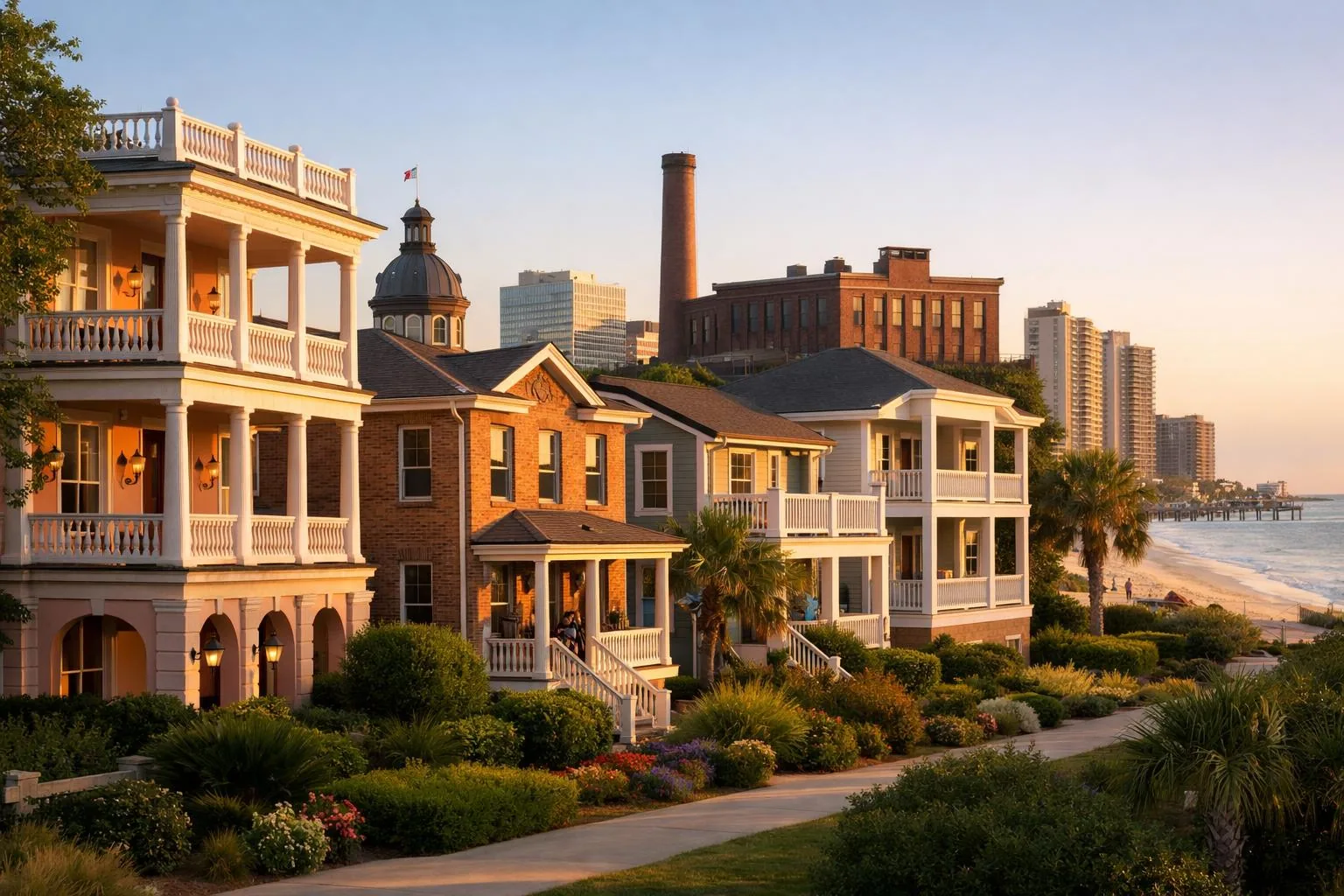
South Carolina has quietly become one of the Sun Belt’s stronger DSCR markets. Charleston’s historic charm and growing biotech/aerospace presence, Greenville’s manufacturing corridor and BMW HQ, Columbia’s state government and University of South Carolina, Myrtle Beach’s vacation-rental economy — each metro offers a different investor thesis, and all operate under South Carolina’s landlord-friendly legal framework. The one complication is the split-rate property tax that treats investor-owned property meaningfully worse than owner-occupied.
This guide covers DSCR lending in South Carolina: the tax structure, the four distinct markets, and the STR opportunity along the coast.
Why Investors Choose South Carolina
South Carolina’s population grew approximately 10% from 2010-2020 and has continued growing. Net in-migration from the Northeast and Midwest is the driver. The Charleston metro added 50,000+ residents from 2015-2023.
Charleston (Charleston, Berkeley, Dorchester counties) — Tourism + Boeing’s 787 final-assembly plant (North Charleston) + Volvo’s US HQ and SUV plant (Ridgeville) + Mercedes-Benz Vans (North Charleston) + growing biotech. Median single-family price in Charleston metro has risen meaningfully, though remains below Raleigh or Nashville.
Greenville (Greenville County) — BMW’s North American manufacturing HQ (Spartanburg nearby), Michelin North America HQ, GE Power, significant automotive supplier cluster. Downtown Greenville has been revitalized dramatically since 2010. The Upstate economy is increasingly Germany-and-France adjacent given the BMW/Michelin anchor.
Columbia (Richland County) — State capital, University of South Carolina (35,000 students), Fort Jackson (Army base). Stable government/education/military economy.
Myrtle Beach (Horry County) — Vacation and retirement economy. Distinct from Charleston or Greenville — more focused on short-term rentals, tourism, and retiree demand. Population has grown faster than most of SC.
Summerville, Mount Pleasant — Charleston suburbs with strong DSCR activity.
DSCR Loan Rules in South Carolina
Every major national DSCR lender funds South Carolina. There are no state-specific DSCR restrictions. South Carolina’s Consumer Finance Law and Mortgage Lending Act govern consumer lending; business-purpose loans to investor LLCs for 1-4 unit property are exempt.
Typical terms: min DSCR 0.75-1.25, max LTV 75%-80% on purchase, 70%-75% on cash-out refi, min FICO 660-680, 6 months reserves.
Taxes & Carrying Costs
South Carolina’s split-rate property tax is the key underwriting variable. Owner-occupied residential (primary residence with homestead exemption) is assessed at 4% of market value. Non-owner-occupied residential (investor rentals) is assessed at 6% of market value. This is a 50% higher assessment base before any homestead exemption considerations.
In practice, an investor-owned $300K rental in Charleston can pay 2-3x what an identical owner-occupied property pays. The statewide effective rate of 0.55% averages both classifications — investor-owned rates are meaningfully higher.
Model the 6% assessment ratio with local millage. Typical investor-owned tax bills:
- Charleston metro: approximately 1.1-1.5% effective on purchase price
- Greenville: approximately 1.0-1.4%
- Columbia: approximately 1.2-1.6%
- Myrtle Beach: approximately 0.9-1.3%
State income tax: graduated 0% to 6.4% in 2026 after reductions (top rate was 7% pre-reform). Out-of-state investors file SC non-resident returns. SC LLCs: $110 online formation, $25 annual report — cheap.
Insurance runs $1,300-$2,200 per $300K inland. Coastal Charleston, Myrtle Beach, and Hilton Head run $2,500-$5,000+ with wind/hurricane exposure. Flood insurance is typically required in coastal FEMA zones.
Foreclosure & Eviction Landscape
South Carolina is a judicial foreclosure state under SC Code Title 29. Process: complaint, answer, default or contested proceeding, Master-in-Equity judgment, sale. Typical timeline 5-9 months uncontested, 9-14 months contested. Faster than many judicial states because SC uses specialized Masters-in-Equity rather than generalist judges for foreclosure.
Eviction in SC runs 14-30 days. Non-payment starts with a 5-day notice to pay or quit. Landlords file ejectment actions in magistrate court. SC is landlord-friendly on eviction timelines.
Landlord-Tenant Law
No rent control. SC Code 27-40 preempts local rent caps. Security deposits not statutorily capped; market practice one month. Landlords have 30 days to return with itemized deductions. SC requires reasonable notice (usually 24 hours) before non-emergency entry. No statewide rental registration.
Charleston and some coastal municipalities have short-term-rental ordinances — primarily permit caps, zoning restrictions, and transient-lodging tax compliance. Verify specific municipality rules before underwriting STR.
Top South Carolina Markets
Charleston / Mount Pleasant / Summerville / North Charleston — The primary DSCR market. Charleston peninsula has historic charm, tight supply, and aggressive pricing. Mount Pleasant is upscale suburban. Summerville and Ladson are more affordable with strong long-term-rental demand from Boeing/Volvo worker base. DSCR properties range $300K-$750K with rents $1,900-$3,500 depending on submarket. Cap rates 5-7%.
Greenville / Spartanburg — Manufacturing corridor. DSCR properties $225K-$400K with rents $1,500-$2,200. Cap rates 6-7.5%. Strong long-term rental demand.
Columbia — State capital + USC. DSCR properties $175K-$275K with rents $1,300-$1,750. Student-housing specialty market available.
Myrtle Beach / Horry County — STR opportunity. Condo DSCR is a specialty category (many DSCR lenders exclude condotels; others specialize in them). Single-family DSCR in the inland Myrtle Beach corridor price $225K-$400K. STR-specific lenders will underwrite to Airbnb revenue.
Hilton Head — Luxury second-home and STR market. High basis.
Entity Formation Notes
SC LLCs cost $110 formation and $25 annually — cheap. Standard structures apply. For multi-state portfolios, Wyoming or Delaware parent holding LLCs owning SC LLCs are common. See the entity structure guide.
Getting Started
Use the DSCR calculator with the 6% assessment rate for investor properties, check current rates, then get matched.
Related guides: North Carolina, Georgia, Florida.
Keep exploring
Hand-picked next steps — whether you want to go deeper on this topic, compare alternatives, or run the numbers.
Editor's picks
Hand-chosen follow-ups for this topic.
- Guide
What Is a DSCR Loan? The Complete 2026 Guide for Real Estate Investors
A DSCR loan qualifies a rental property on rental income ÷ PITIA — not personal income or tax returns. Full 2026 guide to ratios,…
- Guide
DSCR Loan LLC Guide: Entity Structure, Vesting & Personal Guarantees
DSCR loan LLC guide: single-member, multi-member, S-Corp, trusts, personal guarantees, state selection, and lender requirements —…
- Property type
DSCR Loan for Airbnb & Short-Term Rentals: 2026 Complete Guide
DSCR loan for Airbnb and short-term rentals in 2026: AirDNA underwriting, 20% income haircut, STR lender shortlist, and every…
- Property type
DSCR Loan for Non-Warrantable Condos & Condotels: Lender List & Pricing
DSCR loan for non-warrantable condos and condotels in 2026: 65-70% LTV, 1.20+ DSCR, and the specialist lender pool for Miami,…
- Investor profile
BRRRR + DSCR Strategy Guide: Buy, Rehab, Rent, Refinance, Repeat Financing
The BRRRR + DSCR refinance playbook: seasoning by lender, ARV appraisals, capital recycling math, and refinance mechanics that…
Compare other states
DSCR rules, rates, and tax posture in similar markets.
- State guide
DSCR Loans in Colorado
Complete 2026 guide to DSCR loans in Colorado — public-trustee foreclosure, reassessment watch, Denver/Boulder/Colorado Springs…
- State guide
DSCR Loans in Indiana
Complete 2026 guide to DSCR loans in Indiana — strong cash-flow yields, Indianapolis/Fort Wayne markets, judicial foreclosure,…
- State guide
DSCR Loans in Kentucky
2026 guide to DSCR loans in Kentucky — Louisville and Lexington markets, landlord-friendly courts, 0.86% property tax, and 6-12…
- State guide
DSCR Loans in Michigan
DSCR loan Michigan guide 2026 — rates, requirements, Detroit cash-flow math, non-judicial foreclosure, Grand Rapids/Ann Arbor…
DSCR loan products for your next deal
The financing structures investors use most in this market.
- Loan type
DSCR Purchase Loan: Complete 2026 Guide for Investors
Everything real estate investors need to know about using a DSCR purchase loan — LTV limits, rent schedule requirements, closing…
- Loan type
DSCR Cash-Out Refinance: 2026 Playbook for Investors
DSCR cash-out refinance 2026: LTV limits, seasoning rules, tax impact, delayed financing, and when the math actually pencils —…
- Loan type
DSCR Rate-and-Term Refinance: Can You Refinance a DSCR Loan? (2026)
Yes — you can refinance a DSCR loan with rate-and-term or cash-out. Seasoning (often 3–6 months), LTV, DSCR floors, PPP costs,…
Property types investors finance here
- Property type
DSCR Loan for Single-Family Rental (SFR): 2026 Investor Guide
DSCR loan for single-family rentals in 2026: 80% LTV, 0.75+ DSCR, baseline pricing, and the exact SFR lender landscape to shop…
- Property type
DSCR Loan for 2-4 Unit Properties: Duplex, Triplex & Quadplex Guide
DSCR loans for 2-4 unit properties in 2026: 75-80% LTV, 0.85-1.0 DSCR minimums, and the duplex, triplex, and fourplex lender…
Run the numbers
Free interactive tools to stress-test your deal.
- Interactive tool
DSCR Ratio Calculator
Calculate your DSCR in seconds and see pass/fail by lender tier.
- Live rates
Today's DSCR Loan Rates
Live DSCR rate ranges by credit tier, LTV, and product type.
- Resource
Best DSCR Lenders of 2026
Head-to-head shortlist of the leading DSCR lenders with program details.
- Interactive tool
Short-Term Rental DSCR Analyzer
Run Airbnb income through lender STR haircuts with LTR fallback.
Is There a DSCR Lender in This Market?
Coverage, foreclosure timelines, and local overlays decide whether the deal funds. Get matched now.
Shop every major DSCR lender in 60 seconds
Tell us about your deal once. We'll send you the top 3 lender offers within the hour.
Soft match — no credit pull, no spam. Your info stays with licensed brokers only.