State guide · NJ
DSCR Loans in New Jersey: 2026 Investor's Guide
2026 guide to DSCR loans in New Jersey — PPP prohibition on 1-4 units, nation-high 2.23% property tax, Newark/Jersey City markets, and the best NJ DSCR lenders.
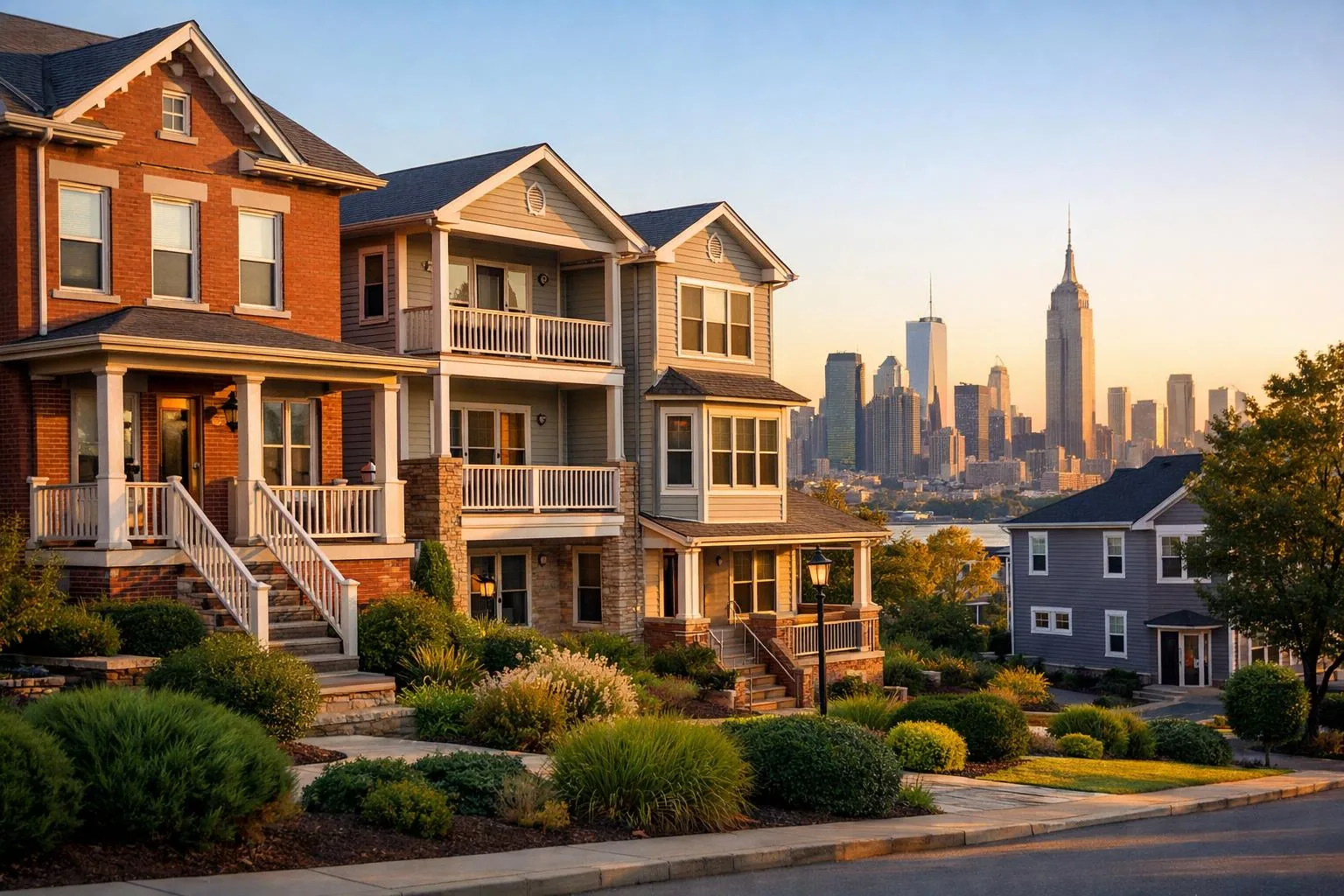
New Jersey is a high-friction, high-cost, high-density DSCR market. It carries the highest property tax rate in the country, a statute prohibiting prepayment penalties on 1-4 unit investment loans, a judicial foreclosure clock among the slowest in the US, and over 100 municipalities with local rent control. The upside: some of the deepest commuter-rail demand in the country, Jersey City and Hoboken’s Manhattan-proximity appreciation, and concentrated blue-collar rental demand in Newark, Paterson, Elizabeth, and Trenton.
This guide covers the New Jersey DSCR environment in 2026: the stacked restrictions, how they price into your loan, and the metros where investors are still finding compelling deals.
Why Investors Choose New Jersey
The NJ thesis is almost entirely about proximity to Manhattan. Hudson County (Jersey City, Hoboken, Union City, Weehawken) has seen appreciation comparable to or better than parts of Brooklyn over the past decade, with lower entry prices and fewer rent-stabilization traps. Essex County (Newark, East Orange, Irvington) trades on rent yield plus transit access. Bergen, Middlesex, and Monmouth counties offer suburban SFR with reliable tenant quality — many DSCR investors target commuter-rail-station ZIPs.
The downside is the tax and regulatory stack, which reduces effective yield and raises required rent-to-price ratios materially compared to, say, Georgia or Ohio.
DSCR Loan Rules in New Jersey
The headline rule: New Jersey prohibits prepayment penalties on 1-4 unit residential investment property loans. All NJ DSCR files close without a PPP, and rates sit 0.25%-0.50% above PPP-allowed states to offset.
Judicial foreclosure premium. Lenders additionally price in the 12-24 month foreclosure clock. Expect NJ DSCR quotes to run 0.375%-0.625% above comparable Pennsylvania or other non-judicial Northeastern quotes.
NJ DFS / Department of Banking and Insurance licenses non-QM lenders. Every major national DSCR lender closes NJ deals, though underwriting is noticeably tighter on rent-controlled cities.
| Typical New Jersey DSCR Terms, 2026 | Range |
|---|---|
| Minimum DSCR | 1.00 - 1.25 |
| Max LTV (purchase) | 70% - 75% |
| Max LTV (cash-out refi) | 65% - 70% |
| Minimum FICO | 660 - 700 |
| Prepayment penalty | Prohibited on 1-4 unit |
Taxes & Carrying Costs
State income tax. Graduated, topping at 10.75% on income over $1M. High by national standards.
Property tax — the nation’s highest. Effective rate of approximately 2.23% statewide. On a $300,000 investment property, that’s ~$6,690/year. On a $500,000 property, roughly $11,150/year. This dwarfs most states and is the single biggest constraint on NJ DSCR ratios. County variation: Essex and Union (~2.5%+ effective), Bergen (~2.0%), Hudson (~1.7%, benefiting from higher values), Ocean (~1.9%).
NJ LLC fees. $125 to form, $75 annual report. No state franchise tax on pass-through LLCs.
Realty Transfer Fee. NJ charges a transfer fee at closing (~1%) paid by the seller; on purchases over $1M the “Mansion Tax” adds 1% paid by the buyer.
Insurance. Coastal NJ (Ocean, Monmouth, Atlantic counties) carries windstorm premiums; post-Sandy flood-zone underwriting is strict. Interior NJ prices standard.
Foreclosure & Eviction Landscape
Judicial foreclosure under the NJ Fair Foreclosure Act. Typical timeline 12-24 months uncontested, longer contested. NJ is routinely in the top-3 slowest foreclosure states alongside NY and HI. This is the single biggest DSCR-pricing variable.
Eviction. NJ Anti-Eviction Act requires just cause for most evictions. Summary dispossess filed in Landlord-Tenant court. Typical timeline 30-90 days uncontested; rent-control cities may see delays. Not the fastest state, but faster than the foreclosure clock.
Landlord-Tenant Law
Rent control — 100+ municipalities. No statewide rent control, but Newark (4% cap or CPI), Jersey City (annual CPI cap on pre-1987 buildings), Hoboken (~5% cap), Elizabeth, Paterson, Passaic, Union City, Weehawken, and many smaller cities all have rent-leveling boards. Caps range from 2%-6% annually, and vacancy decontrol rules vary. This is a critical underwriting variable — your DSCR today and your DSCR at year 5 can be very different depending on the municipality.
Just-cause eviction. NJ Anti-Eviction Act applies to most residential rentals; limited no-fault eviction.
Security deposits. Capped at 1.5 months rent; must be held in a segregated interest-bearing account with annual written accounting.
Late fees. Must be “reasonable” and stated in the lease; typically 5%.
Notice to terminate month-to-month. 30 days (one full rental period).
Top New Jersey Markets
Newark. Cash-flow core. 4% rent-cap ordinance but deep Section 8 / voucher demand, university tenant base (Rutgers-Newark, NJIT), Newark Airport employment. Multifamily 2-4 family is the dominant DSCR asset.
Jersey City. Hudson County appreciation leader. Journal Square, Heights, Downtown submarkets. Rent control applies to pre-1987 buildings — newer construction is exempt, which affects DSCR math.
Paterson. Highest yields, lower entry prices, fastest eviction environment in the state (relatively). Section 8 heavy. Rent control in effect.
Elizabeth / Union County. Port-corridor employment, Newark Airport proximity. Mixed regulatory environment — Elizabeth has rent control, Union Township does not.
Trenton. State-capital demand, lower price points, strong voucher demand. Smaller market.
Special Considerations
The high-property-tax math. Because property tax is 2-3x national average, a rent of $2,500/month on a $300K property that hits 1.0 DSCR in Ohio might only hit 0.85 DSCR in NJ. Many investors find they need to push to 2-4 unit product or target rent-stressed markets (Section 8, voucher) to make the numbers work.
The no-PPP and judicial-foreclosure combo. Both of these premiums stack. NJ DSCR rates are structurally higher than most of the country.
Local rent-control lookup is mandatory. Before writing a contract, look up the specific municipality’s rent-control status. The NJ Department of Community Affairs maintains a list; city-by-city ordinance details matter.
Post-Sandy flood underwriting. Coastal and bay-side parcels have tightened considerably. Elevation certificates and FEMA zone checks are standard.
Entity Formation
Form in NJ if holding NJ property. $125 filing, $75 annual report. No franchise tax on pass-through. Wyoming parent / NJ operating LLC works for anonymity. See our entity-structure guide.
How to Get Started
New Jersey is a high-friction, higher-rate DSCR market where the lender-match question centers on comfort with rent-controlled cities and judicial-foreclosure pricing. The no-PPP rule removes one lender-differentiator — everyone quotes the same structure. Our free matching tool at /get-matched routes to NJ-active lenders and flags the rent-control overlay.
Run numbers through the DSCR calculator (paying careful attention to the property tax line), check rates, review the prepayment penalty guide to understand why NJ pricing looks different, and compare at /compare/best-dscr-lenders. NJ investors often pair with higher-yield markets like Ohio or Tennessee to balance cash flow.
Keep exploring
Hand-picked next steps — whether you want to go deeper on this topic, compare alternatives, or run the numbers.
Editor's picks
Hand-chosen follow-ups for this topic.
- Guide
What Is a DSCR Loan? The Complete 2026 Guide for Real Estate Investors
A DSCR loan qualifies a rental property on rental income ÷ PITIA — not personal income or tax returns. Full 2026 guide to ratios,…
- Guide
DSCR Loan Prepayment Penalties: Structures, Math, and How to Negotiate
Complete guide to DSCR loan prepayment penalties: 5/4/3/2/1 step-downs, buydown math, state restrictions, and exit strategies…
- Guide
DSCR Loan LLC Guide: Entity Structure, Vesting & Personal Guarantees
DSCR loan LLC guide: single-member, multi-member, S-Corp, trusts, personal guarantees, state selection, and lender requirements —…
- Investor profile
BRRRR + DSCR Strategy Guide: Buy, Rehab, Rent, Refinance, Repeat Financing
The BRRRR + DSCR refinance playbook: seasoning by lender, ARV appraisals, capital recycling math, and refinance mechanics that…
- Property type
DSCR Loan for 2-4 Unit Properties: Duplex, Triplex & Quadplex Guide
DSCR loans for 2-4 unit properties in 2026: 75-80% LTV, 0.85-1.0 DSCR minimums, and the duplex, triplex, and fourplex lender…
Compare other states
DSCR rules, rates, and tax posture in similar markets.
- State guide
DSCR Loans in District of Columbia
2026 guide to DSCR loans in Washington DC — Rental Housing Act rent control, TOPA tenant rights, slow judicial foreclosure, and…
- State guide
DSCR Loans in Hawaii
2026 guide to DSCR loans in Hawaii — PPP prohibition on 1-4 units, Honolulu STR rules, lowest US property tax at 0.28%, and best…
- State guide
DSCR Loans in Massachusetts
2026 guide to DSCR loans in Massachusetts — PPP prohibition on 1-4 units, Boston/Worcester markets, no statewide rent control,…
- State guide
DSCR Loans in Minnesota
2026 guide to DSCR loans in Minnesota — PPP prohibition on 1-4 units, Twin Cities markets, 6-month judicial foreclosure, and top…
DSCR loan products for your next deal
The financing structures investors use most in this market.
- Loan type
DSCR Purchase Loan: Complete 2026 Guide for Investors
Everything real estate investors need to know about using a DSCR purchase loan — LTV limits, rent schedule requirements, closing…
- Loan type
DSCR Cash-Out Refinance: 2026 Playbook for Investors
DSCR cash-out refinance 2026: LTV limits, seasoning rules, tax impact, delayed financing, and when the math actually pencils —…
- Loan type
DSCR Rate-and-Term Refinance: Can You Refinance a DSCR Loan? (2026)
Yes — you can refinance a DSCR loan with rate-and-term or cash-out. Seasoning (often 3–6 months), LTV, DSCR floors, PPP costs,…
Property types investors finance here
- Property type
DSCR Loan for Single-Family Rental (SFR): 2026 Investor Guide
DSCR loan for single-family rentals in 2026: 80% LTV, 0.75+ DSCR, baseline pricing, and the exact SFR lender landscape to shop…
- Property type
DSCR Loan for Airbnb & Short-Term Rentals: 2026 Complete Guide
DSCR loan for Airbnb and short-term rentals in 2026: AirDNA underwriting, 20% income haircut, STR lender shortlist, and every…
Run the numbers
Free interactive tools to stress-test your deal.
- Interactive tool
DSCR Ratio Calculator
Calculate your DSCR in seconds and see pass/fail by lender tier.
- Interactive tool
DSCR Qualification Estimator
Estimate your rate range, LTV cap, and approval odds before you apply.
- Live rates
Today's DSCR Loan Rates
Live DSCR rate ranges by credit tier, LTV, and product type.
- Interactive tool
BRRRR Strategy Modeler
Model the full Buy–Rehab–Rent–Refi cycle with DSCR refi seasoning rules.
Is There a DSCR Lender in This Market?
Coverage, foreclosure timelines, and local overlays decide whether the deal funds. Get matched now.
Shop every major DSCR lender in 60 seconds
Tell us about your deal once. We'll send you the top 3 lender offers within the hour.
Soft match — no credit pull, no spam. Your info stays with licensed brokers only.