State guide · OR
DSCR Loans in Oregon: 2026 Investor's Guide
Complete 2026 guide to DSCR loans in Oregon — statewide rent control (SB 608), Portland market, judicial foreclosure, and how to navigate rent caps.
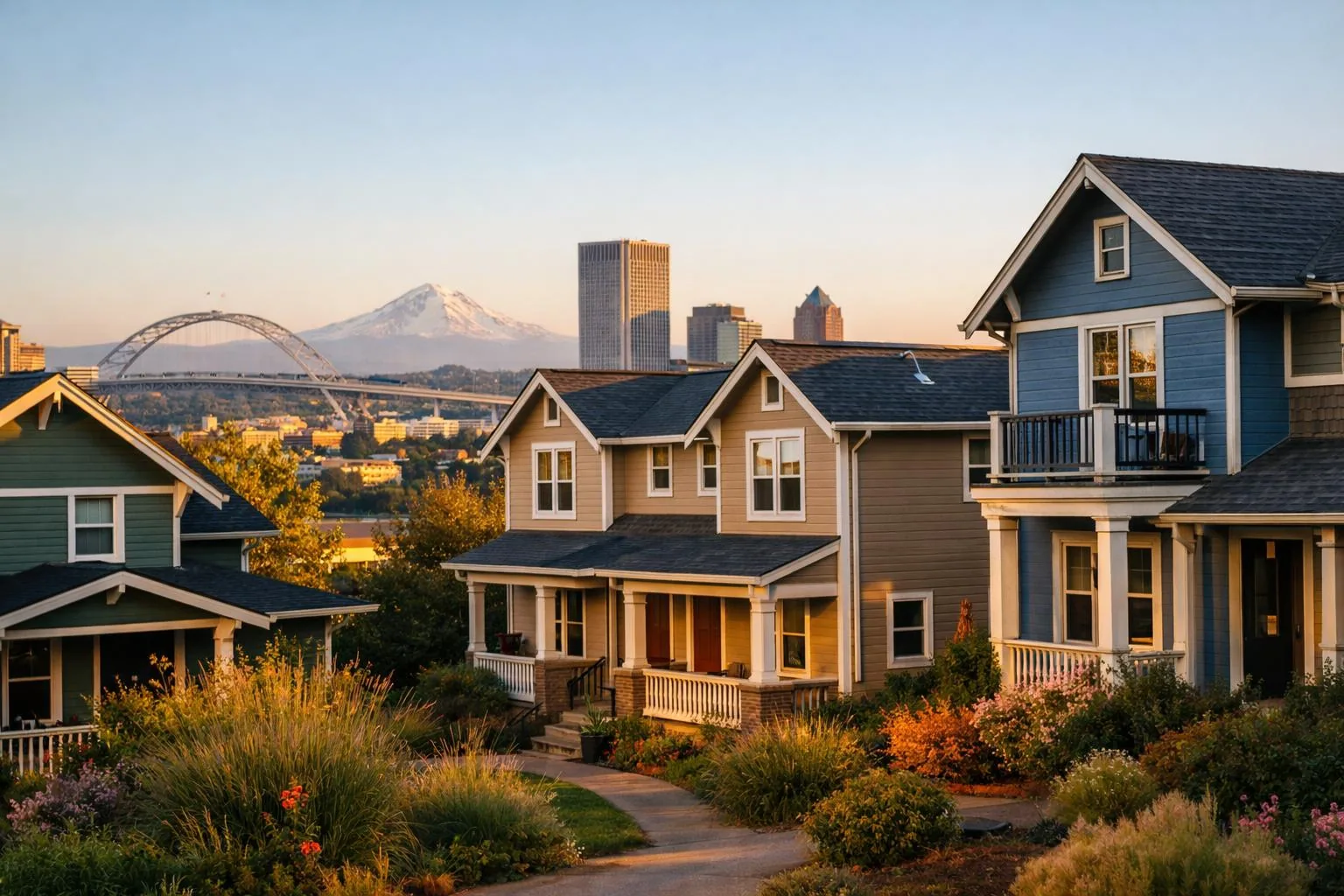
Oregon is one of only a few states with genuine statewide rent control, and that single fact shapes the entire DSCR investor landscape here. SB 608 (2019) and SB 611 (2023) cap rent increases at the lesser of 10% or 7% + CPI and require just-cause for eviction. The Oregon Department of Administrative Services set the 2026 cap at 9.5% (7% + 2.5% West-Region CPI); the 2024 and 2025 caps were both 10.0%. For buildings less than 15 years old, exemptions apply — and this is where most DSCR investor activity concentrates. In 2026, Oregon DSCR investors either target new-construction and recently-built properties (exempt from rent caps) or accept the cap and underwrite to conservative rent growth.
This guide walks through DSCR lending in Oregon, the SB 608 framework, and the metros where volume concentrates.
Why Investors Choose Oregon
Oregon’s population growth slowed meaningfully post-2020 after a decade of rapid in-migration from California. Net migration turned slightly negative in 2022-2023 as housing costs caught up. The Portland metro has had specific demographic challenges post-pandemic — downtown office vacancy, public-safety perceptions, and ongoing discussion of regional economic vitality. But the broader state economy remains anchored by Intel (the largest private employer in Oregon; 22,000+ workers at Hillsboro), Nike (global HQ in Beaverton), Columbia Sportswear, and major healthcare systems.
Bend has been Oregon’s growth outlier — a high-amenity, outdoor-recreation-driven metro that has attracted California and Seattle in-migration. Eugene is University of Oregon. Salem is state government. Medford and Grants Pass are Southern Oregon timber/agriculture markets.
Portland’s 2-4 unit small-multifamily stock is meaningful but the rent-cap environment has slowed transaction velocity. Newer construction (post-2011 Certificate of Occupancy) remains exempt from the cap and continues to attract DSCR investor activity.
DSCR Loan Rules in Oregon
Most major national DSCR lenders fund Oregon. Some smaller lenders have exited the state due to the rent-cap complexity. Expect 3-5 quotes rather than 5-7.
Oregon’s Mortgage Lender Law governs consumer lending; bona-fide business-purpose loans to investor LLCs for 1-4 unit property are exempt. Out-of-state lenders typically hold OR licenses or operate through licensed Oregon broker partners.
Typical terms: min DSCR 0.85-1.20, max LTV 70-75%, min FICO 680-700, 6-9 months reserves. The rent-cap environment produces slightly tighter underwriting than national average.
Taxes & Carrying Costs
Oregon’s effective property tax rate of 0.87% is below national average due to Measure 50 (1997), which capped assessed value increases at 3% per year and — unusually — preserves those caps on sale. This means Oregon properties held long-term carry materially lower tax bills than a straight-millage calculation would suggest. For DSCR investors buying from long-held owners, the tax bill typically DOES NOT reset to market — a genuine advantage versus Michigan or Illinois.
Portland has additional local taxes: the Portland Arts Tax ($35 per adult), Multnomah County Preschool For All income tax (applies to high earners), and Metro Supportive Housing Services tax. These apply mostly to wage income rather than rental income but can affect investor LLC distributions.
State income tax is high: graduated 4.75% to 9.9% — among the highest in the country. Out-of-state investors file OR non-resident returns. Oregon LLCs: $100 formation, $100 annual report.
Insurance in Oregon is moderate — $1,000-$1,500 per $300K in Portland-metro. Wildfire exposure in Central/Southern Oregon has led to some carrier non-renewal in WUI areas (Bend, Ashland, Medford exurbs).
Foreclosure & Eviction Landscape
Oregon permits both judicial and non-judicial foreclosure. Non-judicial under ORS 86.705 is common for investor loans — typical timeline 180 days from notice of default. Judicial foreclosure runs 8-12 months.
Eviction under SB 608 / SB 611 is materially more complex than pre-2019 Oregon. Just-cause eviction applies to most tenancies over 12 months. Non-payment remains a just cause, but “landlord preference” or “end of lease with no cause” is NOT permitted after 12 months without relocation assistance (typically equivalent to one month’s rent). Non-payment eviction timelines run 30-60 days.
Landlord-Tenant Law — SB 608 / SB 611 Rent Cap
Understanding SB 608/611 is essential for any Oregon DSCR deal:
Annual rent cap: Lesser of 10% OR 7% + West-Region CPI. For 2026 the Oregon DAS-published cap is 9.5% (7% + 2.5% CPI); 2024 and 2025 were both 10.0%. Increases in excess require relocation assistance or trigger tenant remedies. Manufactured-home park tenancies with more than 30 spaces are subject to a separate 6% cap in 2026.
Exemptions:
- Buildings with Certificate of Occupancy less than 15 years old (rolling — a 2011 CO becomes subject to the cap in 2026)
- Owner-occupied duplexes (the owner occupies one of the two units)
- Federally subsidized housing (separate rules apply)
- First year of tenancy (cap doesn’t apply — but the just-cause rules do after 12 months)
Just-cause eviction: After 12 months of tenancy, eviction requires either tenant-caused cause (non-payment, lease violation) or qualifying landlord-cause (renovation, family occupancy, sale) with relocation assistance paid.
Underwriting implication: for rent-capped buildings, model 4-8% annual rent growth, not market-rate 10-15%. This narrows DSCR ratios on Portland older-stock deals materially.
Security deposits are not statutorily capped but conventional practice is one to 1.5 months. Landlords must return within 31 days with itemized deductions.
Top Oregon Markets
Portland (Multnomah County) — The dominant metro. DSCR concentrates in 2-4 unit small multifamily in SE Portland, NE Portland, and inner NW. Post-2011 new-construction exempt from SB 608; older stock subject to cap. DSCR properties price $475K-$725K for single-family; 2-4 units $650K-$1.1M. Cap rates 5-6.5%.
Hillsboro and Beaverton (Washington County) — Portland western suburbs. Intel campus, Nike HQ. Strong long-term rental demand. DSCR properties price $500K-$700K with rents $2,600-$3,200.
Gresham (Multnomah County) — Portland eastern suburb. Lower basis. DSCR properties $375K-$525K with rents $2,100-$2,700.
Eugene (Lane County) — University of Oregon. Student and young-professional. DSCR properties $400K-$575K with rents $2,000-$2,600.
Bend (Deschutes County) — Fast-growing but expensive. STR restrictions tightened. DSCR properties $525K-$800K with rents $2,400-$3,400. Tight DSCR math.
Salem (Marion County) — State capital. More affordable than Portland. DSCR properties $325K-$475K with rents $1,700-$2,200.
Special Considerations
SB 608 / SB 611 rent cap is the defining Oregon underwriting variable. New-construction exemption (15-year rolling window) is where most DSCR investor activity concentrates. Bend STR regulations have tightened materially since 2021. Portland downtown office vacancy and policy debates affect demand perception — verify current submarket conditions.
Entity Formation Notes
Oregon LLCs cost $100 formation, $100 annually. Standard structures apply. Many Oregon investors use Wyoming or Delaware parent holding LLCs owning an OR LLC. See the entity structure guide.
Getting Started
Use the DSCR calculator with conservative rent-growth assumptions for rent-capped properties, check current rates, then get matched.
Related guides: Washington, California, Idaho.
Keep exploring
Hand-picked next steps — whether you want to go deeper on this topic, compare alternatives, or run the numbers.
Editor's picks
Hand-chosen follow-ups for this topic.
- Guide
What Is a DSCR Loan? The Complete 2026 Guide for Real Estate Investors
A DSCR loan qualifies a rental property on rental income ÷ PITIA — not personal income or tax returns. Full 2026 guide to ratios,…
- Guide
DSCR Loan LLC Guide: Entity Structure, Vesting & Personal Guarantees
DSCR loan LLC guide: single-member, multi-member, S-Corp, trusts, personal guarantees, state selection, and lender requirements —…
- Guide
DSCR Loan Risks: What Investors Need to Know Before Signing in 2026
DSCR loan risks: ARM rate resets, prepayment traps, insurance spikes, refinance risk, personal guarantees. Honest risk analysis…
- Property type
DSCR Loan for Airbnb & Short-Term Rentals: 2026 Complete Guide
DSCR loan for Airbnb and short-term rentals in 2026: AirDNA underwriting, 20% income haircut, STR lender shortlist, and every…
- Property type
DSCR Loan for 2-4 Unit Properties: Duplex, Triplex & Quadplex Guide
DSCR loans for 2-4 unit properties in 2026: 75-80% LTV, 0.85-1.0 DSCR minimums, and the duplex, triplex, and fourplex lender…
Compare other states
DSCR rules, rates, and tax posture in similar markets.
- State guide
DSCR Loans in Alabama
Complete 2026 guide to DSCR loans in Alabama — rates, non-judicial foreclosure rules, Birmingham and Huntsville markets, and how…
- State guide
DSCR Loans in Alaska
2026 guide to DSCR loans in Alaska — small lender pool, no state income tax, Anchorage and Fairbanks markets, and typical…
- State guide
DSCR Loans in Arkansas
2026 guide to DSCR loans in Arkansas — low property taxes, non-judicial foreclosure, Little Rock and Northwest Arkansas markets,…
- State guide
DSCR Loans in California
Complete 2026 guide to DSCR loans in California — AB1482 rent control, Prop 13 reassessment, $800 LLC tax, LA/SF/San Diego…
DSCR loan products for your next deal
The financing structures investors use most in this market.
- Loan type
DSCR Purchase Loan: Complete 2026 Guide for Investors
Everything real estate investors need to know about using a DSCR purchase loan — LTV limits, rent schedule requirements, closing…
- Loan type
DSCR Cash-Out Refinance: 2026 Playbook for Investors
DSCR cash-out refinance 2026: LTV limits, seasoning rules, tax impact, delayed financing, and when the math actually pencils —…
- Loan type
DSCR Rate-and-Term Refinance: Can You Refinance a DSCR Loan? (2026)
Yes — you can refinance a DSCR loan with rate-and-term or cash-out. Seasoning (often 3–6 months), LTV, DSCR floors, PPP costs,…
Property types investors finance here
Run the numbers
Free interactive tools to stress-test your deal.
- Interactive tool
DSCR Ratio Calculator
Calculate your DSCR in seconds and see pass/fail by lender tier.
- Live rates
Today's DSCR Loan Rates
Live DSCR rate ranges by credit tier, LTV, and product type.
- Resource
Best DSCR Lenders of 2026
Head-to-head shortlist of the leading DSCR lenders with program details.
- Interactive tool
DSCR Qualification Estimator
Estimate your rate range, LTV cap, and approval odds before you apply.
Is There a DSCR Lender in This Market?
Coverage, foreclosure timelines, and local overlays decide whether the deal funds. Get matched now.
Shop every major DSCR lender in 60 seconds
Tell us about your deal once. We'll send you the top 3 lender offers within the hour.
Soft match — no credit pull, no spam. Your info stays with licensed brokers only.